
Choose your trailer size, then enter your cargo and tiedowns. Add your scale weights for the axle and bridge checks, plus your miles and costs for the cost per mile.
Your trailer and load
48 ft deck, 102 in wide, 60 in high, 48,000 lb max cargo.
Working load limits come from the tables to 49 CFR 393.108. Leave the planned tiedowns box blank to skip the securement check.
Your scale weights (optional)
Scale every axle group before you roll. Leave the boxes blank to check gross weight only.
Axle spacings
The drive tandem is a closed 4 ft tandem and flatbeds often run a 10 ft spread axle on the trailer. Defaults suit a standard flatbed rig with a day cab tractor. Measure your own rig for an exact bridge check.
Cost per mile (optional)
Rate, diesel price and every cost figure are your numbers: the tool carries no rate, diesel or cost figure of its own. Annual miles defaults to 100,000 as a starting point: change it to your own miles.
Inspect within the first 50 miles
Securement loosens on the road. Check the load within the first 50 miles, then every 3 hours or 150 miles, under 49 CFR 392.9(b).
Your inputs stay in this browser. Nothing is sent to our servers. There is no account to create.
Working load limit lookup
Look up any tiedown in the full tables to 49 CFR 393.108. Pick the type, grade and size. Add a marked value, a tensioner rating or an anchor point rating to see what the whole assembly is worth. The weakest part sets the limit.
6,600 lb working load limit
Table value for Grade 70 chain, 3/8 in. No marking entered, so the table value applies.
Governing component: tiedown table value. The assembly is worth its weakest part under 393.108(a).
Unmarked welded steel chain counts as Grade 30 proof coil under 393.108(d). An unmarked 3/8 in chain is worth 2,650 lb, not 6,600 lb.
Table values are the unmarked defaults from 49 CFR 393.108, read on eCFR 19 Nov 2026. A manufacturer marking governs over the table. Check the full tables below the tool.
General cargo securement checker
The general securement rules of 49 CFR 393.100 through 393.114 apply to every commercial motor vehicle, not only flatbeds. Enter any load to see the minimum tiedown count, the aggregate working load limit, the blocking notes and the g-force figures for your cargo weight.
Your tiedowns
Group tiedowns that share a type and an attachment pattern. A tiedown counts at half its working load limit when it runs from an anchor point to the cargo or passes over the cargo and anchors on the same side. It counts at full value only when it passes over the cargo and anchors on the other side. Leave a group at 0 to skip it.
Tiedown group 1
Tiedown group 2
Tiedown group 3
Your inputs stay in this browser. Nothing is sent to our servers.
Disclaimer: This tool is provided for general information only. It is not professional advice — verify figures from official sources before acting on them. Scale every axle group before you roll: a legal gross weight can hide an overweight group.
Quick answer: Enter your trailer size, cargo weight and length to see the tiedowns the load needs, the tarp time and the cost per mile. The example loads 40,000 lb of lumber, 40 ft long and 7 ft high, on a 48 ft flatbed: 5 tiedowns, 2 lumber tarps, gross weight 68,500 lb with 11,500 lb to spare.
How many tiedowns does a flatbed load need?
The tiedown count follows article length and weight under 49 CFR 393.110. One tiedown covers an article 5 ft or less and 1,100 lb or less.
Two tiedowns cover a short heavy article or one over 5 ft to 10 ft. Longer articles need two plus one more for each extra 10 ft or part of it.
Cargo blocked against forward movement needs fewer tiedowns: one per 10 ft or fraction under 393.110(c). The example load is unblocked, so the full count rule applies.
Count is only half the rule. The aggregate working load limit of the tiedowns must be at least half the cargo weight under 49 CFR 393.106(d), with each tiedown over the top counting at its full working load limit.
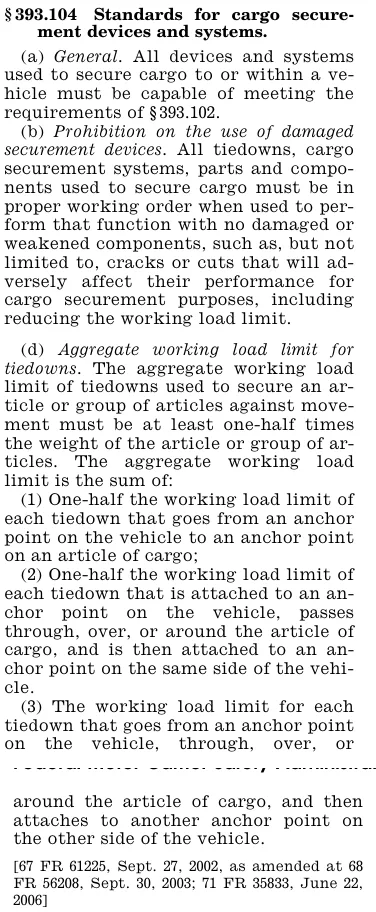
The example loads 40,000 lb of lumber, 40 ft long, on a 48 ft flatbed. The count rule needs 5 tiedowns and the strength rule needs 4, so the load takes 5 Grade 70 chains of 3/8 in at 6,600 lb each, giving 33,000 lb of aggregate working load limit against 20,000 lb needed.

Placing 5 tiedowns takes about 8 minutes at about 90 seconds each for straps, based on a practised driver. Chains take longer. A second check after the first 50 miles is part of the job.
Damaged tiedowns are banned outright. Under 49 CFR 393.104(b) no tiedown may be used with cracks or cuts that reduce its working load limit.
Working load limits: chain and strap grades
Every tiedown has a working load limit set by the tables to 49 CFR 393.108. The limit is the lowest working load limit of any component in the assembly, including the tensioner and the anchor points.
Manufacturer markings govern when a tiedown is marked under 393.108(b). A strap marked 3,335 lb counts at 3,335 lb, not at the 2,000 lb table figure for a 2 in strap.
| Tiedown | Working load limit (lb) |
|---|---|
| Grade 70 chain, 3/8 in | 6,600 |
| Grade 70 chain, 5/16 in | 4,700 |
| Grade 43 chain, 3/8 in | 5,400 |
| Grade 80 chain, 3/8 in | 7,100 |
| Synthetic webbing, 2 in | 2,000 |
| Synthetic webbing, 4 in | 4,000 |
Source: tables to 49 CFR 393.108, read on govinfo, 17 Nov 2026.
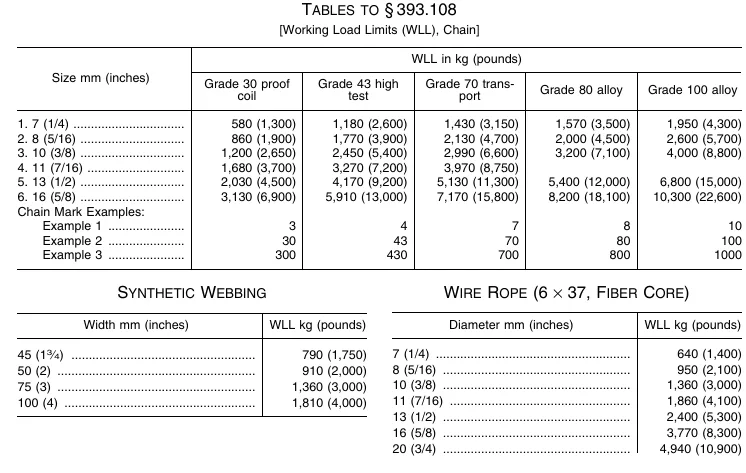
Grade 70 transport chain is the flatbed standard: a 3/8 in chain holds 6,600 lb and a 5/16 in chain holds 4,700 lb. A 4 in strap holds 4,000 lb, so heavy loads need more straps than chains for the same aggregate limit.
The tables below are the complete unmarked tables to 49 CFR 393.108. Use them when a tiedown carries no manufacturer marking. A marked tiedown counts at its marked value. All values are working load limits in pounds.
Chain working load limits
| Chain size | Grade 30 proof coil | Grade 43 high test | Grade 70 transport | Grade 80 alloy | Grade 100 alloy |
|---|---|---|---|---|---|
| 1/4 in | 1,300 | 2,600 | 3,150 | 3,500 | 4,300 |
| 5/16 in | 1,900 | 3,900 | 4,700 | 4,500 | 5,700 |
| 3/8 in | 2,650 | 5,400 | 6,600 | 7,100 | 8,800 |
| 7/16 in | 3,700 | 7,200 | 8,750 | — | — |
| 1/2 in | 4,500 | 9,200 | 11,300 | 12,000 | 15,000 |
| 5/8 in | 6,900 | 13,000 | 15,800 | 18,100 | 22,600 |
No Grade 80 or Grade 100 value exists in the table for 7/16 in chain. A 7/16 in alloy chain counts at its manufacturer marking. Chain grade marks read 3, 4, 7, 8, 10 or 30, 43, 70, 80, 100 or 300, 430, 700, 800, 1000.
Synthetic webbing working load limits
| Webbing width | Working load limit (lb) |
|---|---|
| 1-3/4 in | 1,750 |
| 2 in | 2,000 |
| 3 in | 3,000 |
| 4 in | 4,000 |
Wire rope working load limits (6 x 37 fiber core)
| Wire rope diameter | Working load limit (lb) |
|---|---|
| 1/4 in | 1,400 |
| 5/16 in | 2,100 |
| 3/8 in | 3,000 |
| 7/16 in | 4,100 |
| 1/2 in | 5,300 |
| 5/8 in | 8,300 |
| 3/4 in | 10,900 |
| 7/8 in | 16,100 |
| 1 in | 20,900 |
Wire rope of unknown construction counts as 6 x 37 fiber core under 393.108(e)(2).
Rope working load limits
| Rope diameter | Manila | Polypropylene fiber | Polyester fiber | Nylon | Double braided nylon |
|---|---|---|---|---|---|
| 3/8 in | 205 | 400 | 555 | 278 | 336 |
| 7/16 in | 265 | 525 | 750 | 410 | 502 |
| 1/2 in | 315 | 625 | 960 | 525 | 655 |
| 5/8 in | 465 | 925 | 1,500 | 935 | 1,130 |
| 3/4 in | 640 | 1,275 | 1,880 | 1,420 | 1,840 |
| 1 in | 1,050 | 2,100 | 3,300 | 2,520 | 3,250 |
Polypropylene and polyester figures cover 3-strand and 8-strand constructions. Synthetic cordage of unknown composition counts as polypropylene fiber rope under 393.108(c).
Steel strapping working load limits
| Width x thickness | Working load limit (lb) |
|---|---|
| 1-1/4 in x 0.029 in | 1,190 |
| 1-1/4 in x 0.031 in | 1,190 |
| 1-1/4 in x 0.035 in | 1,190 |
| 1-1/4 in x 0.044 in | 1,690 |
| 1-1/4 in x 0.05 in | 1,690 |
| 1-1/4 in x 0.057 in | 1,925 |
| 2 in x 0.044 in | 2,650 |
| 2 in x 0.05 in | 2,650 |
Source: tables to 49 CFR 393.108, read on eCFR, 19 Nov 2026. Unmarked steel strapping counts at one fourth of the breaking strength in ASTM D3953-97 under 393.104(e).
What is the working load limit of an unmarked tiedown?
A tiedown with no manufacturer marking takes its working load limit from the tables to 49 CFR 393.108. That is the rule in 393.108(b). The tables exist for exactly this case: a chain, strap, rope or wire rope with no tag, no stamp and no label still gets a legal value. The value is always the conservative one for its type.
Unmarked welded steel chain counts as Grade 30 proof coil under 393.108(d). The difference is large. A 3/8 in chain with no grade mark counts at 2,650 lb. The same size in Grade 70 transport chain counts at 6,600 lb. A driver who assumes Grade 70 without checking the mark overstates the tiedown by more than double. The lookup above applies the Grade 30 default whenever no marking is entered.
Synthetic cordage of unknown composition counts as polypropylene fiber rope under 393.108(c). Manila rope with no marking uses the manila table for its diameter under 393.108(f). Unmarked wire rope counts at one fourth of the nominal strength in the Wire Rope Users Manual under 393.108(e)(1). Wire rope of unknown construction counts as 6 x 37 fiber core under 393.108(e)(2). Unmarked steel strapping counts at one fourth of the breaking strength in ASTM D3953-97 under 393.104(e).
A friction mat with no maker rating is worth 50 percent of the weight resting on it under 393.108(g). That figure is a load restraining value, not a working load limit. It measures grip, not strength. It never enters the aggregate working load limit count.
The practical habit is simple. Read the marking before the load leaves the yard. A missing tag is not a paperwork problem. It cuts the legal value of the tiedown, sometimes by more than half. Replace unmarked tiedowns with marked ones when the load needs the higher value.
Use the lookup at the top of this page to check one tiedown at a time. Pick the type, the grade or material and the size. The lookup shows the table value for that combination. Enter a marked value when the tiedown carries one. Add the tensioner rating and the anchor point rating when you know them. The lookup then shows the assembly value and names the part that governs it.
Which part of a tiedown sets its working load limit?
The weakest part sets it. Section 393.108(a) puts the rule in one sentence: the working load limit of a tiedown is the lowest working load limit of any of its components, tensioner included, or the working load limit of the anchor points, whichever is less. A tiedown is an assembly. The chain, the hooks, the binder and the anchor point each carry a rating. The assembly is worth the smallest one.
Take a common flatbed setup. A 3/8 in Grade 70 chain holds 6,600 lb. The lever binder on it is rated at 5,400 lb. The trailer anchor point is rated at 5,000 lb. The tiedown counts at 5,000 lb. The chain rating never reaches the calculation. The anchor point governs. Swap in a stronger anchor point and the binder governs at 5,400 lb.
A manufacturer marking governs over the table value under 393.108(b). A 2 in strap marked 3,335 lb counts at 3,335 lb even though the table gives a 2 in strap 2,000 lb. The marking wins in both directions. A strap marked below the table value counts at the marked value too. Read the tag. The table is the fallback, not the first choice.
Anchor points deserve the same attention as the tiedown itself. Section 393.104(c) requires anchor points, decks, floors and walls to be strong enough for the job with no damaged or weakened parts. A rusted D-ring or a cracked rub rail pocket cuts the rating of everything attached to it. Check the anchor point rating on the trailer spec plate when the load is heavy. The lookup above takes an anchor point rating and shows when it governs.
Log loads work to a different aggregate rule: one sixth of the stack weight, not one half. The Log Securement Calculator covers log tiedowns and wrappers under 49 CFR 393.116.
When is a tiedown illegal to use?
A tiedown with a damaged or weakened component is illegal to use. Section 393.104(b) requires every tiedown, securement system, part and component to be in proper working order with no damaged or weakened components. Cuts and cracks are named in the rule. Frayed webbing, stretched chain links, bent hooks and seized binders fail the same test. A tiedown that has lost strength has lost its working load limit.
A damaged tiedown does not count toward the tiedown count or the aggregate working load limit. It is dead weight in the calculation. Using one is a violation of 393.104(b). It is not an out of service defect on its own. The distinction matters at a roadside inspection: the inspector cites the violation and the load still needs enough sound tiedowns to meet the count and the aggregate limit.
Knots are banned outright. Section 393.104(f)(1) states that tiedowns and securing devices must not contain knots. A knot cuts rope strength by a large margin and hides the damage it causes. Use the proper end fitting or splice instead. If a tiedown is repaired, the repair must follow the standard for its material or the maker instructions under 393.104(f)(2).
Every tiedown must stay fastened in transit under 393.104(f)(3). A binder that works loose or a hook that can open defeats the securement. Edge protection is mandatory wherever a tiedown would be abraded or cut where it touches the cargo under 393.104(f)(4). The protection must resist abrasion, cutting and crushing. A folded rag is not edge protection. Use a rated sleeve or corner guard. Inspect tiedowns with the rest of the load: the Pre-Trip Inspection Checklist covers cargo securement checks before the trip starts.
How do chain grades and markings work?
Chain grades run from Grade 30 proof coil to Grade 100 alloy. Grade 30 is the lightest grade in the table. Grade 43 high test roughly doubles it at most sizes. Grade 70 transport chain is the flatbed standard: strong enough for heavy loads, light enough to handle all day. Grade 80 and Grade 100 alloy chains serve the heaviest securement jobs. The grade is stamped on the links. Marks read 3, 4, 7, 8, 10 or 30, 43, 70, 80, 100 or 300, 430, 700, 800, 1000.
A higher grade number does not always mean a higher working load limit at every size. Grade 80 chain at 5/16 in is rated 4,500 lb. Grade 70 chain at the same size is rated 4,700 lb. The alloy grade loses by 200 lb at that size. The table is the authority, not the grade number. Always read the row for the exact size and grade in front of you.
The table has a gap at 7/16 in. No Grade 80 or Grade 100 value exists for that size. An unmarked 7/16 in chain counts as Grade 30 at 3,700 lb. A marked 7/16 in alloy chain counts at its marked value. Without a marking there is no higher value to claim. Buy 3/8 in or 1/2 in alloy chain when the job needs a table value above Grade 70.
Some loads restrict the tiedown type by rule. Large boulders take chain only under 49 CFR 393.136. No strap or wire rope qualifies, whatever its rating. The Large Boulder Securement Calculator works out the chain pattern and the blocking for boulder loads. Heavy equipment needs four tiedowns at designed mounting points under 49 CFR 393.130. The Heavy Equipment Securement Calculator covers that rule.
What is a friction mat worth in a securement plan?
An unmarked friction mat is worth 50 percent of the weight resting on it. That is the rule in 393.108(g). A 20,000 lb coil sitting on mats resists horizontal movement with 10,000 lb of restraining value. A mat with a maker rating counts at its rated value instead. The lookup above works out the value from the weight you enter.
A mat value is not a working load limit. The distinction is not wordplay. The aggregate working load limit rule in 393.106(d) counts tiedowns only. Mat values never enter that count. A load held by mats alone fails the aggregate test no matter how much grip the mats add. Mats support tiedowns. They never replace them.
Mats earn their place on smooth loads that slide. Paper rolls on a steel deck, steel coils on a flatbed and machinery on a smooth trailer floor all move more easily than rough cargo. A mat under the load raises the friction between cargo and deck. That friction keeps the load still while the tiedowns do the rated work. The Paper Roll Securement Calculator and the Metal Coil Securement Calculator both cover mats in their securement patterns.
Keep mats clean, dry and flat. Oil, ice and curled edges cut grip. A worn mat with a glazed surface is worth less than the rule assumes. Check mats at the same time as tiedowns and replace any mat that has lost its texture. A cheap mat is still cheaper than a shifted load.
Flatbed sizes
Flatbeds come in two standard lengths: 48 ft and 53 ft. Both are 102 in wide with a deck about 60 in high. Both carry up to 48,000 lb of cargo.
Flatbeds are about 9 percent of US trailer production. A 48 ft flatbed tares about 10,500 lb and a 53 ft about 11,000 lb: check the tare on your own trailer before you trust a default.
| Size | Deck length | Width | Deck height | Tare (lb) | Max cargo (lb) |
|---|---|---|---|---|---|
| 48 ft flatbed | 48 ft | 102 in | 60 in | 10,500 | 48,000 |
| 53 ft flatbed | 53 ft | 102 in | 60 in | 11,000 | 48,000 |
Source: Fontaine and Globe maker specs plus industry guides, checked 17 Nov 2026. The 53 ft tare is a 500 lb planning step above the 48 ft figure: use the stenciled tare on your own trailer.
Tarps: size, time and pay
A tarp must cover the load and reach down both sides of the trailer. The width rule is simple: trailer width plus twice the drop, so an 8 ft drop on an 8 ft wide trailer needs a 24 ft wide tarp.
A steel tarp is 16 ft by 27 ft with a 4 ft drop and covers loads up to 3 ft above the deck. A lumber tarp is 24 ft by 27 ft with an 8 ft drop and covers loads up to 7 ft above the deck.
The example load is 7 ft high and 40 ft long, so it takes 2 lumber tarps, each 24 ft by 27 ft. Two 27 ft tarps cover a 48 ft deck with 6 ft of overlap in the middle.
Tarping takes about 30 minutes for this load at about 15 minutes per tarp, an estimate for an experienced driver. Tarp pay typically runs $50 to $100 per load: get it on the rate confirmation before you roll.
A torn heavy duty tarp costs $400 to $1,500 to replace. Check the tarp for cuts and worn stitching before every load: a damaged tarp is a damaged securement device under 49 CFR 393.104(b).
Axle groups, the spread axle and the bridge formula
Gross weight is only half the check. Each axle group has its own limit: 20,000 lb for a single axle and 34,000 lb for a tandem under 23 CFR 658.17.
The bridge formula then caps groups of axles by their spacing. W equals 500 times the bracket of L times N over N minus 1, plus 12N, plus 36.
W is the weight in pounds. L is the distance in feet between the first and last axle of the group. N is the number of axles in the group.
A 10 ft spread tandem allows 40,000 lb by the bridge formula: 500 times the bracket of 10 times 2 over 1, plus 24, plus 36, equals 40,000 lb. A 9 ft spread allows 39,000 lb and an 8 ft spread is capped at 34,000 lb.
States vary on spread axles. The bridge formula governs where a state sets no higher limit. The tool computes the limit from the spread you enter: it does not carry a state table.
The example scale ticket reads steer 11,500 lb, drives 30,000 lb and trailer tandem 27,000 lb. The three groups add to 68,500 lb, matching the gross weight.
Drives plus trailer tandem total 57,000 lb against a 68,000 lb bridge limit over 48 ft. The whole rig at 59 ft with 5 axles is capped by the 80,000 lb gross limit.
The 40,000 lb load leaves 8,000 lb of the 48,000 lb payload unused. The 40 ft of cargo fits on the 48 ft deck with 8 ft to spare.
The tool checks the steer axle against a 12,000 lb practical ceiling from tire and axle ratings. Federal law allows 20,000 lb on the steer axle, but most steer tires and axles are rated well below that. Two consecutive tandems may each carry 34,000 lb when the first to last axle distance is 36 ft or more.

The Bridge Formula Axle Weight Checker linked below runs the same formula on any axle group with your own spacings.
Height: no federal limit, a practical ceiling
There is no federal vehicle height limit. The Federal Highway Administration states it plainly: no federal vehicle height limit is imposed. State standards range from 13.6 ft to 14.6 ft.
The tool checks deck height plus cargo height against 13 ft 6 in, the lowest common state ceiling. The example load totals 144 in: a 60 in deck plus 84 in of cargo, clearing the 162 in limit by 18 in.
Freight up to 102 in high, or 8 ft 6 in, fits on a 60 in deck under the 13 ft 6 in ceiling. Check the route before you roll: a low bridge beats any calculator.
The federal width limit is 102 in on the National Network under 23 CFR 658.15. A standard flatbed is 102 in wide, so the deck itself sits at the limit and no load may overhang the sides without a permit.

Inspect within the first 50 miles
Securement is not a one time job. Under 49 CFR 392.9(b) the driver must inspect the cargo and the securement devices within the first 50 miles after beginning a trip.
The driver must reexamine the load whenever duty status changes, after 3 hours, or after 150 miles, whichever occurs first. Add tiedowns at any check where the load has shifted.

What the cost per mile covers
Enter your diesel price and MPG, your annual insurance premium, your maintenance cost per mile and your fixed costs to see the full cost per mile. The tool adds the four parts you enter and shows the all-in figure. Every money input is your number: the tool carries no rate, diesel or cost figure of its own.
As an example only, take 500 loaded miles plus 60 deadhead miles at a $3.50 rate, $4.75 diesel and 6.5 MPG. Fuel costs $0.73 a mile.
Add $14,200 insurance a year, $0.22 maintenance a mile and fixed costs of $2,500 truck plus $700 trailer a month and $1,500 permits a year. Insurance adds $0.14 a mile, maintenance $0.22 and fixed costs $0.40, for $1.49 all-in.
The run breaks even at $1.67 a loaded mile and nets $914.61 after a $835.39 total cost. Gross revenue is $1,750.00, net per loaded mile is $1.83 and net per total mile is $1.63, with deadhead at 10.7 percent of miles.
Flatbed insurance averaged $14,200 a year in 2026, with a typical range of $11,000 to $18,000. Use your own premium: the example figure is a benchmark, not your rate.
Deadhead is the silent cost: the average truck ran 16.5 percent of its non-tank miles empty in 2025, according to ATRI. Every empty mile burns fuel and time with no revenue, so the break even rate climbs as deadhead grows. Enter your own deadhead miles to see what empty running costs you.
How to use this calculator
Six steps and one result. No account and no email needed.
- Choose your trailer size: 48 ft or 53 ft flatbed.
- Enter your cargo weight, length, height and type, plus the tiedowns you plan to use.
- Pick a tarp option, or let the tool choose from your cargo height.
- Enter your scale weights for the steer axle and both tandems.
- Read the verdict: the tiedown count, the tarp plan, the axle checks and the bridge checks.
- Enter your miles, rate and costs to see your cost per mile and net.
What do the g-force rules require of tiedowns?
Every tiedown has two limits. Under 49 CFR 393.102 the forces on a tiedown assembly must never exceed the manufacturer breaking strength rating at 0.8g deceleration forward, 0.5g acceleration rearward or 0.5g acceleration sideways.
The working load limit test is tighter in two directions. Forces must not exceed the working load limit at 0.435g forward, 0.5g rearward or 0.25g sideways. The forward number is the one that surprises drivers: a tiedown rated for the road ahead needs far more strength in that direction than sideways.
An article that is not fully contained within the structure of the vehicle needs downward force equal to at least 20 percent of its weight. A load inside a closed van is fully contained, so the downward rule does not apply to it. A load on an open flatbed is not contained, so the tiedowns must press it down as well as hold it back.
The rule also accepts equivalent means of securement. Cargo that is immobilized so it cannot shift or tip, cargo in a sided vehicle with walls of adequate strength where each article sits against a wall or other articles, or cargo secured under 49 CFR 393.104 through 393.136 meets the performance criteria.
| Direction | Breaking strength test | Working load limit test |
|---|---|---|
| Forward | 0.8g: 32,000 lb | 0.435g: 17,400 lb |
| Rearward | 0.5g: 20,000 lb | 0.5g: 20,000 lb |
| Sideways | 0.5g: 20,000 lb | 0.25g: 10,000 lb |
| Downward (uncontained cargo) | Not tested | 20 percent of weight: 8,000 lb |
Forces for the 40,000 lb example load on this page, under 49 CFR 393.102. The checker above works out the same forces for your own cargo weight.
The checker above works out these forces for your own cargo weight. The figures show why the forward direction governs most securement plans: it carries the highest breaking-strength test and the tightest working load limit test of the three directions.
Which vehicles do the cargo securement rules cover?
The rules cover more than flatbeds. Under 49 CFR 393.100(a) they apply to trucks, truck tractors, semitrailers, full trailers and pole trailers. A dry van, a reefer, a box truck, a step deck and a lowboy all fall under the same subpart.
The duty is simple to state. Under 49 CFR 393.100(b) each commercial motor vehicle carrying cargo on public roads must be loaded and equipped, with the cargo secured, to prevent the cargo from leaking, spilling, blowing or falling from the vehicle. Under 49 CFR 393.100(c) cargo must be contained, immobilized or secured to prevent shifting that would affect the stability or maneuverability of the vehicle.
The driver carries the duty personally. Under 49 CFR 392.9(a) a driver may not operate a commercial motor vehicle unless the cargo is properly distributed and adequately secured as specified in 49 CFR 393.100 through 393.136. The motor carrier may not require or permit the driver to operate it either.
A sided vehicle has an easier path to compliance. Under 49 CFR 393.102(c)(2) cargo in a sided vehicle with walls of adequate strength meets the performance criteria when each article sits in contact with a wall or other articles, or close enough to them, that it cannot shift or tip to the extent that stability or maneuverability is affected. Walls do the work that straps do on an open deck.
The checker above works for any of these vehicles. Pick your vehicle type and enter the cargo. The checker applies the general rules of 49 CFR 393.100 through 393.114 to your load.
How does the aggregate working load limit add up?
The count rule is only half the test. Under 49 CFR 393.106(d) the aggregate working load limit of the tiedowns must be at least half the weight of the article or group of articles. A 40,000 lb load needs 20,000 lb of aggregate working load limit, whatever the count rule says.
Not every tiedown counts at full value. A tiedown from an anchor point on the vehicle to an anchor point on the cargo counts at half its working load limit. A tiedown that passes through, over or around the cargo and anchors again on the same side of the vehicle also counts at half. Only a tiedown that passes through, over or around the cargo and anchors on the other side of the vehicle counts at its full working load limit.
A worked example shows the difference. Four 4 in straps over the top of a load, each anchored on both sides at 4,000 lb, give 16,000 lb of aggregate working load limit. Two Grade 70 chains of 3/8 in fastened directly from anchor points to the cargo at 6,600 lb each give only 6,600 lb between them, because each direct tiedown counts at half. The mixed set totals 22,600 lb, enough for a 40,000 lb load with 2,600 lb to spare.
Friction mats help, but they sit outside this sum. Under 49 CFR 393.108(g) an unmarked friction mat provides resistance to horizontal movement equal to 50 percent of the weight placed on it. That resistance helps the load meet the performance criteria of 49 CFR 393.102, yet the aggregate sum in 49 CFR 393.106(d) counts tiedowns only. The checker shows mat resistance as a separate line so the two figures are never mixed.
The weakest link governs each tiedown. Under 49 CFR 393.108(a) the working load limit of a tiedown is the lowest working load limit of any of its components, including the tensioner, or the working load limit of the anchor points, whichever is less. A 6,600 lb chain on a 5,000 lb anchor point is a 5,000 lb tiedown.
Damaged tiedowns count for nothing. Under 49 CFR 393.104(b) no tiedown may be used with damaged or weakened components, including cracks or cuts that reduce the working load limit. A cut strap or a cracked chain does not count toward the tiedown count or the aggregate working load limit. It is a violation to use one, not an out-of-service defect on its own.
What counts as blocked against forward movement?
Blocking changes the tiedown count. Under 49 CFR 393.110(b) an article that is not blocked or positioned to prevent forward movement needs the full count: 1 tiedown for a short light article, 2 for a short heavy article or one over 5 ft to 10 ft. Longer articles need 2 plus 1 more for each extra 10 ft beyond the first 10 ft.
Under 49 CFR 393.110(c) an article that is blocked, braced or immobilized to prevent forward movement needs only 1 tiedown for every 10 ft of length or fraction of it. A 40 ft load drops from 5 tiedowns to 4 when it is properly blocked.
The rule names what counts as blocking: a headerboard, a bulkhead, other cargo positioned to prevent movement, or other appropriate blocking devices. Other cargo counts only when it is itself adequately secured. A loose article in front of the load is not blocking.
A headerboard must earn the name. Under 49 CFR 393.114 it must reach 4 ft above the floor or the height at which it blocks forward movement, whichever is lower. It must span the width of the vehicle or the blocking width, whichever is narrower. It must withstand a horizontal forward load of half the cargo weight when under 6 ft high, or four-tenths of the cargo weight at 6 ft or higher.
Penetration matters as much as strength. Under 49 CFR 393.114(d) the structure must resist penetration by any article of cargo that contacts it when the vehicle decelerates at 20 ft per second per second, with no aperture large enough to let cargo pass through. A headerboard with a gap big enough for a pipe to slide through fails the rule even when it is strong enough.
When does the tiedown count rule not apply?
One class of vehicle escapes the count rule. Under 49 CFR 393.110(d) the count rules do not apply to a vehicle carrying one or more articles of cargo such as machinery or fabricated structural items that must be fastened by special methods because of their design, size, shape or weight.
The rule gives examples: steel or concrete beams, crane booms, girders and trusses. The list is open, so other articles qualify when their design, size, shape or weight demands special fastening. The test is the article, not the trailer.
The exemption is narrow. Every article on that vehicle must still be securely and adequately fastened to the vehicle. The aggregate working load limit rule in 49 CFR 393.106(d) still applies, since the exemption covers the count rules of 49 CFR 393.110 only.
Pick the special-purpose vehicle type in the checker above to see this treatment. The checker drops the count rule and keeps the aggregate test. It still works out the g-force figures and the blocking notes for the load.
Why must tiedowns tighten in transit?
Loads settle and straps stretch. Under 49 CFR 393.112 each tiedown, its connectors or its attachment mechanisms must be designed, constructed and maintained so the driver of an in-transit commercial motor vehicle can tighten them. Steel strapping is the only exception.
The rule pairs with the inspection duty. Under 49 CFR 392.9(b) the driver must inspect the cargo and the securement devices within the first 50 miles after beginning a trip and make any adjustments needed, including adding more securement devices. The driver must reexamine the load whenever duty status changes, after 3 hours or after 150 miles, whichever occurs first.
Two situations excuse the in-transit inspection. Under 49 CFR 392.9(b)(4) the rules do not apply to the driver of a sealed commercial motor vehicle who has been ordered not to open it, or to a vehicle loaded in a way that makes inspection of the cargo impracticable. The securement still has to be right before the trip starts.
Tiedowns must also stay put on their own. Under 49 CFR 393.104(f)(3) each tiedown must be attached and secured so it cannot become loose, unfasten, open or release while the vehicle is in transit. Knots are banned outright under 49 CFR 393.104(f)(1). Edge protection is required wherever a tiedown would be subject to abrasion or cutting at the point where it touches the cargo.
What must a front-end structure withstand?
A front-end structure is a wall that earns its keep in a hard stop. Under 49 CFR 393.114(c) a structure under 6 ft high must withstand a horizontal forward static load equal to half the weight of the articles of cargo on the vehicle. A structure 6 ft high or higher must withstand four-tenths of that weight.
The figures are large because the load is large. A 40,000 lb cargo needs a structure rated for 20,000 lb of forward load when the structure is under 6 ft high, or 16,000 lb at 6 ft or higher. The load is spread uniformly over the structure: for the shorter structure, over the portion within 4 ft above the floor or at or below the blocking height, whichever is less.
Height and width follow the same lower-of-two logic. The structure must extend to 4 ft above the floor or to the height at which it blocks forward movement of the cargo, whichever is lower. Its width must be at least the width of the vehicle or the width that blocks forward movement of the cargo, whichever is narrower.
A substitute device can stand in for a front-end structure. Under 49 CFR 393.114(e) the requirements may be met by devices performing the same functions, when the devices are at least as strong and provide protection against shifting cargo at least equal to a conforming front-end structure. The substitute has to match the real thing on both counts.
When do the commodity rules replace the general rules?
The general rules are the default, not the whole story. Under 49 CFR 393.106(a) the general requirements apply to the cargo types covered by the commodity-specific rules of 49 CFR 393.116 through 393.136. The commodity-specific rules take precedence over the general requirements when additional requirements are given for a commodity listed in those sections.
One class of cargo sits outside the general rules entirely. Commodities in bulk that lack structure or fixed shape, such as liquids, gases, grain, liquid concrete, sand, gravel or aggregates, are excepted when transported in a tank, hopper, box or similar device that forms part of the structure of the vehicle.
Each commodity below has its own calculator on Trucking Mind, built on its own section of the rules. Use the commodity calculator when your load matches one of these cargoes. Use the general checker above for everything else.
- Metal Coil Securement Calculator: coils of 5,000 lb or more under 49 CFR 393.120, by eye orientation
- Paper Roll Securement Calculator: rolls of 5,000 lb or more under 49 CFR 393.122, with tipping ratios
- Concrete Pipe Securement Calculator: pipe groups under 49 CFR 393.124, with blocking and bell rules
- Log Securement Calculator: logs under 49 CFR 393.116, where the aggregate working load limit is one-sixth of the stack weight
- Lumber and Building Products Securement Calculator: lumber bundles under 49 CFR 393.118, single tier and multi-tier
- Intermodal Container Securement Calculator: containers on chassis under 49 CFR 393.126
- Auto Transport Securement Calculator: vehicles of 10,000 lb or less under 49 CFR 393.128
- Heavy Equipment Securement Calculator: machines of 10,000 lb or more under 49 CFR 393.130
- Crushed Vehicle Securement Calculator: flattened or crushed cars under 49 CFR 393.132
- Roll-Off Container Securement Calculator: roll-off and hook-lift containers under 49 CFR 393.134
- Large Boulder Securement Calculator: boulders over 11,000 lb under 49 CFR 393.136, chain only
Flatbed calculator questions
How many tiedowns does a flatbed load need?
It depends on the article length and weight under 49 CFR 393.110. A 5 ft article at 1,100 lb or less needs 1 tiedown while a short heavy article needs 2 and longer articles need 2 plus 1 more for each extra 10 ft or part of it. The aggregate working load limit must also reach half the cargo weight.
What size tarp fits my flatbed load?
Tarp width follows the drop: trailer width plus twice the drop. A steel tarp covers loads up to 3 ft above the deck and a lumber tarp up to 7 ft. The tool picks the size from your cargo height, or you can choose it yourself.
How much weight can a spread axle carry?
A 10 ft spread tandem allows 40,000 lb by the bridge formula, not by a fixed table. The formula gives 39,000 lb at a 9 ft spread and caps an 8 ft spread at 34,000 lb. States vary, so the tool computes the limit from the spread you enter.
Is there a federal height limit for trucks?
No. The Federal Highway Administration states that no federal vehicle height limit is imposed, with state standards ranging from 13.6 ft to 14.6 ft. The tool checks your total height against 13 ft 6 in, the lowest common state ceiling.
When must I recheck my load?
Inspect the cargo and the securement devices within the first 50 miles after beginning a trip, under 49 CFR 392.9(b). Reexamine the load whenever your duty status changes, after 3 hours, or after 150 miles, whichever occurs first. Add tiedowns at any check where the load has shifted.
What is a good cost per mile for a flatbed?
There is no single good number: your cost per mile depends on your truck payment, your insurance, your fuel economy and your miles. The tool adds your four cost parts, so the figure it shows is your cost, not a market average. Compare your all-in cost per mile against the break even rate it shows for each run.
What is the 0.8g forward rule for tiedowns?
Under 49 CFR 393.102 the forces on a tiedown must not exceed the manufacturer breaking strength rating at 0.8g deceleration forward, 0.5g acceleration rearward or 0.5g acceleration sideways. The working load limit is the tighter test forward: forces must not exceed the working load limit at 0.435g forward, 0.5g rearward or 0.25g sideways.
Do the cargo securement rules cover dry vans and box trucks?
Yes. Under 49 CFR 393.100 the rules apply to trucks, truck tractors, semitrailers, full trailers and pole trailers, so a dry van, a reefer or a box truck is covered. A sided vehicle can meet the performance criteria when each article sits in contact with a wall or other articles and cannot shift or tip enough to affect stability or maneuverability.
How do tiedowns anchored on both sides count toward aggregate working load limit?
Each tiedown that passes through, over or around the cargo and anchors on both sides of the vehicle counts at its full working load limit. A tiedown from an anchor point to the cargo counts at half its working load limit, as does a tiedown that passes over the cargo and anchors again on the same side. The total must reach at least half the cargo weight under 49 CFR 393.106(d).
What is a special-purpose vehicle under the securement rules?
Under 49 CFR 393.110(d) the tiedown count rules do not apply to a vehicle carrying articles such as machinery or fabricated structural items that must be fastened by special methods because of their design, size, shape or weight. Steel beams, concrete beams, crane booms, girders and trusses are examples. Every article on that vehicle must still be securely and adequately fastened. The aggregate working load limit rule still applies.
Does a headerboard mean my load is blocked?
Only when the headerboard meets 49 CFR 393.114 and the cargo is blocked, braced or immobilized against forward movement. The structure must reach 4 ft above the floor or the blocking height, whichever is lower. It must withstand half the cargo weight if under 6 ft high or four-tenths of it at 6 ft or higher. A blocked load needs one tiedown per 10 ft under 49 CFR 393.110(c).
Do I have to tighten tiedowns during the trip?
Yes. Under 49 CFR 393.112 each tiedown must be designed so the driver can tighten it in transit, with steel strapping as the only exception. Under 49 CFR 392.9(b) the driver must inspect the cargo and the securement devices within the first 50 miles, then reexamine them at every change of duty status, after 3 hours or after 150 miles, whichever comes first. Add tiedowns where the load has shifted.
What is the working load limit of a 3/8 inch Grade 70 chain?
6,600 lb under the tables to 49 CFR 393.108. The same size in Grade 43 high test is 5,400 lb and in Grade 30 proof coil is 2,650 lb. An unmarked 3/8 inch chain counts as Grade 30, so it is worth 2,650 lb until a grade mark proves otherwise.
What working load limit does an unmarked chain get?
Grade 30 proof coil under 49 CFR 393.108(d). A 3/8 inch unmarked chain counts at 2,650 lb. A 1/2 inch unmarked chain counts at 4,500 lb. The marking is what lifts the value: a chain stamped 70 counts at the Grade 70 row for its size.
Does the binder or the anchor point limit my tiedown?
Either one can. Under 49 CFR 393.108(a) a tiedown is worth the lowest working load limit of any component, tensioner included, or the anchor point rating, whichever is less. A 6,600 lb chain on a 5,000 lb anchor point is a 5,000 lb tiedown. The lookup above shows which part governs.
Can I use a damaged strap if it still holds?
No. Section 393.104(b) bans damaged or weakened tiedowns outright. A cut or frayed strap does not count toward the tiedown count or the aggregate working load limit. Using one is a violation, though not an out of service defect on its own. Replace the strap before the load moves.
What is a friction mat worth?
An unmarked mat resists horizontal movement equal to 50 percent of the weight resting on it under 49 CFR 393.108(g). A 20,000 lb load on mats gains 10,000 lb of restraining value. That value is not a working load limit, so it never counts toward the aggregate working load limit. Mats add grip beside tiedowns. They never replace them.
Related tools and guides
- Tanker Load Calculator: work out tanker load weight, axle weights and the most you can legally load
- Step Deck Fit Calculator: check freight fit on both step deck levels plus payload
- Doubles Calculator: split pup weight, check axle groups and the bridge formula
- Dry Van Calculator: check pallet count and cube against payload plus cost per mile
- Bridge Formula Axle Weight Checker: check any axle group against the bridge formula with your own spacings
- Cost Per Mile Calculator: put maintenance and repair costs beside fuel and insurance in your full cost per mile
- Metal Coil Securement Calculator: work out coil tiedowns, blocking and mats for eye-vertical, eye-crosswise and eye-lengthwise coils
- Log Securement Calculator: check log tiedowns and wrappers, with the aggregate limit at one sixth of the stack weight
- Large Boulder Securement Calculator: chain-only tiedowns, blocking and patterns for boulders over 11,000 lb
- Paper Roll Securement Calculator: tipping ratios, banding and anti-tip rules for paper rolls over 5,000 lb
- Lumber and Building Products Securement Calculator: check lumber bundle securement under 49 CFR 393.118, single tier and multi-tier
- Heavy Equipment Securement Calculator: check securement for machines of 10,000 lb or more under 49 CFR 393.130
- All Trucking Mind tools: free calculators and checkers for drivers and carriers
This calculator follows the cargo securement rules in 49 CFR 393.104, 393.106, 393.108 and 393.110, the inspection rule in 49 CFR 392.9, the weight limits in 23 CFR 658.17 and the width rule in 23 CFR 658.15. It is guidance only.
Weight limits and size rules change. Confirm your figures with the current rule text before you rely on a single number.
Your inputs stay in your browser. Nothing is sent to our servers.