
Tick Checked for each item you inspect. Tick Problem when you find a defect. Items marked Out of Service park the truck when flagged.
Engine compartment
Oil level sits between the marks on the dipstick. No oil puddle or drip under the engine.
Coolant level is correct in the reservoir. Hoses feel firm with no leaks, cracks or swelling.
Belts are tight with no cracks, fraying or missing pieces.
No fuel drip anywhere, including the heater and reefer fuel lines. The fuel tank is secure on its mounts.
Out of service: a dripping fuel leak at any point, or a fuel tank that is not secure. CVSA item 8.a.
No exhaust leak ahead of or under the cab. No burnt or charred wiring, fuel line or body part near the exhaust.
Out of service: an exhaust leak ahead of or under the cab where fumes can enter, or exhaust routed where it can burn wiring or fuel parts. CVSA item 6.
Battery is secure with tight cables. No bare wire showing through damaged insulation.
Cab and interior
The driver seat is the fitted seat, secure on its mounts.
Out of service: a temporary seat such as a crate or stool in place of the fitted driver seat. CVSA item 5.
Mirrors are clean, secure and adjusted so you can see both sides.
The horn sounds.
The driver side wiper works and the washer sprays. A dead driver side wiper puts the truck out of service in wet weather.
The seat belt fastens, holds and retracts.
Cab equipment
Cab equipment rules from 49 CFR 393.77 to 393.94 and Part 392. None of these 11 items parks the truck on its own, so none carries the Out of Service marker. Every one is still a violation: fix it and report it on your DVIR.
The defroster clears frost and fog from the windshield. On trucks built before December 25, 1968, any working means of keeping the view clear passes.
49 CFR 393.79. Trucks built on or after December 25, 1968 must meet FMVSS 103.
Two outside mirrors, one on each side, firmly attached and adjusted to show the road behind on both sides.
49 CFR 393.80. One driver side mirror passes only where an interior mirror gives a rear view. Use the mirror checker below for the exceptions.
The speedometer works and reads within 5 mph at 50 mph. Test it against a GPS reading with the speedometer checker below.
49 CFR 393.82: accurate within plus or minus 5 mph at 50 mph (8 km/h at 80 km/h).
The cab floor is solid with no holes, no loose boards and no oil soaked patch under your feet.
49 CFR 393.84: floors must be substantially built, free of unnecessary holes, and kept so fumes, exhaust and fire cannot enter.
No screen is fitted where the driver can see it while driving. Any TV sits behind the back of the driver seat with controls out of reach from the seat.
49 CFR 393.88. If no TV is fitted, tick Checked. Use the TV checker below.
The seat frame is solid with no crack, and the seat belt anchorages are tight with no loose bolt.
49 CFR 393.93: seats and belts must meet FMVSS 207, 208, 209 and 210 for the year the truck was built. 49 CFR 392.16: the driver and every other occupant must be properly restrained.
No exhaust leak, loose panel or failed mount makes the cab louder than normal at speed.
49 CFR 393.94 caps interior noise at 90 dB(A) at the driver seat, with a 2 dB test tolerance. A sudden rise in cab noise usually means an exhaust or body leak.
No prohibited heater is fitted or in use: no open flame, no exhaust fed heater, no portable heater in the cab, no heater drawing air from the engine bay.
49 CFR 393.77 bans unenclosed flame heaters and heaters that feed exhaust or engine air into the cab. 49 CFR 392.67: an open flame heater used for loading or unloading must never run while the truck is moving.
No exhaust smell in the cab, and no headache, dizziness or nausea among the occupants.
49 CFR 392.66: do not drive until a carbon monoxide condition is fixed. Park the truck and report it.
At least one window on each side of the cab, each at least 200 square inches, opens and closes.
49 CFR 393.61: each side window must be at least 200 square inches (a 13 by 17 3/4 inch rectangle).
No radar detector is fitted, mounted or carried anywhere in the truck, whether it is switched on or not.
49 CFR 392.71: using or carrying a radar detector in a commercial motor vehicle is prohibited. Remove it before you drive. Use the radar flag below.
Lights and reflectors
At least one low beam headlamp works. No working low beam puts the truck out of service once lights are required.
At least one stop lamp works on the rear of the last vehicle.
Out of service at any time of day or night. CVSA item 9.b.(1).
Turn signals work on both sides at the rear.
Out of service at any time of day or night. CVSA item 9.b.(2).
Tail lamps burn steady on the rear. The trailer pigtail is plugged in and every trailer light works.
Out of service: all trailer lights dead because the pigtail is unplugged or loose. CVSA item 9.b.(4).
Reflectors and conspicuity tape are in place, clean and unbroken.
Steering
Steering wheel free play stays inside the limit with the engine running.
Out of service: free play past 30 degrees on a manual system or 45 degrees on power steering. On a 20 inch wheel that is 5-1/4 inches manual or 7-7/8 inches power. CVSA item 10.a.
The steering wheel is secure. The column locks in position with no loose U-bolts.
Out of service: a steering wheel that is not secure, a column that will not lock, or loose or missing U-bolts. CVSA item 10.b.
No cracks, loose parts or welded repairs in steering parts. No loose stud nut on a ball joint. No loose clamp or nut on a tie rod or drag link.
Out of service: any crack or welded repair in steering parts, any movement of a ball joint stud nut under steering load, or a loose tie rod or drag link clamp. CVSA item 10.
Tires and wheels
Steer tires carry at least 4/32 inch of tread in the major grooves.
Out of service below 2/32 inch in any two adjacent major grooves. The legal minimum is 4/32 inch. CVSA item 12.a.(1).
Drive and trailer tires carry at least 2/32 inch of tread in the major grooves.
Out of service below 1/32 inch in two adjacent grooves at three spots around the tire. The legal minimum is 2/32 inch. CVSA item 12.b.(11).
No tire shows cord through the tread or sidewall. No tire has a bulge, a flat or an audible leak. Pressure stays above half the maximum on the sidewall.
Out of service: cord showing, a bulge from separation, a leak you can hear or feel, or pressure at half the sidewall maximum or less. CVSA item 12.
No tire touches the body, the frame or its mate in a dual set. No tire carries more than its sidewall load limit. Nothing solid is lodged between dual tires.
Out of service: tire contact, overload past the sidewall limit, or a solid object lodged between dual tires. CVSA item 12.
No crack runs around a rim. No disc wheel crack runs past 3 inches or between two holes. No piece of rim is missing.
Out of service: any rim crack, a disc wheel crack past 3 inches or between two holes, or a piece of rim missing. CVSA item 14.
Wheel fasteners are tight with none missing, broken or cracked past the limit. Hub caps are in place with no smoking hub and no leaking seal.
Out of service: on a 10 fastener wheel, 3 bad fasteners anywhere or 2 side by side; on 8 or fewer, 2 anywhere. CVSA item 14.g.
Brakes
Every service brake applies and releases when you press the pedal. No brake is missing from an axle that must have brakes.
Each bad brake counts toward the 20 percent rule. Two bad brakes on a 10 brake combination put the truck out of service.
Both steering axle brakes work.
Out of service on its own: one dead steering axle brake parks the truck. CVSA item 1.b.(1).
Pushrod travel stays inside the limit on every brake.
A brake 1/4 inch or more past its limit counts as one defective brake toward the 20 percent rule. A brake 1/8 inch past counts as half a brake.
No hose is damaged into the reinforcement ply, bulged under pressure, crimped or heat damaged. No air leaks at a fitting.
Out of service: hose damage into the reinforcement ply, a bulge under pressure, a crimp that blocks air flow, or a leak at a bad fitting. CVSA item 1.h.
The low air warning sounds or lights before pressure falls to 55 psi.
Out of service: a missing or dead warning device. One working warning, sound or light, passes. CVSA item 1.j.
With the engine at idle and pressure at 80 to 90 psi, the pressure holds with the brakes applied.
Out of service: a leak found and pressure not held at 80 to 90 psi. CVSA item 1.k.
The parking brake holds the truck. The trailer breakaway system is fitted and works.
Out of service: a parking brake that applies no brake at all, or a missing or dead trailer breakaway. CVSA item 1.d and 1.e.
Suspension and driveline
No U-bolt or spring clamp bolt is cracked, broken, loose or missing. No axle has shifted from its normal place.
Out of service: any bad U-bolt, or an axle shifted by a cracked or broken part. CVSA item 11.a.
No main leaf is broken. Fewer than 25 percent of the leaves in any spring are broken. No leaf is missing, separated or displaced toward a tire.
Out of service: a broken main leaf, 25 percent or more of the leaves broken, or a leaf displaced toward a tire. CVSA item 11.b.
Air bags are inflated with none deflated. No coil spring is broken and no rubber spring is missing.
Out of service: a deflated air bag, a broken coil spring, or a missing rubber spring. CVSA item 11.b.
Driveshaft yokes show no cracks. U-joint caps and bolts are all in place with no play past 1/8 inch.
Out of service: a cracked yoke, a missing U-joint cap or bolt, or play past 1/8 inch. CVSA item 4.
Coupling devices
The fifth wheel is locked with the handle closed. The plate shows no crack and the mounting is tight with no loose fasteners.
Out of service: a handle not locked, a plate crack past 20 percent across, or more than 20 percent of mounting fasteners missing or loose. CVSA item 3.a.
The kingpin is secure with no cracks or loose parts in the upper coupler.
Out of service: a cracked or loose kingpin or upper coupler part. CVSA item 3.b.
Gladhands are sealed and locked with no air leak. The electrical cord is connected.
Trailer and body
Doors close and latch. No frame rail or body rail is cracked, sagging or broken where it can shift onto moving parts.
Out of service: a cracked, loose or broken frame member that can shift the body or collapse. CVSA item 7.
The load is secured with tight tiedowns. Nothing can fall, roll or shift. Tiedowns meet the count for the load length.
Out of service: any part of the load that can fall on the road, or tiedowns below half the cargo weight in total. CVSA item 2.
Landing gear is fully raised, secure and undamaged.
The sliding tandem is locked with its pins engaged.
Out of service: more than 25 percent of the sliding suspension locking pins missing or disengaged. CVSA item 11.e.
Emergency equipment
A fire extinguisher is fitted, charged and secure, rated 5 B:C or more.
Three reflective triangles are on board.
A spare fuse is on board for each fuse type the truck uses.
Cab equipment checkers
Four quick checks for the cab rules that need a measurement or a yes-no answer. A failing result ticks Problem found on the matching checklist item above, so it shows in your summary.
Speedometer accuracy
Drive at a steady speed on a flat road, read your speedometer, and read the true speed from a GPS app or a radar speed sign. The rule is 49 CFR 393.82: within plus or minus 5 mph at 50 mph (8 km/h at 80 km/h).
Test at 50 mph (80 km/h) if you can. The legal test is at that speed, so a check at another speed is a guide, not the test itself.
Mirror rule
The rule is 49 CFR 393.80: two outside mirrors, one on each side. Two exceptions change that. Answer the questions to see which rule your truck falls under.
Television position
The rule is 49 CFR 393.88. A TV is legal in the cab only when all three conditions hold. If no TV or screen is fitted, pick No and the check passes.
Radar detector flag
The rule is 49 CFR 392.71: no driver may use a radar detector in a commercial motor vehicle, or drive a commercial motor vehicle that is equipped with or contains one. Switched off and unplugged still counts.
Keep going. 0 of 57 items checked.
Your checks stay in this browser. Nothing is sent to our servers. There is no account to create.
Out-of-Service Criteria Companion
The checklist above covers 57 pre-trip items. This companion grades a defect you have already found against the out-of-service criteria: pick the system, pick the defect, add a measurement where one is needed, and the companion says whether the truck is out of service, which rule governs, and what to do next.
Disclaimer: This tool is provided for general information only. It is not professional advice — verify figures from official sources before acting on them. The out-of-service criteria change every April 1, so confirm any single threshold against the current CVSA edition before you dispute a citation.
Quick answer: Work through 57 checks in inspection order, from the engine to the emergency equipment. Items that fail CVSA out-of-service criteria carry a red Out of Service marker: any flagged marker means do not drive until the defect is fixed. The checklist saves in your browser, so a half finished check waits for you.
What out of service means
An inspector places a vehicle out of service when its condition would likely cause a crash or a breakdown. The rule is 49 CFR 396.9(c). The vehicle must stay parked until every defect on the notice is repaired.
Not every defect parks the truck. A defect is out of service only when it meets the CVSA North American Standard Out-of-Service Criteria, the rulebook inspectors use at every roadside check. This checklist marks those 29 items in red.
Brakes dominate the results. In the 2026 International Roadcheck, inspectors ran 54,575 inspections across North America and placed 10,350 vehicles out of service, 19 percent of all inspections. Brake faults caused 5,451 out-of-service violations, 39.1 percent of the 13,924 vehicle violations found.
| Violation | Out-of-service violations | Share |
|---|---|---|
| Brake systems | 3,379 | 24.3% |
| Tires | 2,914 | 20.9% |
| 20% defective brakes | 2,072 | 14.9% |
| Cargo securement | 1,724 | 12.4% |
| Lights | 1,659 | 11.9% |
Read the full results on the CVSA Roadcheck 2026 page. Of the 44,047 Level I, II and V vehicle inspections, 23.5 percent ended with the vehicle out of service. The other side of the same count: inspectors issued 17,680 CVSA decals to vehicles with zero critical violations.
The 20 percent brake rule catches drivers by surprise. When 20 percent or more of the service brakes on a vehicle or combination are defective, the whole unit goes out of service. Two bad brakes on a 10 brake combination are enough.
The law behind the checklist
Before driving a motor vehicle, the driver shall be satisfied that it is in safe operating condition. Section 396.13 of 49 CFR Part 396 sets that duty, plus two more: review the last driver vehicle inspection report and sign it to acknowledge the review and the repair certification.
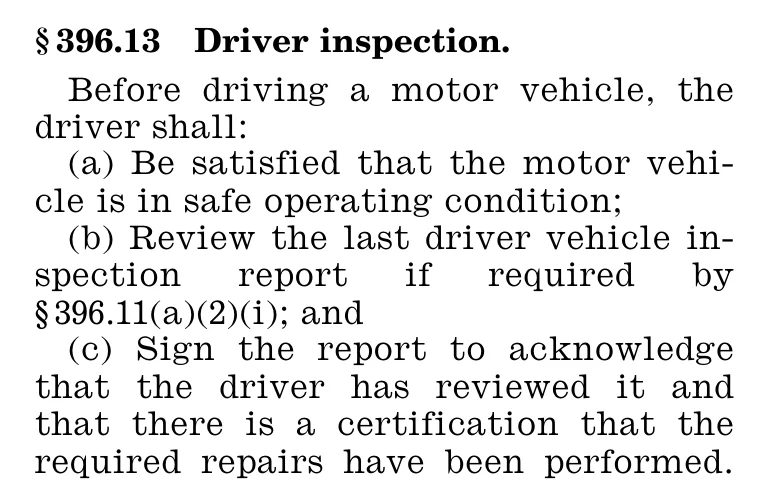
Reports may now be electronic. Paragraph (d) of 396.13, added in February 2026, allows the reports to be created and kept in electronic format under 49 CFR 390.32. You can read the current text on eCFR.
Section 392.7 names the parts the driver must be satisfied with before driving: service brakes, parking brake, steering, lights and reflectors, tires, horn, wipers, mirrors, coupling devices, wheels and rims, plus emergency equipment. This checklist covers those parts, grouped in the order a driver walks around the truck.
The carrier carries the other half of the duty under 49 CFR 396.3: it must systematically inspect, repair and maintain every vehicle it controls. Under 49 CFR 396.11 the driver reports defects at the end of each day. The carrier repairs safety defects plus certifies the repair, then keeps reports for three months.
The tread depth trap
Two different numbers govern tire tread: the legal minimum and the out-of-service line. The legal minimum for a steer tire is 4/32 inch of tread under 49 CFR 393.75. The out-of-service line sits lower: below 2/32 inch in any two adjacent major grooves.
A steer tire at 3/32 inch earns a citation but does not park the truck. The same gap applies to other tires: the legal minimum is 2/32 inch, while the out-of-service line is below 1/32 inch measured in two adjacent grooves at three spots around the tire. Read the full tire rule in the Code of Federal Regulations.
Pressure has its own line. A tire with a leak you can hear or feel is out of service, as is a tire at half its sidewall maximum pressure or less. A bulge from tread or sidewall separation is out of service, while a repair bulge up to 3/8 inch high is allowed.
What is not out of service
Some required items never park the truck on their own. Emergency equipment sits in that group: the fire extinguisher and the warning triangles are required by 49 CFR 393.95, but no CVSA out-of-service item covers them. A missing extinguisher is a violation, not an out-of-service order.
Spare fuses are still worth carrying, though FMCSA removed the federal spare-fuse rule on April 20, 2026.
The extinguisher still has a rating to meet. A power unit that does not haul hazardous materials carries an extinguisher rated 5 B:C or more, or two rated 4 B:C or more. A hazmat power unit carries one rated 10 B:C or more.
Two more items surprise drivers: a dead driver side wiper is out of service only in wet weather, while a dead headlamp is out of service only once lights are required. Hub oil level lost its out-of-service status in the 2026 criteria, when CVSA removed the low lubricant item.
One bad brake is not out of service either. Each defective brake counts toward the 20 percent rule, with the truck parking only when the count reaches the line. Use the Brake Inspection Readiness Checker to work out the 20 percent result for your truck.
The criteria change every year. The 2026 edition took effect on April 1, 2026 with 17 changes, including the rim and hub updates used in this checklist. This page follows the April 1, 2022 edition with those 2026 changes applied; the next refresh checks the current book.
What defects put a truck out of service?
The checklist above flags 29 items that park the truck when a driver finds them. The companion on this page covers the wider field: every system an inspector grades, from tires and wheels to cargo securement, with the measurement that decides each close call.
Two tiers decide every defect. The first is the rule itself: a tire below the legal tread depth, a lamp that will not light, a tiedown count short of the minimum. The second is the out-of-service line, which sits past the rule: a steer tire is legal down to 4/32 inch but out of service below 2/32 inch, and steering play on a 20 inch power wheel is a citation past 5-1/4 inches but out of service at 7-7/8 inches. A defect between the two lines earns a citation and a repair order; a defect past the out-of-service line parks the truck until it is fixed. The companion grades both tiers for every defect it covers, and names the governing rule for each answer.
For the deepest checks in a single system, use the dedicated tool: the Tire Compliance Checker for tread, pressure and damage, the Brake Pushrod Stroke Checker for stroke and lining, the Steering Lash Checker for the full play table, and the Lighting and Reflector Checker for every required lamp and reflector. Brake grading, including the 20 percent defective brakes rule, lives in the Brake Inspection Readiness Checker.
What happens after an inspector places your truck out of service?
The inspector declares the vehicle out of service and marks it with a sticker under 49 CFR 396.9. From that moment the vehicle may not be operated at all, including by towing, except by a crane or hoist, until every repair the notice requires is complete. The sticker stays on until the repairs are done.
The driver gives a copy of the inspection report to the carrier, and to the intermodal equipment provider where one is involved, at the next terminal or facility, or sends it at once if the driver will not reach one within 24 hours. The carrier then has 15 days to certify that all violations noted on the report have been corrected. If the state agency that issued the report asks for the completed form back, the carrier returns it within the same 15 days; in every case the carrier keeps a copy of the report at its principal place of business, or where the vehicle is housed, for 12 months.
An out-of-service order also carries CSA weight: the violations behind it score against the carrier, and a driver can check what a violation costs in the CSA Violation Points Checker.
Can you drive an out-of-service truck to the nearest repair shop?
No, once an inspector has declared the truck out of service. Section 396.9 bars all operation until the repairs are complete, and the nearest-repair rule does not override it. The rule drivers sometimes quote, 49 CFR 396.7(b), covers a different situation: a vehicle that is found unsafe while it is being operated on the highway, before any inspector has declared it out of service, may continue only to the nearest place where repairs can safely be made, and only when driving there is less hazardous to the public than staying where it is.
So the sequence matters. A defect found on a pre-trip inspection is repaired before the truck moves. A defect found on the highway, before an inspector stops the truck, allows a drive to the nearest safe repair point when that is the less hazardous choice. A defect an inspector has declared out of service allows no driving at all until it is fixed.
What changed in the 2026 out-of-service criteria?
The 2026 edition of the CVSA North American Out-of-Service Criteria took effect on 1 April 2026 with 17 changes. Five matter most to drivers. First, an audible air leak at the air chamber and a disconnected service air connection no longer park the truck on their own; each now counts as one defective brake toward the 20 percent rule. Second, hydraulic and electric brake lining thickness is aligned with the federal rule, at less than 1/16 inch. Third, the parking brake heading is now Parking or Emergency Brake. Fourth, the rim crack item now covers missing pieces of rim over 3 inches at the bead area, and center holes no longer count for the crack between two holes item. Fifth, the hub item for no visible or measurable lubricant is gone: a dry hub no longer parks the truck, though the carrier still has a duty to lubricate the vehicle properly.
The 2026 book is sold by CVSA and is not freely available, so the thresholds in this companion come from the 2022 edition, the latest full text publicly available, with the 2026 changes applied from CVSA summaries. The April refresh re-checks every threshold against the current edition.
Why is a cracked windshield not out of service?
Because no out-of-service item covers windshield glass. A crack in the viewing area above the steering wheel can still be a violation under 49 CFR 393.60, unless it is a single crack that no other crack intersects, or the damage is small enough to cover with a 3/4 inch disc and sits at least 3 inches from any other damage. The wiper is a different story: a dead driver side wiper is out of service, but only in wet weather that requires wiper use. In dry weather it is a violation.
The annual inspection standard is stricter than the operating rule in one more way: Appendix G to Subchapter B, the minimum periodic inspection standards, also requires a crack in the viewing area to be no more than 1/4 inch wide. A windshield that passes the operating rule can still fail an annual inspection.
How do you check a defect that needs a measurement?
Pick the system, pick the defect, and the companion asks for the number that decides it: tread depth in 32nds of an inch, steering play at the rim, movement between two parts, the count of broken leaves, or the weight and tiedown numbers for a load. Enter the measurement as you read it, and the companion compares it with both lines, the compliance limit and the out-of-service line, and says which side of each line the measurement falls on.
Where the two books disagree, the companion says so: on a 16 inch power steering wheel, Appendix G lists 4-1/2 inches of play against 4-1/4 inches in 49 CFR 393.209, and the companion uses the 393.209 figure as the compliance line. Measurements taken by hand, such as universal joint play, use hand pressure only, as the criteria specify.
How to use this checklist
Forty-six checks in inspection order. No account and no email needed.
- Start at the engine and work through the groups in order.
- Tick Checked for each item you inspect and find clear.
- Tick Problem on any item where you find a defect.
- Read the summary for the out-of-service verdict.
- Copy your summary and report every defect on your DVIR.
What cab equipment does the DOT require?
The cab is the driver workplace, and Part 393 of the federal safety rules sets equipment standards for it, item by item. The checklist above now covers 11 cab equipment checks, from the defroster to the radar detector ban. Each one traces to a numbered section of 49 CFR, and each one is a violation when it fails, even when it does not put the truck out of service.
The rules split into two groups. The equipment rules in Part 393 cover what the truck must carry and how it must work: wipers, defroster, mirrors, horn, speedometer, floors, television position, seats and belts, interior noise, and heaters. The conduct rules in Part 392 cover what the driver must do: wear the belt, keep radar detectors out of the truck, and never drive with a carbon monoxide condition in the cab.
| Cab item | Rule | What the rule requires |
|---|---|---|
| Wipers and washer | 49 CFR 393.78 | FMVSS 104 system on trucks built on or after Dec 25, 1968; at least two power driven blades on older trucks |
| Defroster and defogger | 49 CFR 393.79 | FMVSS 103 system on trucks built on or after Dec 25, 1968 |
| Mirrors | 49 CFR 393.80 | Two outside mirrors, one each side; replacements meet FMVSS 111 |
| Horn | 49 CFR 393.81 | A horn that gives an adequate and reliable warning signal |
| Speedometer | 49 CFR 393.82 | Accurate within plus or minus 5 mph at 50 mph |
| Cab floor | 49 CFR 393.84 | Substantially built, free of unnecessary holes, fumes kept out |
| Television | 49 CFR 393.88 | Behind the back of the driver seat, not visible to the driver, controls out of reach |
| Seats and belts | 49 CFR 393.93 | FMVSS 207, 208, 209 and 210 by manufacture date |
| Interior noise | 49 CFR 393.94 | No more than 90 dB(A) at the driver seat |
| Heaters | 49 CFR 393.77 | No open flame, exhaust fed, or portable heater in occupied space |
| Radar detectors | 49 CFR 392.71 | Use or possession in a commercial motor vehicle is prohibited |
| Carbon monoxide | 49 CFR 392.66 | Do not drive until a carbon monoxide condition is fixed |
| Side windows | 49 CFR 393.61 | At least one window each side, at least 200 square inches |
Most of these rules are old and stable. The speedometer, mirror, floor, television, and noise sections have not changed in years, and none of them was touched by the 2026 deregulatory batch. What changes is enforcement attention: inspectors check the cab on every Level I inspection, and a cab defect found at the roadside goes on the inspection report the same way a brake defect does.
How accurate must a truck speedometer be?
A truck speedometer must be accurate to within plus or minus 5 mph at a speed of 50 mph. The rule is 49 CFR 393.82, and it states the metric twin as well: plus or minus 8 km/h at 80 km/h. A speedometer that reads 55 mph when the truck is doing 50 mph is at the edge of the limit. A speedometer that reads 56 mph at a true 50 mph is past it.
The test is easy to run. Drive at a steady 50 mph on a flat road and compare the dash reading with a GPS speed app or a radar speed sign. Hold the speed steady for a few seconds before you compare, since a GPS reading lags a little when the speed is changing. The speedometer checker above does the math: enter both readings and it tells you whether the error sits inside the limit.
A wrong speedometer does more than risk a citation. It throws off every speed based judgment the driver makes, from following distance to the speed limit itself, and it feeds wrong numbers into any log or record that uses the dash reading. If the checker shows a fail, fix the speedometer and report the defect on your DVIR before you drive.
Are radar detectors illegal in commercial trucks?
Yes. Section 392.71 of 49 CFR bans radar detectors in commercial motor vehicles outright. No driver may use one in a commercial motor vehicle, and no driver may operate a commercial motor vehicle that is equipped with or contains one. The words “equipped with or contains” matter: a detector sitting switched off in the glove box still violates the rule, because the truck contains it.
The ban covers the driver and the carrier alike. Paragraph (b) of the same section says no motor carrier may require or permit a driver to violate it, so a fleet that looks the other way is in violation too. There is no exception for personal vehicles used part time, and no exception for detectors that are unplugged or out of sight.
Note what the rule does not ban. It bans radar detectors, not every electronic device in the cab. GPS units, electronic logging devices, and dash cameras are governed by their own rules, not by 392.71. If a radar detector is anywhere in the truck, take it out before you drive. The radar flag above records the check in your summary.
What are the DOT mirror requirements for trucks?
Every bus, truck, and truck tractor must carry two rear vision mirrors, one at each side, firmly attached to the outside of the vehicle and placed to reflect a view of the highway to the rear along both sides. The rule is 49 CFR 393.80, and it adds that the mirrors and their replacements must meet FMVSS 111 as it stood when the vehicle was built. A cheap replacement mirror that does not meet the standard is a violation even when it looks fine.
Two exceptions narrow the rule. First, a truck needs only one outside mirror, on the driver side, when it is built so the driver has a rear view by means of an interior mirror. That exception fits box trucks with a clear view through the cab, not tractors pulling a trailer. Second, in driveaway-towaway operations the driven vehicle needs at least one mirror giving a clear view to the rear. Mirrors fitted before January 1, 1981 may stay in service, but any replacement must meet FMVSS 111.
Mirrors sit on the same pre-drive list as lights and reflectors under 49 CFR 392.7, so check them together on the walk around. If you want the full lamp and reflector list for your truck, use the Lighting and Reflector Checker to see what your configuration must carry.
Can you have a TV in a truck cab?
Yes, with three conditions, all in 49 CFR 393.88. The screen must sit to the rear of the back of the driver seat when it is in the same compartment as the driver. It must be placed so the driver cannot see it while driving. And its operating controls must be placed so the driver cannot work them without leaving the driver seat. All three conditions must hold at once.
A television mounted in the sleeper berth behind the seats passes easily, since the driver cannot see it from the driving position. A screen mounted on the dash or on a cab wall in the driver line of sight fails, even when it is switched off, because the rule turns on where the screen sits and whether the driver can see it, not on whether it is playing. The same test applies to any screen that receives a television broadcast, whatever the device is called.
Use the TV checker above when a screen is fitted. If no TV or video screen is fitted at all, the rule does not apply and the checklist item passes on its own.
How loud can a truck cab be?
Interior noise at the driver seat must not exceed 90 dB(A), measured under the test procedure in 49 CFR 393.94. The procedure parks the truck clear of reflecting surfaces, closes the doors, windows, and vents, switches off the accessories, and runs the engine at governed speed or maximum rated horsepower with a sound level meter six inches to the right of the driver right ear. Two readings within 2 dB of each other are averaged, and a 2 dB tolerance over the 90 dB(A) limit is allowed for test variation.
Most drivers will never run that test. The practical check is simpler: a cab that suddenly gets louder usually has a real defect behind it, most often an exhaust leak ahead of or under the cab, a failed body seal, or a loose panel. An exhaust leak is also the carbon monoxide risk in 49 CFR 392.66, so treat new cab noise as a safety signal, not an annoyance, and report it on the DVIR.
Which cab defects put a truck out of service?
Almost none of them. The CVSA out-of-service criteria cover a small set of cab items: a temporary seat such as a crate or stool in place of the fitted driver seat, and a dead driver side wiper in wet weather. Those two are already in the checklist above. The speedometer, mirrors, defroster, floor, television, seat anchorages, noise, heaters, radar detector, and side windows have no out-of-service item in the criteria, so a defect in any of them is a violation to fix and report, not an order that parks the truck.
That distinction matters at the roadside but not in the yard. A violation still goes on the inspection report, still counts against the carrier safety record, and still has to be fixed. The pre-trip habit is the same either way: find the defect before you drive, fix it, and report it on the DVIR.
Two nearby checks do carry out-of-service lines and are worth running with the cab checks. Steering free play has both a federal limit and a looser out-of-service line, and the Steering Lash Checker shows both. Emergency equipment sits in the same violations-only group as the cab items, and the Emergency Equipment Checker covers the extinguisher ratings and warning device rules that the checklist only touches.
Pre-trip inspection questions
What does out of service mean?
An inspector finds a defect serious enough to make driving unsafe. The vehicle must stay parked until the defect is fixed. The rule is 49 CFR 396.9(c).
Does a flagged defect always mean out of service?
No. Only the 29 items marked Out of Service in this checklist can park the truck on their own. The other 17 items are still violations, so fix them and report them on your DVIR.
Why does the checklist show two tread numbers?
The legal minimum for steer tires is 4/32 inch under 49 CFR 393.75. The out-of-service line sits lower, at 2/32 inch in two adjacent grooves. A steer tire at 3/32 inch earns a citation but does not park the truck.
What if my truck has a brake defect?
One bad brake counts toward the 20 percent rule, not out of service on its own. Two bad brakes on a 10 brake combination put the truck out of service. Use the Brake Inspection Readiness Checker to work out the 20 percent result for your truck.
Does this checklist replace my DVIR?
No. This checklist helps you find defects before you drive. Report every defect you find on your driver vehicle inspection report, then wait until safety defects are fixed and certified before you drive.
How current are the out-of-service criteria here?
The criteria follow the CVSA April 1, 2022 edition. The 2026 edition changed 17 items, with this page reflecting the changes that affect the checks here. CVSA revises the criteria every April 1, so check the current edition before you rely on a single threshold.
Are radar detectors illegal in a commercial truck?
Yes. 49 CFR 392.71 bans using a radar detector in a commercial motor vehicle and bans driving a commercial motor vehicle that is equipped with or contains one. A detector sitting switched off in the glove box still violates the rule, because the truck contains it. Remove it before you drive.
How accurate must a truck speedometer be?
Within plus or minus 5 mph at 50 mph, under 49 CFR 393.82. The metric twin is plus or minus 8 km/h at 80 km/h. A speedometer that reads 56 mph at a true 50 mph is past the limit. Test it against a GPS reading at a steady 50 mph.
How many mirrors does a truck need?
Two outside mirrors, one on each side, under 49 CFR 393.80. The one exception: a truck needs only a driver side mirror when the driver has a rear view by interior mirror. Replacements must meet FMVSS 111.
Can I have a TV in my truck cab?
Yes, when all three conditions in 49 CFR 393.88 hold: the screen sits behind the back of the driver seat, the driver cannot see it while driving, and the driver cannot work its controls without leaving the seat. A sleeper berth TV passes; a dash mounted screen fails.
Is a broken speedometer out of service?
No. The CVSA out-of-service criteria have no item for the speedometer, so a broken or inaccurate speedometer is a violation, not an out-of-service order. Fix it and report it on your DVIR before you drive.
What is the DOT noise limit inside a truck cab?
90 dB(A) at the driver seat, measured under the test procedure in 49 CFR 393.94, with a 2 dB tolerance for test variation. A cab that suddenly gets louder usually has an exhaust leak or a failed seal behind it, so report it on the DVIR.
How long does a carrier have to certify an out-of-service repair?
Within 15 days of the inspection the carrier certifies that all violations noted on the report have been corrected. If the issuing state agency asks for the completed form back, the carrier returns it within the same 15 days. In all cases the carrier keeps a copy of the report for 12 months. 49 CFR 396.9(d)(3).
Can I drive my truck to a repair shop after it is placed out of service?
No. Once an inspector declares the vehicle out of service, 49 CFR 396.9(c)(2) bars all operation, including towing except by a crane or hoist, until every repair on the notice is complete. The nearest-repair rule in 49 CFR 396.7(b) covers a defect the driver finds while on the highway, before any inspector declares the truck out of service.
Is a cracked windshield out of service?
No. No CVSA out-of-service item covers windshield glass. A crack in the viewing area can still be a violation under 49 CFR 393.60 unless it is a single crack that no other crack intersects, or damage small enough to cover with a 3/4 inch disc and at least 3 inches from other damage. The wiper is different: a dead driver side wiper is out of service in wet weather.
Is low hub oil still out of service in 2026?
No. CVSA removed the low lubricant hub item from the 2026 criteria, effective April 1, 2026, because enforcement was inconsistent. A hub with no visible lubricant is still a lubrication failure to fix under 49 CFR 396.5, but it no longer parks the truck on its own.
How much steering play is out of service?
More than the compliance limit in 49 CFR 393.209, and at or past the higher CVSA line. On a 20 inch wheel with power steering, the compliance limit is 5-1/4 inches and the out-of-service line is 7-7/8 inches, measured at the rim with the engine running. Use the Steering Lash Checker for the full table.
What tread depth puts a steer tire out of service?
Below 2/32 inch measured in any two adjacent major grooves. The legal minimum is higher, 4/32 inch, so a steer tire at 3/32 inch earns a citation but does not park the truck. On other tires the out-of-service line is below 1/32 inch in two adjacent grooves at three spots around the tire.
Related tools and guides
- Brake Inspection Readiness Checker: grade seven brake checks and work out the 20 percent result for your truck
- CSA Violation Points Checker: see what each violation does to your CSA score and when the points fall off
- HOS Calculator: work out your legal driving hours for today under the current rules
- Cost Per Mile Calculator: put maintenance and repair costs beside fuel and insurance in your full cost per mile
- All Trucking Mind tools: free calculators and checkers for drivers and carriers
- Tire Compliance Checker — check tread depth, pressure and damage against the tire rules.
- Brake Pushrod Stroke Checker — measure pushrod stroke and lining thickness against the limits.
- Steering Lash Checker — measure steering wheel play against both the compliance limit and the out-of-service line.
- Lighting and Reflector Checker — check every required lamp and reflector for your vehicle.
This checklist follows 49 CFR Part 393 and Part 396 as printed in the Code of Federal Regulations, 2025 edition, plus the CVSA out-of-service criteria named above. It is guidance only.
The inspector at the roadside applies the current CVSA edition. Confirm any single threshold before you dispute a citation.
Your checks stay in your browser. Nothing is sent to our servers.