
0 of 6 steps done
Your next step is step 1: Get your SAP list, register and designate your SAP.
The four conditions
Your ticks stay in this browser. Nothing is sent to our servers. There is no account to create.
Disclaimer: This tool is provided for general information only. It is not professional advice — verify figures from official sources before acting on them. This tool is not legal advice; ticking a step here does not change your Clearinghouse record, since only SAP and employer reports change it.
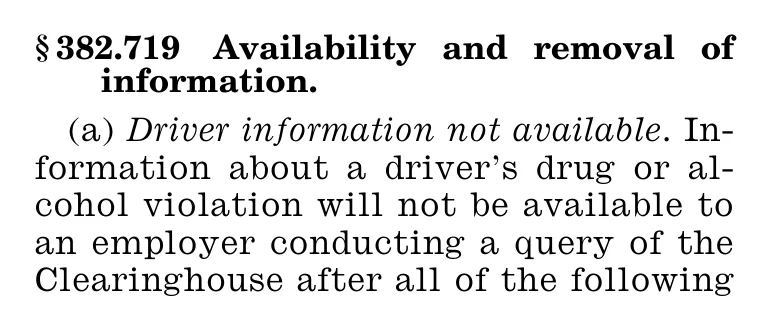
Quick answer: A driver who failed a DOT drug or alcohol test gets back behind the wheel in six steps. Tick each step off above as you complete it and the tracker saves your progress in this browser. The record clears only when all four conditions in 49 CFR 382.719(a) are met, including five years from the violation determination date.
The six steps, in order
The process comes from 49 CFR Part 40, Subpart O. The Clearinghouse records each step as it happens. This tracker follows the same six milestones in the same order.
The first step is the one drivers skip most: getting the SAP list, registering in the Clearinghouse and designating a SAP. Nothing else can be recorded until the SAP is designated. The education or treatment step sits between the two SAP evaluations and sets the pace for everything after it.
Tick the steps in order. The return-to-duty test cannot happen until the SAP finds you complied. The follow-up plan starts only after you return to duty.
What each step unlocks
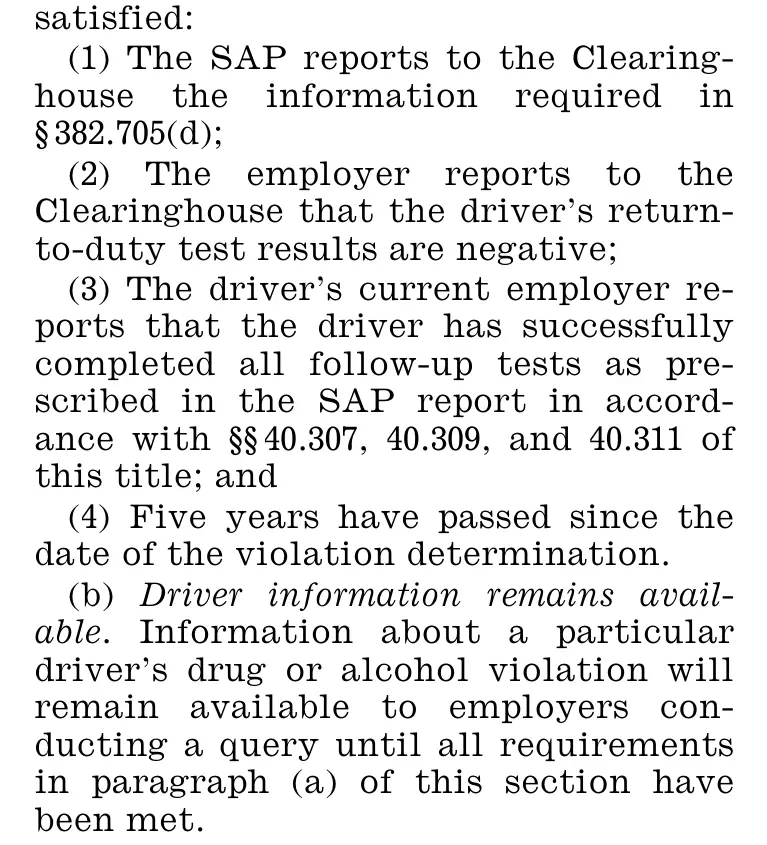
Three of the six steps feed the four conditions in 49 CFR 382.719(a). Step 4 feeds the first condition, step 5 feeds the second and step 6 feeds the third. The fourth condition is time: five years from the violation determination date.
Steps 1 to 3 feed no condition, but they unlock everything after them. Without the SAP designation the SAP cannot report at all. Without the education or treatment the SAP cannot find compliance.
Your Clearinghouse status changes at step 5, when the negative return-to-duty test is recorded. The record itself stays visible until all four conditions are met. That is why finishing the steps early still leaves a wait for the five-year date.
Follow-up testing: the long tail
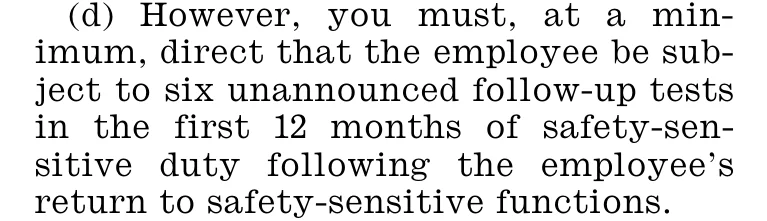
Step 6 is the longest step. The SAP must direct at least six unannounced follow-up tests in your first 12 months back in safety-sensitive duty. The SAP may also require tests during the 48 months after that first year, so follow-up testing can run for up to five years in total.
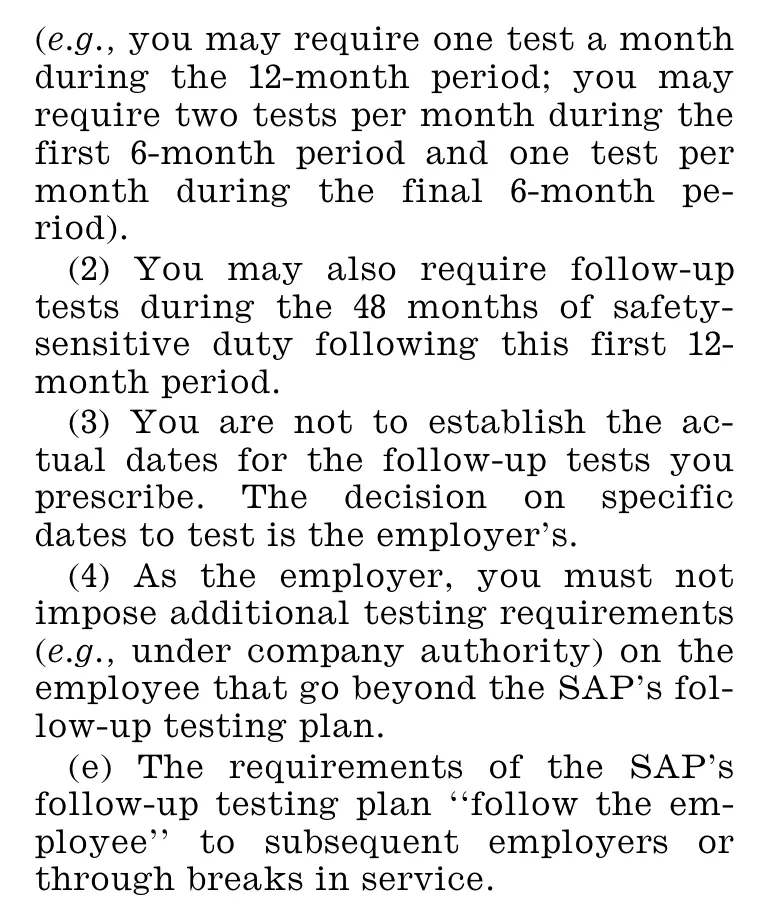
Follow-up tests are unannounced, with no pattern you can predict. A random test cannot be substituted for a follow-up test. The plan follows you to a new employer and through breaks in service.
Your employer reports completion of the plan to the Clearinghouse. That report closes the last recorded milestone. It also satisfies the third of the four conditions.
The return-to-duty test
Only a DOT-regulated employer can send you for the return-to-duty test. If you are an owner-operator, your consortium or third-party administrator handles it. You cannot order the test yourself.
The pass mark is strict: a negative drug result and an alcohol result below 0.02. The test cannot happen until the SAP finds you complied with the education or treatment. The collection is directly observed.
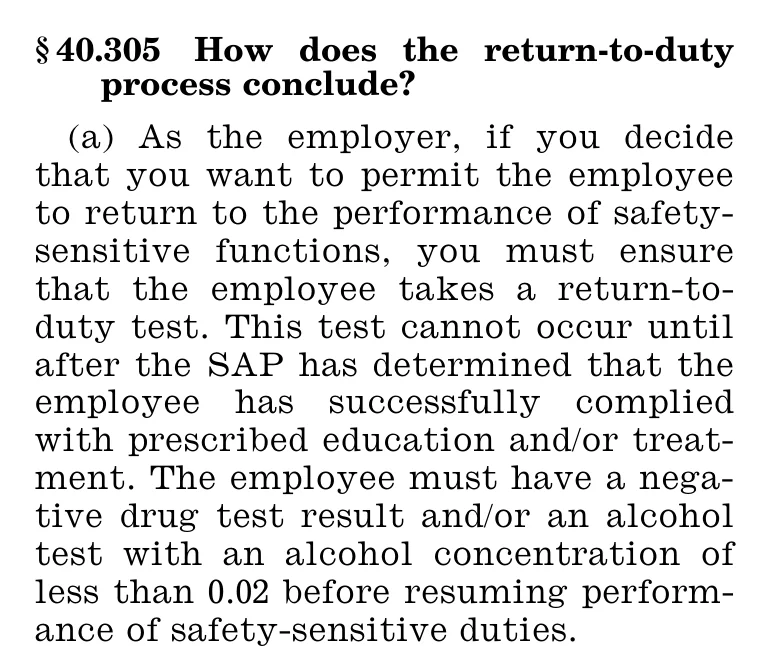
Your employer reports the negative result to the Clearinghouse by the close of the third business day after receiving it. When the result is recorded, your status changes from prohibited to not prohibited. Passing the test does not guarantee your old job back, since returning you to duty is a personnel decision.
What it costs
The federal rules set no fee for any part of this process. Clearinghouse registration is free. The employer pays the query fee.
SAP fees are set by providers and vary by place. AACS Counseling 2026 guide lists $300–$600 for the initial evaluation and $100–$300 for the follow-up evaluation, with typical total SAP fees of $400–$1,200. Education or treatment costs extra, at a price set by what the SAP prescribes.
Be wary of anyone who charges you to register in the Clearinghouse or to view your own record. Both are free. Be wary of anyone who guarantees a price and a completion date before evaluating you.
Why starting now matters
Prohibited status has no sunset. It lifts only when the process is completed through the return-to-duty test. Waiting changes nothing.
FMCSA counted 360,759 CDL and CLP holders with at least one violation on record as of October 1, 2026. Of those, 218,977 were in prohibited status. Of the prohibited drivers, 174,051 had not started the return-to-duty process at all, which is 79.5 percent of them.
Since November 18, 2024, your state must also downgrade your CDL, generally within 60 days of the FMCSA notice. The downgrade stays until FMCSA tells the state you are not prohibited again. Starting the process is the only move that shortens the time off the road.
How to use this tracker
Six boxes, about one minute to set up. No account and no email needed.
- Tick off step 1 once you have your SAP list, your Clearinghouse registration and your SAP designation.
- Tick each later step as you complete it, in order.
- Read the next-step line to see what to do next.
- Check the four conditions box to see which Clearinghouse reports are still open.
- Copy your progress to keep it with your return-to-duty paperwork.
Return-to-duty tracker questions
Do I have to do the steps in order?
Yes. The regulation builds each step on the one before it: the return-to-duty test cannot happen until the SAP finds you complied. This tracker warns you if you tick a later step while an earlier one is still open.
Does ticking a step here change my Clearinghouse record?
No. Ticking a step here changes nothing outside this browser; only SAP and employer reports change your Clearinghouse record. Check your official record at clearinghouse.fmcsa.dot.gov.
Where is my progress saved?
In this browser only, using local storage. Nothing is sent to our servers and there is no account. Clearing your browser data or switching devices starts the tracker empty again.
Can I switch to a different SAP halfway through?
No. Once a SAP accepts your designation in the Clearinghouse, you cannot designate a different one. You also cannot seek a second SAP evaluation to get a softer recommendation; the first SAP prescription is the only one that counts.
How long does the whole process take?
There is no set timeline in the regulation. Some drivers reach the return-to-duty test within weeks; others take months, because the education or treatment step sets the pace. Follow-up testing then runs for at least 12 months after you return to duty.
What happens when all six steps are done?
Your Clearinghouse status is already not prohibited once the negative return-to-duty test is recorded at step 5. Finishing step 6 closes the last recorded milestone, but the violation stays visible to employers until five years pass from the determination date. Use the Clearinghouse Record Countdown to work out that date.
Related tools and guides
- Clearinghouse Record Countdown: work out your five-year date from the violation determination date
- Clearinghouse Query Tracker: the employer-side tool for annual queries, the 24-hour rule and return-to-duty follow-up tests
- SAP Program and Return-to-Duty Process: every step, cost and timeline of the way back to driving
- Drug and Alcohol Clearinghouse and Consortium: the owner-operator guide to the Clearinghouse and testing programmes
- All Trucking Mind tools: free calculators and checkers for drivers and carriers
This tracker follows 49 CFR Part 40, Subpart O and 49 CFR 382.719 as printed in the Code of Federal Regulations, 2025 edition. It is guidance only.
Ticking a step here does not change your Clearinghouse record. Confirm each step against your own Clearinghouse record before you act on it.
Your ticks stay in your browser. Nothing is sent to our servers.