
Pick your product, enter the gallons in each compartment, then check the weights. The result shows load weight, gross weight, axle estimates, bridge checks and the most you can legally load.
Federal hazmat minimum is 1 percent. Many carriers load at 3 to 5 percent outage.
Bridge lengths (feet)
Outer bridge runs from the steer axle to the last trailer axle. Steer to drive runs from the steer axle to the last drive axle. Drive to trailer runs from the first drive axle to the last trailer axle.
Enter your load to see the weights.
Axle weights are estimates
The split puts 61 percent of tractor tare on the steer axle and 45 percent of the loaded trailer weight on the drive tandem. Weigh the loaded truck on a certified scale before you roll.
Your inputs stay in this browser. Nothing is sent to our servers. There is no account to create.
Disclaimer: This tool is provided for general information only. It is not professional advice — verify figures from official sources before acting on them. Axle weights here are estimates from standard split ratios, so weigh the loaded truck on a certified scale before you roll.
Quick answer: Enter your product and gallons to see load weight, gross weight, axle estimates and the most you can load at your outage percent. The example below loads 8,000 gallons of gasoline at 6.2 lb per gallon for a 49,600 lb load and a 76,600 lb gross weight, with the drive tandem closest at 98 percent.
How the axle estimates work
The tool splits the weight with fixed ratios. It puts 61 percent of tractor tare on the steer axle, 39 percent on the drive tandem, then 45 percent of the loaded trailer weight on the drives and the rest on the trailer tandem.
A gasoline load of 8,000 gallons at 6.2 lb per gallon weighs 49,600 lb. With an 18,000 lb tractor and a 9,000 lb trailer the gross weight is 76,600 lb, the steer axle carries 10,980 lb, the drives carry 33,390 lb and the trailer tandem carries 32,230 lb.
The steer check uses a 12,000 lb practical ceiling from steer tire and axle ratings. Federal law caps a single axle at 20,000 lb under 23 CFR 658.17, so a steer axle over 12,000 lb is a warning to check your ratings, not a federal violation on its own.
The most you can load is 8,218 gallons in that example, set by the drive tandem. Every limit is checked at once, so the answer names the one that binds first.
The outage rule
Federal hazmat rules set a minimum outage for bulk tanks. Under 49 CFR 173.24b(a), liquids and liquefied gases must be loaded with at least 5 percent outage for materials poisonous by inhalation and at least 1 percent for all other materials.
The rule covers cargo tanks, portable tanks, tank cars and any compartment of those tanks. It applies to hazmat loads; milk and water carry no federal outage rule, so the tool uses 1 percent as a practical allowance for them.
Many carriers load at 3 to 5 percent outage in practice, which leaves more room for expansion on a hot day. The outage box on the tool takes any value from 0 to 20 percent.

Weight limits and the bridge formula
Interstate weight limits come from 23 CFR 658.17. Gross weight caps at 80,000 lb, a single axle at 20,000 lb and a tandem at 34,000 lb.
The bridge formula caps the weight on any group of two or more consecutive axles. It reads W = 500 x [(L x N) / (N – 1) + 12N + 36], where W is gross weight, L is the axle spacing in feet and N is the axle count.
Two consecutive tandems may each carry 34,000 lb when the first and last axle are 36 feet or more apart. The tool applies that exception on the drive to trailer group and rounds every bridge limit to the nearest 500 lb.

The tool checks three axle groups: the outer bridge with 5 axles, the steer to drive group with 3 axles and the drive to trailer group with 4 axles. Each group is checked against its own bridge limit. The result names the group that binds.
Endorsements: N and X
A tank vehicle is a commercial motor vehicle designed to transport liquid or gaseous material in a tank or tanks with an individual rated capacity over 119 gallons and an aggregate rated capacity of 1,000 gallons or more. Both parts of that definition must be met.
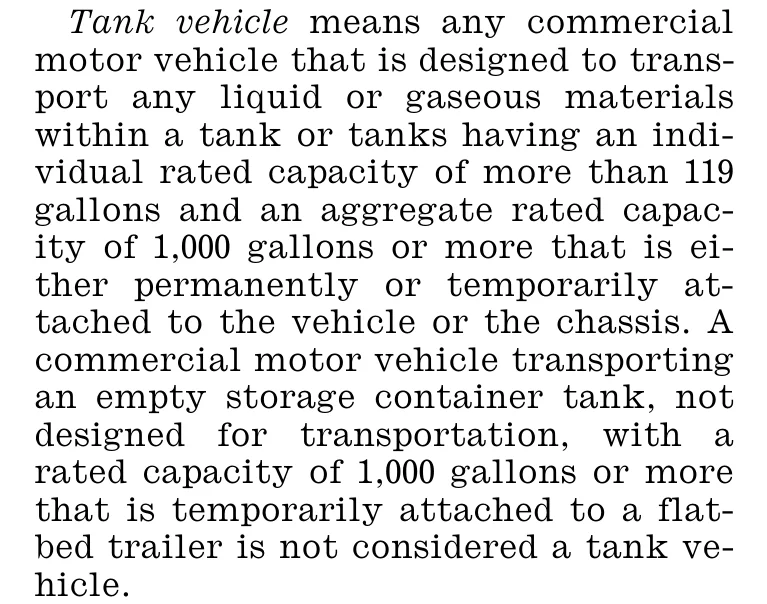
Driving a tank vehicle needs an N endorsement on your CDL. The N endorsement needs a knowledge test only, with no skills test.

Hauling hazmat in a tank needs an X endorsement, which combines the tank vehicle and hazardous materials endorsements. Gasoline and diesel are hazmat in a tank, so fuel haulers need the X.

Milk and water are not hazmat, so those loads need the N only. For a chemical load, check the shipping papers: a placarded hazmat needs the X.
Product densities
The tool uses a fixed density for four products and takes a custom density for chemicals and other liquids. Densities are in pounds per gallon at about 60 degrees F.
| Product | Density (lb per gallon) | Source |
|---|---|---|
| Diesel | 7.1 | DOE Transportation Energy Data Book |
| Gasoline | 6.2 | Typical 0.74 g per mL; NIOSH range 0.72 to 0.76 |
| Milk | 8.6 | USDA Agricultural Marketing Service |
| Water | 8.34 | NIST at 60 degrees F |
| Chemical | Enter your own | Shipping papers or safety data sheet |
Chemical density varies by product, so the tool never guesses one. Enter the density from the shipping papers or the safety data sheet for that load.
How to use this calculator
Five steps and one result. No account and no email needed.
- Pick your product from the list.
- Enter the gallons in each compartment.
- Check the tare weights and bridge lengths against your truck.
- Read the verdict, the axle estimates and the max loadable gallons.
- Copy your summary and weigh the loaded truck on a certified scale.
Tanker load questions
How many gallons can I legally load?
It depends on the product, your tare weights and the bridge lengths. Enter your load above and the tool works out the most you can load. The result names the limit that binds first.
Why is my max load lower than the tank capacity?
Weight limits bind before volume on most loads. A heavy liquid fills the weight limit with the tank only part full. The outage rule also keeps the top of the tank empty.
What outage should I use?
Federal hazmat rules need at least 1 percent outage for most liquids and 5 percent for materials poisonous by inhalation. Many carriers load at 3 to 5 percent in practice. Enter your own value in the outage box above.
Do I need an endorsement to haul a tanker?
Yes, when the tank meets the tank vehicle definition: one tank over 119 gallons plus 1,000 gallons total. That load needs an N endorsement. Add H for an X endorsement when the liquid is a hazmat.
Are the axle weights exact?
No. The tool estimates axle weights from standard split ratios. Weigh the loaded truck on a certified scale before you roll.
What is liquid surge?
Liquid surge is the push of the load when the liquid moves inside the tank. The risk is highest when the tank is 40 to 74 percent full. Brake early and keep extra space ahead in that range.
Related tools and guides
- Bridge Formula Axle Weight Checker: check any axle group against the bridge formula with your own spacings
- Hotshot Axle Weight Checker: check a hotshot load against ratings based axle limits
- Hazmat, Tanker and Doubles/Triples Practice Test: study for the N, H and X endorsements with practice questions
- Cost Per Mile Calculator: put maintenance and repair costs beside fuel and insurance in your full cost per mile
- All Trucking Mind tools: free calculators and checkers for drivers and carriers
This calculator follows the outage rule in 49 CFR 173.24b(a), the weight limits in 23 CFR 658.17 and the tank vehicle definition in 49 CFR 383.5. It is guidance only.
Weight limits and endorsement rules change. Confirm your figures with the current rule text before you rely on a single number.
Your inputs stay in your browser. Nothing is sent to our servers.