
Enter the date shown as the violation determination date on your Clearinghouse record.
Your entries stay in this browser. Nothing is sent to our servers. There is no account to create.
Disclaimer: This tool is provided for general information only. It is not professional advice — verify figures from official sources before acting on them. This tool is not legal advice and does not check any individual Clearinghouse record; check your own record at clearinghouse.fmcsa.dot.gov.
Quick answer: A violation determined on March 14, 2024 reaches its five-year date on March 14, 2029. Enter your own determination date above for your countdown. The record stops showing only when the SAP report, the negative return-to-duty test and the completed follow-up tests are also reported.
Check what else is on your record: the Whats on My Driving Record Checklist lists all four driver records, what each one holds and what each one costs.
The five-year rule, in plain English
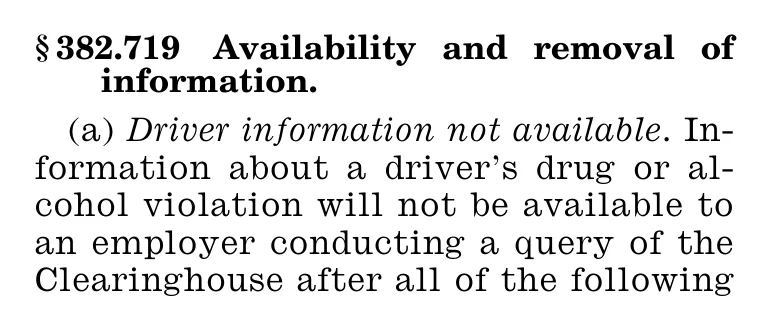
The rule is one date plus five years. Under 49 CFR 382.719, a violation stops being available to employers who query the Clearinghouse once five years have passed since the date of the violation determination. This tool adds those five years to the date you enter.
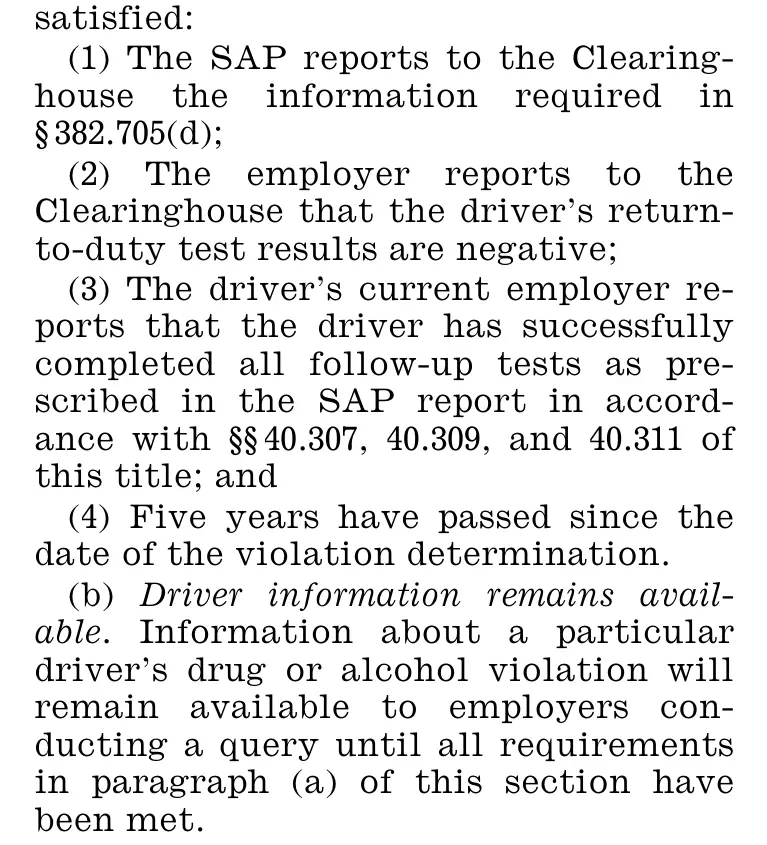
The five years are only one of four conditions. The SAP must also report your completion, your employer must report a negative return-to-duty test and your employer must report your completed follow-up tests. Until all four are met, the record stays visible.
Time alone never clears the record. A driver who finishes return to duty in a year still waits four more years for the five-year mark. A driver who never starts the process stays visible past the five-year date.
What determination date means
The determination date is the date the violation was determined, not the date of the test. For a positive drug test it is the date the Medical Review Officer verified the result. The test itself may have been days earlier.
It is also not the date your employer reported the violation. The employer reports by the close of the third business day after learning of it, while the MRO reports a verified result within 2 business days. Both dates fall after the determination date.
Use the date shown on your own Clearinghouse record. Register free at clearinghouse.fmcsa.dot.gov and read the determination date from the violation entry. That date is the one this tool needs.
- Positive drug test: the date the Medical Review Officer verified the result.
- Alcohol at 0.04 or higher: the date of the confirmation test.
- Refusal to test: the date of the refusal determination.
What happens on the five-year date
The record stops being available to employers who query the Clearinghouse. A query run after the five-year date, with the other three conditions met, shows no violation. The driver is no longer flagged in the system.
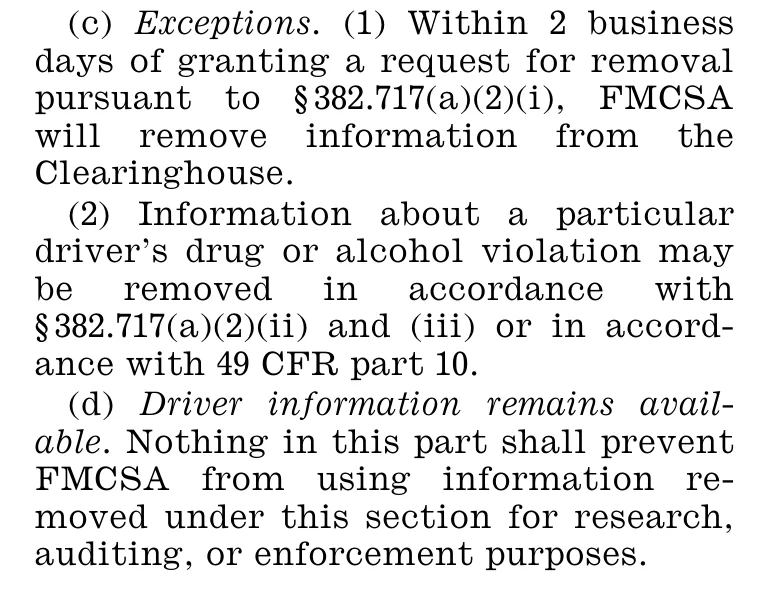
The information is not wiped from every record. FMCSA may still use removed information for research, auditing or enforcement.
A record entered in error can come out sooner. A driver may petition FMCSA to correct or remove incorrectly reported information under 49 CFR 382.717. FMCSA decides within 45 days of receiving a complete petition.
What employers see after the five-year date
After the five-year date passes with all four conditions met, an employer query returns no violation for that entry. The hiring carrier sees a clean query result and may proceed with the hire. The driver no longer needs to explain the old violation at every application.
Drivers who want to check their own standing can review the full record first. The What is on My Driving Record page lists all four driver records and what each one holds. Carriers planning the annual query cycle can use the Clearinghouse Query Tracker to stay on schedule.
The five-year date is only the last step. The SAP report, the negative return-to-duty test and the completed follow-up tests must all reach the Clearinghouse first. Drivers still working through those steps can track each one with the SAP Return-to-Duty Tracker.
Keep the paperwork after the date passes. The SAP completion letter and the negative test results prove the steps were done if a query ever shows an old entry.
How to use this calculator
Five steps, about one minute. No account and no email needed.
- Find your violation determination date on your Clearinghouse record at clearinghouse.fmcsa.dot.gov.
- Enter that date in the box above.
- Press the button to see your five-year date and the days left.
- Read the notes: the five-year date clears the record only when the return-to-duty steps are also done.
- Copy the result to keep it with your return-to-duty paperwork.
Clearinghouse countdown questions
When does a Clearinghouse violation go away?
It stops being available to employers once four conditions are all met: the SAP reports your completion, your employer reports a negative return-to-duty test, your employer reports your completed follow-up tests and five years pass from the violation determination date. Time alone does not clear it. This tool works out the five-year date from the determination date you enter.
What is the violation determination date?
It is the date the violation was determined, not the date of the test or the date your employer reported it. For a positive drug test it is the date the Medical Review Officer verified the result. Use the date shown on your own Clearinghouse record.
Does the five-year clock start over if I fail another test?
No. Each violation carries its own five-year clock from its own determination date. A second violation gets its own Clearinghouse entry and its own five-year date, while the first violation keeps running on its own clock.
My five-year date has passed. Why does the record still show?
The five years are only one of four conditions. The record stays visible until the SAP report, the negative return-to-duty test and the completed follow-up tests are all reported too. Check your record to see which step is still open.
Does the five-year date restore my CDL?
No. The CDL downgrade is separate from the Clearinghouse record. Your state restores the commercial privilege only after you complete the return-to-duty process; the state has 60 days to finish a downgrade once FMCSA notifies it.
What if my violation was determined on February 29?
This tool counts February 28 as the five-year date in a year with no February 29. Five years after a leap day is never a leap year, so the rule always applies. The regulation does not name a leap-day rule, so this page states the tool rule plainly.
Related tools and guides
- Clearinghouse Query Tracker: the employer-side tool for annual queries, the 24-hour rule and return-to-duty follow-up tests
- SAP Program and Return-to-Duty Process: every step, cost and timeline of the way back to driving
- Drug and Alcohol Clearinghouse and Consortium: the owner-operator guide to the Clearinghouse and testing programmes
- CSA Violation Points Checker: work out what a roadside violation costs in CSA points
- All Trucking Mind tools: free calculators and checkers for drivers and carriers
This calculator follows 49 CFR 382.719 as printed in the Code of Federal Regulations, 2025 edition, plus the reporting rules in 49 CFR 382.705. It is guidance only.
The five-year date is a calendar calculation from the date you enter. Confirm the determination date against your own Clearinghouse record before you act on the result.
Your entries stay in your browser. Nothing is sent to our servers.