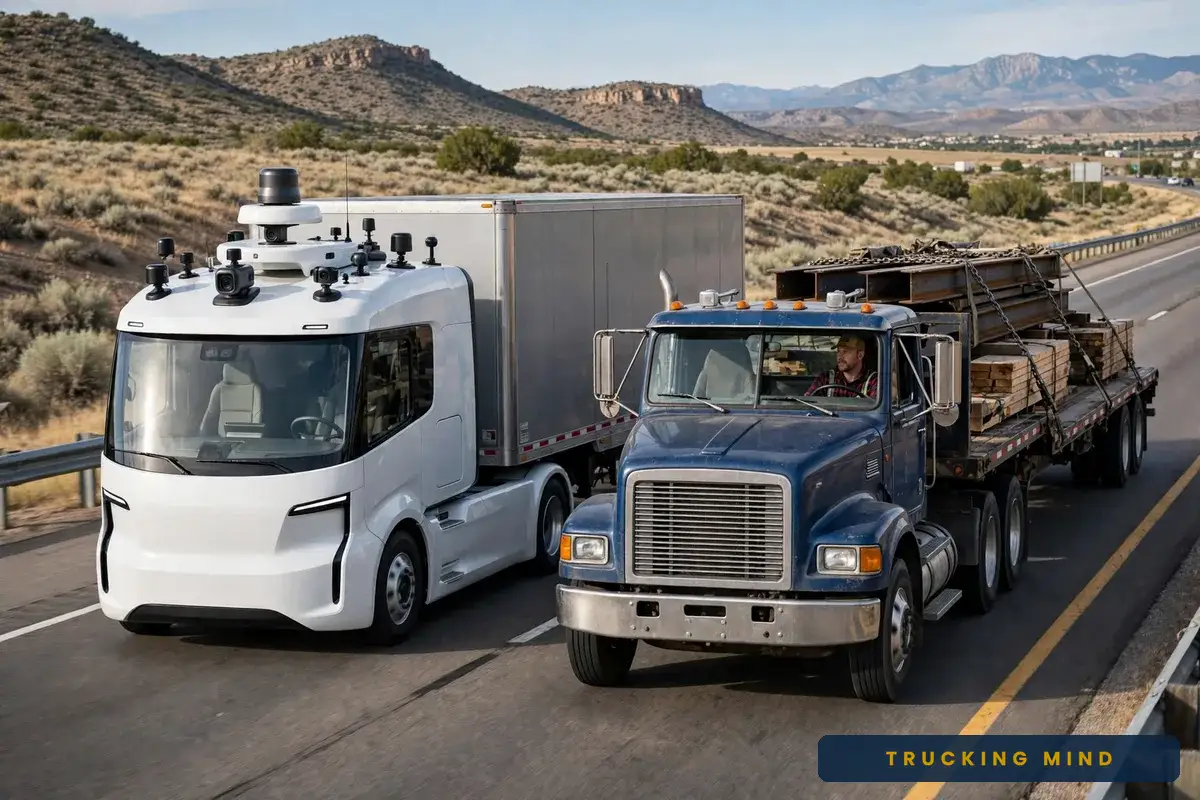
Driverless trucks will not take “truck driving” — there is no single job by that name and the technology is not coming for all of it at once. It is coming for one specific kind of work first: repetitive, hub-to-hub, long-haul dry van freight on fixed Interstate corridors, the kind Aurora has run without a driver between Dallas and Houston since April/May 2025. Everything else — hazmat, flatbed, local and multi-stop work, jobsites, freight you have to touch — sits years behind that and some of it has no driverless programme aimed at it at all.
The honest 2027 picture is a change that arrives lane by lane and segment by segment, against an industry that employs 2,221,200 heavy truck drivers and is still projected to grow. This guide works through the order of change, segment by segment, with the actual fleet numbers, so you can judge your own exposure by the freight you haul — not by a headline.
One thing this guide will not do is give you a percentage chance of losing your job. The generic calculators that do that — one widely shared site puts heavy truck drivers at 68 percent “high risk”, another at 79 percent, both from old occupation-level studies — know nothing about your freight, your lane, or your state.
Segments are the truth. Percentages are marketing.
Key Points
- Change comes in a strict order: hub-to-hub long-haul dry van first, regional freight second and hazmat, flatbed, oversize, local/multi-stop, yard and oilfield driving last — because fixed routes, transfer terminals and supervision economics decide the order, not the calendar.
- The entire verified driverless highway presence in late 2026 is a few dozen trucks per company: Aurora had more than 20 driverless trucks built and 500,000 driverless miles by its Q3 2026 letter of 28 October 2026; Kodiak’s 37 driverless trucks work off-highway in the Permian Basin.
- Against that, BLS counts 2,221,200 heavy truck driver jobs (2025), projects 4 percent growth from 2025 to 2035 and expects about 214,500 openings a year (Occupational Outlook Handbook, updated 27 August 2026).
- Drivers rank autonomous trucks the number 4 concern in ATRI’s Top Industry Issues 2026 (released 18–19 October 2026, about 3,100 respondents) — number 3 among company drivers — but the topic did not make owner-operators’ top five concerns.
- A phased-impact analysis reported by CCJ from NACFE work (18 August 2026) puts the first phase at 30,000–80,000 jobs on easy Sun Belt routes — a study estimate, not a count — which is why segment and geography, not panic, are the right way to read this.
Why Hub-to-Hub Goes First: Routes, Terminals and Supervision Math
Every driverless launch on a public highway so far shares the same three ingredients and they explain the whole order of change.
Fixed routes. A driverless truck does not roam the spot market. It runs one surveyed corridor between two points it knows completely — Dallas to Houston, Fort Worth to El Paso, Fort Worth to Phoenix.
Aurora’s 10 routes (February 2026) are all fixed Interstate lanes. The fewer surprises per mile, the sooner the freight qualifies.
Terminal infrastructure. The model is hub-to-hub: the driverless truck hauls the long middle between transfer terminals and humans handle the first and last miles, the docks and the paperwork at both ends. That only works where a shipper or carrier moves enough identical trailers between the same two points to justify the terminals — which means high-volume dry van linehaul, not your irregular route.
Supervision economics. A driverless truck still has humans around it — remote assistance staff who help a stopped or confused truck from a desk (Kodiak advertised assisted-autonomy remote roles at $34 an hour in October 2026) and safety drivers during testing. That supervision cost is spread across trucks, so it pays only where trucks run almost constantly on dense lanes.
Aurora added night operations in July 2025 — a truck with no hours-of-service limit earns in the dark in a way a one-driver operation cannot. Aurora’s September 2026 investor material claims about $0.85 or more per mile for its driver system against about $1.03 per mile for driver wages and benefits in ATRI’s figures — a company claim to investors, not an audited number, but it shows exactly which cost the industry is aiming at: the linehaul driver’s mile, on the lanes where the truck never sleeps.
Put the three together and the targeting is obvious. The exposed job is not “truck driver.” It is the driver whose whole week is terminal-to-terminal dry freight on a major Interstate — and even there, exposure means competing with a few dozen trucks today, not a fleet.
The Order of Change, Segment by Segment
| Segment | Order | Why | Status, late 2026 |
|---|---|---|---|
| Hub-to-hub long-haul dry van | First | Fixed Interstate corridors, transfer terminals at both ends, trucks run day and night | Driverless: Aurora on Dallas–Houston since April/May 2025, 10 routes, 500,000 driverless miles |
| Regional retail and grocery (medium-duty) | Second | Short fixed routes between distribution centres, same freight daily | Driverless: Gatik box trucks in Texas, Arizona and Arkansas; about 85,000 driverless orders by September 2026 |
| Regional Class 8 | Third | Same logic as linehaul but thinner lanes and later investment | Supervised only: PlusAI’s I-35 Laredo–Temple loop since March 2026; driverless targeted 2027 |
| Hazmat | Last | Placards, incident response and a driver legally in charge; FMCSA’s 2026 beacon exemption pointedly excludes hazmat | No driverless hazmat programme; exemption of 7 October 2026 excludes hazmat carriers |
| Flatbed and oversize | Last | Load securement is physical work; jobsites, escorts and permits change load by load | No driverless programme aimed at it |
| Local and multi-stop delivery | Last | Docks, customers, city streets, freight handling — the driver is the service | No driverless programme aimed at it |
| Yard and oilfield driving | Last (with a closed-site exception) | The driving job runs on public roads and unstructured jobsites; automation exists only inside closed private operations | Kodiak’s 37 driverless trucks work a closed Permian Basin industrial operation for Atlas; Outrider automates inside yards — neither touches the open-road driving job |
What “First” Actually Looks Like So Far
Aurora is the whole first chapter. It launched driverless freight on Dallas–Houston in April/May 2025, passed 250,000 driverless miles in January 2026 and 500,000 by late October 2026, with more than 20 driverless trucks built against a 200-truck target that has already slipped to February 2027.
Bot Auto ran the first fully humanless commercial truckload — nobody in the truck, no remote operator — from Houston to Dallas on 29 April 2026. Gatik’s driverless medium-duty trucks move retail and grocery freight in three states, with PepsiCo announcing 41 driverless box trucks in June 2026.
If you run a regular lane, check whether driverless trucks already run on it with the Driverless Lane Checker.
Behind them, the second wave is still supervised. Waabi runs Dallas–Houston with an observer in the seat and targets driverless operation in 2027 with Volvo. Torc, Daimler’s unit, targets driver-out running by the end of 2026 and first commercial freight in 2027.
PlusAI has run a supervised 600-mile I-35 loop since March 2026 and has no public-road driverless miles yet. Kodiak — the name with the largest real driverless fleet — runs its 37 trucks off-highway for Atlas in the Permian Basin; its highway driverless launch on Dallas–Houston was targeted for the end of 2026 and had not happened in the record through November 2026, although it signed a binding 75-truck deal with DTL in late October 2026, the most serious fleet commitment in the segment.
Read that list again and notice what is missing from it: variety. Every public-highway driverless mile in America is dry or reefer freight between fixed points on Interstate corridors, most of it in Texas. That is not a criticism of the technology — it is the map of which jobs it can currently do and it is a very small corner of the industry.
The Segments That Stay Human Longest — and Why
Hazmat. A placarded load needs a qualified driver in charge of it — at the dock, on the road and first on scene when something goes wrong.
It is telling that FMCSA’s one concrete driverless action of 2026, the 7 October 2026 exemption letting Level 4 trucks use cab-mounted beacons instead of warning triangles when stopped (Federal Register doc 2026-20734), explicitly excludes hazmat and passenger carriers. The regulator’s first driverless rule does not touch hazmat, because the warning problem the exemption solves is unsolved for a driverless tanker.
Flatbed and oversize. The driving is the easy part of a flatbedder’s day.
The job is chains, straps, tarps, edge protection, load checks, jobsite directions, escorts and permits that change with every load. No driverless programme is aimed at freight that has to be physically secured by the person hauling it.
Local and multi-stop. A P&D or local driver’s value is the stops: backing into docks that were designed for smaller trucks, dealing with receivers, handling freight, solving the problem when the address is wrong. A driverless truck optimised for 500 identical Interstate miles is the wrong tool for 40 different problems a day.
Yard and oilfield — the honest nuance. You will hear that yard and oilfield work is “already automated,” and the claim needs its limits.
Outrider automates trailer moves inside closed distribution yards under a five-year deal announced in October 2026 and Kodiak’s driverless trucks work a closed industrial site in the Permian Basin. Both are private, fenced, mapped environments with no public traffic.
The oilfield driving job — frac sand, water and equipment moving on public roads between changing jobsites — and the yard hostler’s public-road work are not what those systems do. Closed-site automation is real; it is not your job unless your job is entirely inside the fence.
The Denominator: 2.2 Million Jobs, a Few Dozen Trucks
Every frightening headline about this topic should be forced to stand next to two numbers. The first is the workforce: BLS counts 2,221,200 heavy truck driver jobs in 2025, projects the occupation to grow 4 percent from 2025 to 2035 — faster than it sounds, because it sits on top of enormous turnover — and expects about 214,500 openings a year (BLS Occupational Outlook Handbook, updated 27 August 2026). The median wage was $58,640 in May 2025.
The second is the fleet. The Robotaxi Database’s freight census, checked 11 November 2026, tracks five driverless carriers at 259 trucks and 4.2 million miles in total, including supervised operations — against an industry that runs millions of trucks.
Aurora, the leader, had more than 20 driverless trucks built. Even the companies’ own targets are modest near-term: Aurora’s 200-truck goal slipped to February 2027.
For the company-by-company count of confirmed driverless trucks, see the Driverless Truck Counter.
Between those numbers sits the serious analysis. A phased-impact study reported by CCJ from NACFE work (18 August 2026) estimates a first phase shedding 30,000–80,000 jobs on easy Sun Belt routes, with a possible 1–2 million over 2035–2045 in its third phase and cites a US Department of Transportation study finding a fast scenario of 1.7 percent of the long-haul workforce a year. The same analysis puts new autonomous-vehicle roles at 280,000–500,000.
Treat all of these as study estimates with wide error bars — but notice that even the aggressive version is a decades-long, segment-by-segment shift, not an event. The drivers’ own ranking of the threat matches that reading: ATRI’s 2026 survey puts autonomous trucks at number 4 for drivers overall and number 3 for company drivers — while owner-operators, the readers closest to the freight itself, did not put it in their top five at all.
The Other Brake: Politics, Unions and Public Opinion
Technology is not the only thing setting the pace — permission is. There is no comprehensive federal AV statute and the states are writing 50 different answers: 36 states plus DC allow AV testing or deployment in some form and at least 16 permit autonomous trucks (Delaware Legislative Services report, February 2026). California, the biggest freight state of all, adopted heavy-duty testing rules on 28 April 2026 that require a safety driver first and 500,000 miles per phase — and the Teamsters sued the California DMV over them.
In Colorado, the governor vetoed human-operator bills in both 2025 and 2026, pushing the question toward voters. Every one of those fights is a year or more added to a corridor’s timeline.
The rules differ in every state. Check whether driverless operation is legal where you run with the Driverless State Law Checker.
The public is not pushing for speed, either. An Advocates for Highway and Auto Safety poll of March 2026 found 85–86 percent of the public concerned about driverless trucks and a study of 4,245 TruckersReport forum posts (November 2025) found drivers generally unfavourable, with displacement the core concern — the same concern that put 402 comments, with OOIDA mobilising, into FMCSA’s beacon docket in 2026.
Organised, sceptical drivers are part of the environment every state regulator works in. For a working driver, that is not a reason to relax about your segment — it is a reason the segment order in this guide will unfold over years of argument, not months of surprise.
What To Actually Do With This
Know your segment, not the headlines. Lay your last month of loads against the table above.
If most of your work is terminal-to-terminal dry van on Interstate corridors in the Sun Belt, you are in the first segment — not displaced this year or next, but in the lane the industry is automating and your long-term plan should bend away from pure linehaul. If your work is placards, straps, docks and jobsites, the technology has no programme aimed at you.
Move toward the human parts of the job. Specialised freight, customer relationships, freight you inspect and secure yourself and operations where the driver is also the problem-solver are the durable parts of this industry. They were also, not coincidentally, the better-paying parts before anyone said the word autonomy.
Keep your record clean — it is becoming the currency. The new roles this industry is creating (safety driver, vehicle operator, remote assistance) are hired on a Class A CDL with experience and a clean record, at $31–46 an hour in October 2026 job ads. A clean MVR and a current medical card make you eligible for both the old industry’s best seats and the new industry’s first ones.
Run your own numbers. The economic pressure, where it comes, will arrive as rates on specific lanes. The defence is the same as it always was: know your cost per mile the way our cost per mile guide walks through and you will see a lane turning unprofitable long before a robot is the reason.
Common Mistakes and Watch-Outs
Believing a percentage. Sites claiming heavy truck drivers face a 68 or 79 percent chance of replacement are recycling occupation-level studies from a decade ago (one traces to the 2013 Frey–Osborne paper). They cannot see segments, lanes or states — the three things that decide your actual exposure.
Counting announcements as trucks. Hirschbach’s 500 trucks and Charger’s 500 are non-binding memorandums of understanding.
Kodiak’s 75-truck DTL deal is binding. Only binding deals and built trucks change a lane.
Confusing supervised with driverless. Waabi, PlusAI and Torc run with trained observers in the seat today. A truck with a driver in it, however quiet his job, is not evidence that your job is being done without one.
Assuming the map is the territory. Driverless freight today is a few Texas-centred corridors and one closed oilfield operation. A driver in Ohio flatbed or Northeast local work reading Texas headlines is worrying about a different industry from his own — for now.
Paying for fear. Worry is a market: ATRI ranks autonomy a top-four driver concern and courses and “future-proof your CDL” programmes are being sold against it. The sourced response is cheaper — read the fleet numbers, know your segment, keep your record clean.
Frequently Asked Questions
Will driverless trucks replace truck drivers?
Not wholesale and not soon. Driverless trucks are replacing specific work — hub-to-hub dry van linehaul on fixed Interstate corridors — at a scale of a few dozen trucks, against 2,221,200 heavy truck driver jobs that BLS projects to grow 4 percent from 2025 to 2035. Most driving work (hazmat, flatbed, local, multi-stop, jobsite) has no driverless programme aimed at it.
Which trucking jobs are affected first?
Terminal-to-terminal long-haul dry van jobs on major Sun Belt Interstate corridors, above all in Texas — the only work driverless trucks actually do today. Regional retail and grocery distribution follows. A phased-impact analysis reported by CCJ (18 August 2026) estimates the first phase at 30,000–80,000 jobs on easy Sun Belt routes, as a study estimate.
How many driverless trucks are on the road now?
Very few. Aurora, the leader, had more than 20 driverless trucks built and 500,000 driverless miles by 28 October 2026.
Kodiak’s 37 driverless trucks work off-highway in the Permian Basin. The Robotaxi Database census tracks five carriers at 259 trucks including supervised operations.
Are owner-operators worried about driverless trucks?
Less than company drivers, on the evidence. ATRI’s Top Industry Issues 2026 puts autonomous trucks at number 4 for drivers overall and number 3 for company drivers — but the topic did not make owner-operators’ top five concerns, where the economy, rates and costs dominate.
What should a driver do now?
Check which segment your freight sits in, bend your work toward the human-heavy segments (specialised, hazmat, flatbed, local) and keep your record clean — the new safety-driver and operator roles hire on exactly that. No course or certificate is required and nobody selling one is selling something the industry asks for.
Bottom Line
Driverless trucks change trucking in a strict order: hub-to-hub dry van linehaul first, regional freight next and hazmat, flatbed, local, jobsite, yard and oilfield driving last — because that is what fixed routes, transfer terminals and supervision economics dictate. The fleet doing it today is a few dozen trucks against 2,221,200 driving jobs and about 214,500 openings a year.
Your exposure is not a percentage on a calculator; it is the freight you hauled last month. Know your segment, keep your record clean and let the headlines argue with the fleet numbers.
Related Guides
- How to Calculate Cost Per Mile
- DOT Physical in 2027: Cost, Requirements and What Actually Disqualifies You
- MC Number vs DOT Number: What’s the Difference?
- MCS-150 Biennial Update in the Motus Era
- Driverless Trucks in Texas: What the Law Allows in 2027
- How Many Driverless Trucks Are Really on the Road in 2027?
- The New CDL Jobs Driverless Trucks Are Creating: Safety Driver and Remote Operator Roles in 2027