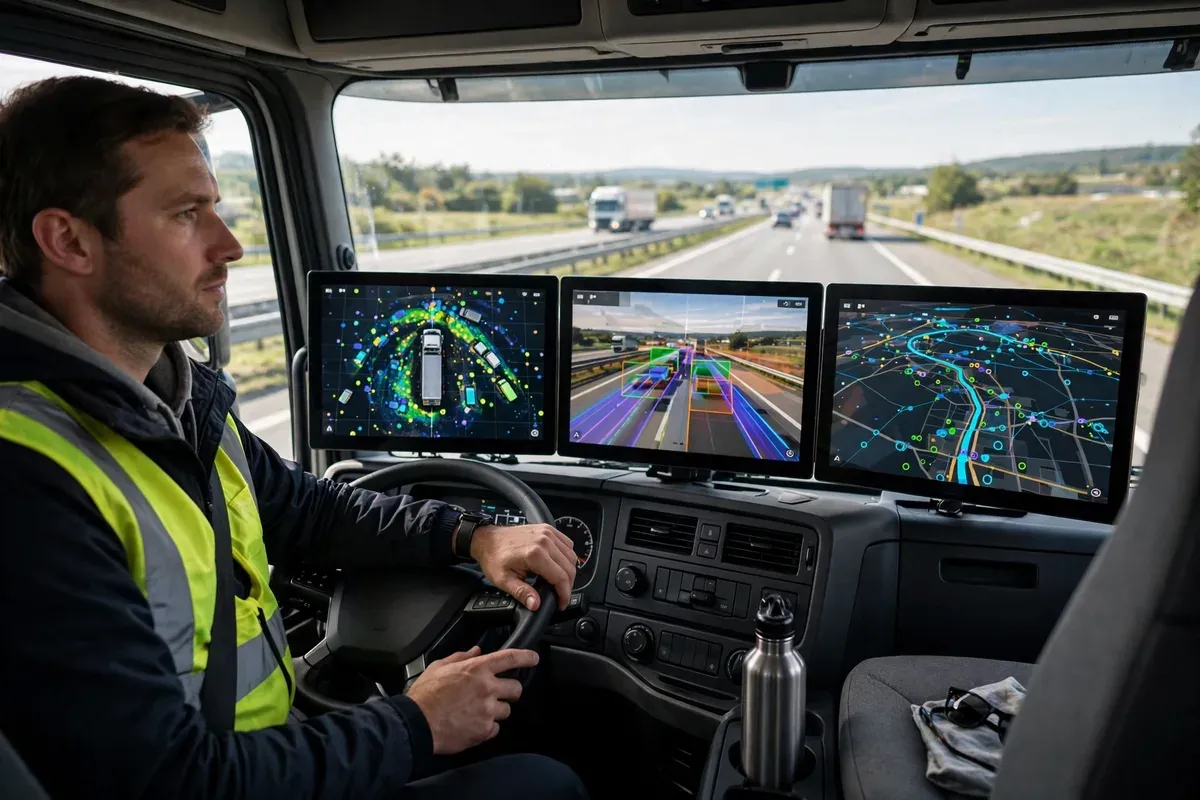
Driverless trucks are not only removing drivers from cabs — at this stage of the industry, they are hiring them. Every supervised test run in America rolls with a CDL holder in the seat, every stuck driverless truck is unstuck by a human on a screen, and the companies building these systems advertised real jobs at real pay in October 2026: $37 an hour for a Kodiak safety driver in Lancaster, Texas, $31–43 an hour for Waabi vehicle operators, $32–37 an hour for Stack AV operations specialists. This guide covers what those roles actually involve, what the ads actually require, where the jobs are — and the honest limits, because a few hundred new roles against 2,221,200 driving jobs is a career option for some drivers, not a lifeboat for the industry.
Key Points
- The new roles are real and were advertised in October 2026: Kodiak safety driver at $37/hr (Lancaster, Texas), Waabi vehicle operator at $31–43/hr, Stack AV operations specialists at $32–37/hr, Kodiak assisted-autonomy remote operators at $34/hr, and Aurora testing operators in ads at $36–46/hr.
- The entry ticket is the one you already hold: a Class A CDL, experience (3 or more years in most ads; Stack AV asked 7 or more), a clean driving record, and a current medical card.
- The work is Texas-heavy — the Dallas–Houston corridor and its terminals are where the supervised miles are — and it is mostly home-based fleet work, not over-the-road.
- The limits are real: these are hundreds of roles, not thousands, against BLS's count of 2,221,200 heavy truck driver jobs. And this industry's employers fail — TuSimple wound down its US operation in 2023/24 and Embark shut down in March 2023.
- A study reported by CCJ from NACFE work (18 August 2026) estimates 280,000–500,000 new autonomous-vehicle roles over the long term — an estimate with wide error bars, and a reason to position yourself, not to bet the farm.
The Roles, With the Pay From the Actual Ads
| Role | Company | Pay in the ad | What the ad asked |
|---|---|---|---|
| Safety driver | Kodiak (Lancaster, Texas) | $37/hr | Class A CDL, experience, clean record |
| Vehicle operator | Waabi | $31–43/hr | Class A CDL, experience, clean record |
| Operations specialist | Stack AV | $32–37/hr | Class A CDL, 7+ years of experience |
| Testing operator | Aurora | $36–46/hr (an earlier ad showed $30–40/hr) | Class A CDL, experience, clean record |
| Remote assistance operator | Kodiak (assisted autonomy) | $34/hr | CDL background, desk-based remote support work |
Two things stand out from that table. First, the pay is honest money — at or above what BLS reports as the median heavy truck driver wage of $58,640 a year (May 2025), for work that is largely home-daily out of a terminal. Second, every single role starts from the same foundation: a working driver's licence, a working driver's experience, and a clean record. The industry automating the Interstate mile has discovered it cannot test, supervise or rescue its trucks without the people it is supposed to be replacing.
What a Safety Driver Actually Does All Day
Forget the image of a passenger napping behind a robot. On a supervised run — Waabi's Dallas–Houston trucks with an observer in the seat, PlusAI's 600-mile I-35 Laredo–Temple loop running since March 2026, Kodiak's supervised operations for Roehl on Dallas–Houston from April 2026 and Charger on Dallas–Laredo from October 2026 — the safety driver is the legally and practically responsible human in a truck that drives itself until it shouldn't.
The day is terminal-based and repetitive in the way linehaul is: pre-trip inspection of a truck carrying sensor equipment that must be clean and calibrated to be legal tender, the run itself spent monitoring the system's behaviour with hands ready, interventions when the system asks or when judgement says so, and detailed reporting afterwards — what the truck did, where it hesitated, what it got wrong. Test fleets live on that feedback; it is why the role asks for experienced drivers rather than cheap ones. Between runs there is yard and terminal work: moving trucks and trailers around the operation, positioning equipment for loading and testing.
It is, in short, driving work transformed into supervision work — same CDL, same road, same corridor, with the steering traded for judgement. Drivers who hate the physical grind but know a lane cold are exactly who these ads are written for.
The Remote Operator: Driving From a Desk
The second role never touches the truck. Kodiak's assisted-autonomy operation advertised remote roles at $34 an hour in October 2026: when a driverless truck meets something it cannot resolve — a confusing construction layout, a blocked lane, an odd obstacle — it stops and asks, and a remote operator reviews the scene and guides it through. The job is judgement at a screen: understanding what a truck can and cannot do, reading a road situation from cameras, and making the conservative call.
Note what this role is not. It is not remote driving in the video-game sense, and the purest driverless run yet made deliberately had none of it: Bot Auto's fully humanless Houston–Dallas truckload of 29 April 2026 ran with nobody in the truck and no remote operator. Remote assistance is a support layer some operators build and others design out — which means these jobs exist where companies choose supervision as a feature, and a driver building a plan should treat the role as real but company-specific.
Where the Jobs Are
Texas, overwhelmingly. The supervised miles are Texas miles — Dallas–Houston above all, plus the I-35 corridor — and the ads follow the miles: Kodiak hiring in Lancaster, in the Dallas logistics belt; Aurora's Texas terminals; Waabi's Dallas–Houston operation. Arizona appears as Aurora's network extends toward Phoenix. This is a map a Texas CDL holder can use today and a driver in Maine mostly cannot — one more reason these roles are a regional opportunity, not a national programme.
The pattern is worth watching rather than chasing. Supervised operations expand corridor by corridor, and each new supervised lane is a small fleet of safety-driver jobs before it is anything else. The drivers positioned for them are the ones already in the region with the record the ads ask for.
The Honest Limits
Now the part the recruiting posts leave out. These roles number in the hundreds, across an industry with 2,221,200 driving jobs and about 214,500 openings a year (BLS, updated 27 August 2026). If every supervised truck in America hired three safety drivers tomorrow, the total would not register against a single month of ordinary driver turnover. A phased-impact analysis reported by CCJ (18 August 2026) estimates 280,000–500,000 new AV roles in the long run — but that is a study's estimate of a decades-long transition, and the same analysis has driverless freight taking segments over the same period. The new jobs are a bridge some drivers will cross, not a replacement workforce. See how small that driverless fleet still is with the Driverless Truck Counter.
The second limit is employer risk, and this industry has earned the warning. TuSimple, once the loudest name in driverless trucking, wound down its US operation in 2023/24 and pivoted to gaming AI. Embark shut down in March 2023 after being valued in the billions — $614 million in one accounting of its raise. Locomation closed in 2023, and Waymo walked away from trucking entirely. A safety-driver job at a venture-funded AV company is a good hourly wage at a firm whose survival is not guaranteed; take the pay, bank the experience, and keep your ordinary driving options warm.
How To Position Yourself
Protect the record. Every ad in the table asks for a clean driving record, and the work is judgement work — a preventable accident or a DUI does not just cost you a job, it costs you this entire category. The same medical discipline applies: these roles need a current medical card, under the same DOT physical rules as any CDL job.
Bank experience where it counts. Most ads ask 3 or more years; Stack AV asked 7 or more. Years on Interstate linehaul in the regions where testing happens — Texas above all — are the experience being bought. If you are early-career, the play is not to wait for these roles but to be three clean years deeper when the map reaches you.
Be the driver who can explain the road. The reporting half of the safety-driver job — describing precisely what happened, where, and why it mattered — is the skill that separates a monitor from an operator. Drivers who already write clear incident notes, inspection reports and broker updates are practising it.
Do not pay for positioning. No ad in this research asked for an "AV certification", an autonomy course, or any paid credential — the requirements are licence, experience, record. Anyone selling a certificate as the key to these jobs is selling something the employers do not ask for.
Common Mistakes and Watch-Outs
Reading a salary band as a promise. The figures above are from advertisements found in October 2026 — Kodiak's $37 an hour in Lancaster, Waabi's $31–43. Bands move, ads close, and an advertised role at a startup is an offer with a company's risk attached, not a market rate. Verify the current ad before you plan around it.
Quitting a driving job to wait for one. With roles in the hundreds and hiring corridor by corridor, these jobs go to drivers who are already working, local, and ready — not to applicants holding a CDL and a hope. Apply from a position of employment.
Assuming the role is permanent if the company is. A safety driver's job is designed to end: the whole point of the seat is to supervise a system until it no longer needs supervising on that lane. Kodiak's highway driverless launch was targeted for the end of 2026 — its supervised lanes are supposed to graduate. Treat the role as well-paid experience with an expiry date, and keep the skills current — your cost awareness, your record, and your ordinary driving currency, the same discipline our cost per mile guide applies to an owner's numbers.
Frequently Asked Questions
What is a safety driver for a driverless truck company?
A CDL driver who rides in a self-driving truck during supervised operations, monitors the system, takes control when needed, and reports the truck's behaviour in detail. October 2026 ads offered $37 an hour at Kodiak in Lancaster, Texas, and $31–43 an hour at Waabi — Class A CDL, experience and a clean record required.
Do I need a special licence or certificate for these jobs?
No. Every advertisement in this research asked for a standard Class A CDL, driving experience (3 or more years; 7 or more at Stack AV), a clean record and a current medical card. No employer asked for an AV certificate or paid course.
How much do remote operators for driverless trucks make?
Kodiak's assisted-autonomy remote roles were advertised at $34 an hour in October 2026. The work is desk-based: guiding a stopped driverless truck through situations it cannot resolve alone. Not all operators use remote assistance — Bot Auto's fully humanless run of 29 April 2026 had no remote operator by design.
Where are these jobs?
Mostly Texas — the Dallas–Houston corridor, Lancaster and the state's AV terminals — because that is where the supervised miles run, with Arizona growing as networks extend toward Phoenix. Hiring follows testing corridors, so the map changes as operations expand.
Are these jobs a safe long-term career?
They are well-paid and real, but two cautions apply: the roles are few (hundreds, against 2.2 million driving jobs), and the employers are startups in an industry where TuSimple wound down and Embark shut down in March 2023. A safety-driver role is also designed to end when its lane graduates to driverless. Take the pay and experience; keep your ordinary driving options open.
Bottom Line
The driverless industry is hiring drivers — safety drivers at $31–43 an hour, remote operators at $34, operations specialists at up to $37 an hour — on the strength of the licence and record you already have, mostly in Texas. The numbers are small and the employers are mortal, so treat these roles as what they are: a well-paid option for experienced drivers near the testing corridors, earned with a clean record, and no certificate required. Keep driving, keep the record spotless, and if a corridor opens near you, you will already be what the ad asks for.