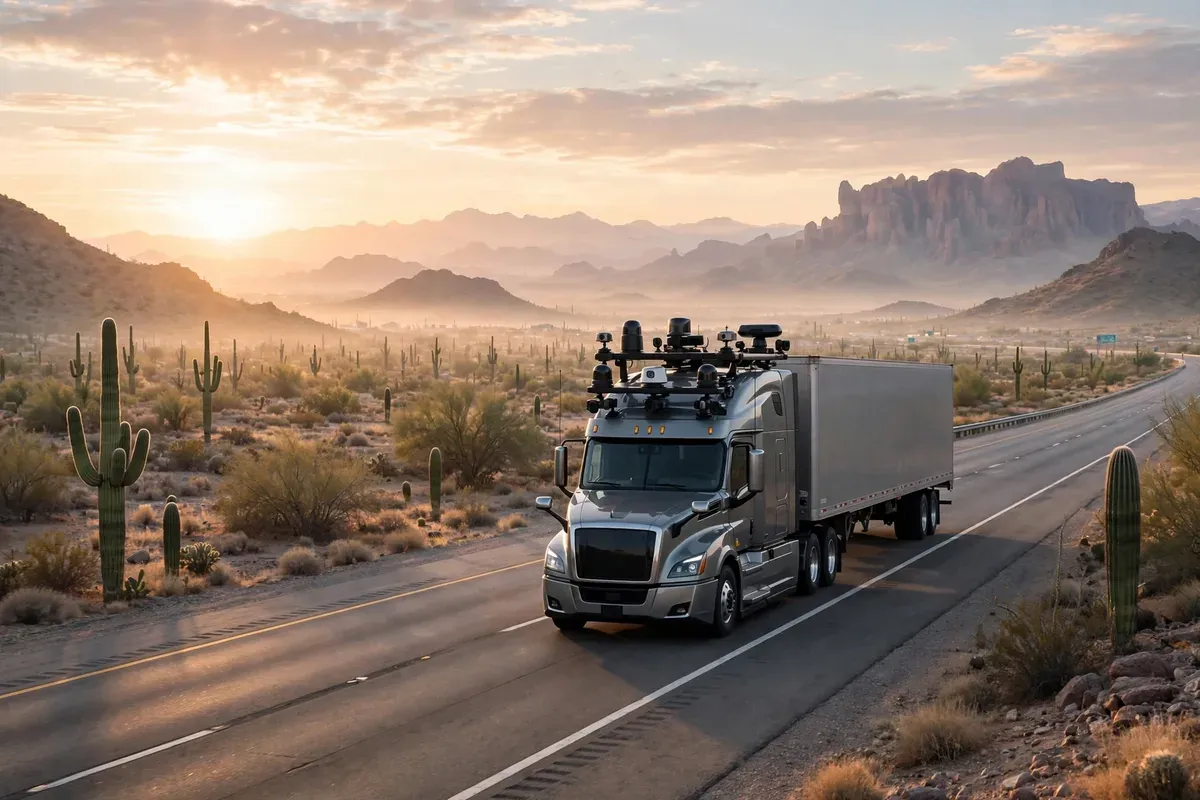
Yes — driverless trucks already run in Arizona, but the Arizona story is narrower than the national headlines suggest. The clearest Class 8 evidence is Aurora's driverless Fort Worth–Phoenix route, added in February 2026. The clearest medium-duty evidence is Gatik, which operates driverless box trucks in Arizona as part of a footprint that also covers Texas and Arkansas. If your work takes you through Phoenix or onto I-10, this is no longer a future-tense subject.
What Arizona does not yet have, at least in the independently sourced record behind this guide, is a neat public rule story to set beside the operations. Texas has a named commercial authorisation and a much larger highway footprint. Arizona has real driverless work and a deployment-friendly posture, but this guide will not invent a statute number, permit form, or state fleet count that the research does not support. The routes are the solid ground. Start there.
Key Points
- Aurora added a driverless Fort Worth–Phoenix route in February 2026, one of 10 routes in a network that had passed 500,000 driverless miles with more than 20 driverless trucks built, per Aurora's Q3 2026 shareholder letter of 28 October 2026.
- Gatik operates driverless medium-duty trucks in Arizona, Texas and Arkansas. Its companywide driverless orders reached about 85,000 by September 2026, with more than $600 million contracted; those are network figures, not Arizona counts.
- A Delaware Legislative Services report of February 2026 counts 36 states plus DC allowing AV testing or deployment in some form and at least 16 states permitting autonomous trucks. State permission takes different forms, so a route list is more useful than a yes/no map.
- No comprehensive federal driverless-truck law had been enacted by November 2026, and FMCSA's ADS-equipped commercial vehicle rulemaking had been listed but not published in checks through 10 November 2026.
- Autonomous trucks ranked number 4 among driver concerns in ATRI's Top Industry Issues 2026, while BLS still projected heavy truck driver employment to grow 4% from 2025 to 2035.
The Short Answer: Operations Are Ahead of the Public Rulebook
Arizona belongs on the short list of states where driverless trucking is an operating fact. Aurora's Fort Worth–Phoenix service puts a driverless Class 8 truck on a route ending in Phoenix. Gatik's Arizona work puts driverless medium-duty trucks into regional freight. Those are two different kinds of operation, and keeping them separate matters: a Class 8 linehaul tractor crossing the desert is not the same job, vehicle, or labour question as a box truck moving regional retail freight.
The legal picture needs a more careful sentence. The research behind this guide does not establish an Arizona statute number, an application process, or an Arizona-only permit condition for these operations. It does establish the wider landscape: state governments remain the main source of AV permission, 36 states plus DC allow some form of AV testing or deployment, and at least 16 permit autonomous trucks (Delaware Legislative Services, February 2026). Arizona's operations prove that a lawful operating path exists in practice. They do not justify filling the gaps with details copied from another state. Check whether driverless operation is legal where you run with the Driverless State Law Checker.
For a driver, that distinction is not academic. If you are asking whether a truck with an empty cab can be working around Phoenix in 2027, the answer is yes. If you are asking exactly which Arizona form the operator filed, this guide will not pretend to know. Those are different questions, and only the first one can be answered from the sourced deployment record.
Aurora's Phoenix Route: the Class 8 Landmark
Aurora is the company that makes Arizona part of the heavy-truck story. It began driverless operations between Dallas and Houston in April/May 2025, added Fort Worth–El Paso in October 2025, and reached 10 routes by February 2026, including Fort Worth–Phoenix at roughly 1,000 miles. Phoenix is therefore not a pin on a speculative expansion map. It is the western end of a route in a network that Aurora says passed 250,000 driverless miles in January 2026 and 500,000 by the third quarter.
The fleet number keeps the route in proportion. Aurora's Q3 2026 letter of 28 October 2026 put the network at more than 20 driverless trucks built, not hundreds working in Arizona. Its 200-truck target slipped to February 2027, while targets of 1,000 or more by the end of 2027 and 30,000 by 2030 remain targets. One route to Phoenix proves the technology can be operated commercially across a long Interstate corridor. It does not prove that Arizona's ordinary linehaul market has changed hands.
The launch history also explains why caution belongs in any 2027 forecast. In May 2025 Aurora's truck partner PACCAR asked for an observer back in the cab, and second-generation trucks in July 2026 resumed running without one. The Phoenix route's significance is not that progress moves in a straight line. It is that, even after that reversal, driverless operation expanded west and reached Arizona.
What Is Actually Running in Arizona
| Operation | Arizona connection | Status | What the figure really means |
|---|---|---|---|
| Aurora | Fort Worth–Phoenix route | Driverless Class 8 | Route added February 2026; company network totals were 10 routes, 500,000 driverless miles and 20+ trucks built by Q3 2026 |
| Gatik | Arizona included in its driverless operating footprint | Driverless medium-duty | Company operates in Texas, Arizona and Arkansas; about 85,000 driverless orders by September 2026 were networkwide, not Arizona-only |
| Other named Class 8 developers | No Arizona driverless route established in the research | Mostly supervised or targeted elsewhere | Do not transfer Texas launch claims into Arizona without a named route and date |
Read the table as a warning against blended statistics. Aurora's miles are company-network miles. Gatik's orders are company-network orders. Neither figure tells you how many driverless trucks will be in Phoenix on a given Tuesday. The verified Arizona facts are the route, the operating footprint, and the vehicle class — enough to establish presence, not saturation.
Gatik: Arizona's Medium-Duty Side
Gatik works a different part of freight. Its trucks are medium-duty box trucks used for regional, repeatable freight rather than Class 8 tractors pulling long-haul trailers. The company reported 60,000 driverless orders in January 2026 and about 85,000 orders with more than $600 million contracted by September 2026. It also targeted more than 100 trucks by the end of 2026. Again, those figures cover the business, including operations outside Arizona.
The Arizona point is the segment. A driverless box truck on a repeatable regional pattern reaches a different set of driving jobs from an Aurora tractor on Fort Worth–Phoenix. It points first at short, structured middle-mile and regional work — the kind of route that can be repeated, measured and gradually handed to a system designed for that operating domain. It does not tell you that every box-truck job in Arizona is exposed, and it says nothing directly about flatbed, tanker, construction, or multi-stop final delivery.
PepsiCo's announcement of 41 driverless Gatik box trucks in June 2026 shows that customers are putting real equipment behind the model. The research does not assign those 41 trucks to Arizona, so this guide does not either. Arizona's place in Gatik's footprint is established; an Arizona fleet count is not.
What Arizona Drivers Will Actually See in 2027
The most likely encounter is not a robot truck beside you at every fuel stop. It is a specific kind of truck on a specific kind of work: an Aurora tractor on the long Interstate run into Phoenix, or a Gatik box truck in regional service. The rest of Arizona freight — the loads with jobsite access, awkward docks, changing stops, freight handling, or direct customer contact — remains human work because the operating problem is larger than steering down a highway.
The labour numbers argue against both complacency and panic. BLS counted 2,221,200 heavy and tractor-trailer truck driver jobs in 2025 and projected 4% growth from 2025 to 2035, with about 214,500 openings a year (Occupational Outlook Handbook, updated 27 August 2026). ATRI's 2026 survey still put autonomous trucks fourth among driver concerns, and third among company drivers. Drivers are right to watch the corridors. The national hiring picture has not collapsed because one route reached Phoenix.
New paid roles are also appearing around the systems. October 2026 advertisements in the wider market offered $37 an hour for a Kodiak safety driver in Texas and $31–43 an hour for Waabi vehicle operators. Those were not Arizona job offers, and they should not be quoted as Arizona pay. They do show the form of the earliest AV driving work: a Class A licence, experience, a clean record, and a driver moved into supervision, testing, or operations. Your licence and record remain the asset; keep them clean under the same DOT physical rules that govern conventional driving jobs.
For an owner-operator, the sharper question is lane economics. A driverless system competes first where a route is long, repeatable and easy to standardise. If you sell capacity on work that resembles that pattern, know your real number before a broker uses technology as a negotiating story. Our cost per mile guide shows how to build the figure from your own truck instead of arguing against a headline.
The Federal Layer Still Sitting Over Arizona
State permission is only part of the picture. There is still no comprehensive federal AV statute, and FMCSA's proposed rule for ADS-equipped commercial vehicles — listed in the August 2026 Unified Agenda — had not appeared in checks through 10 November 2026. That leaves Arizona operators in the same national position as everyone else: state deployment rules today, federal commercial-vehicle rules still catching up.
One federal detail will be visible at the roadside. On 7 October 2026 FMCSA granted a five-year exemption, Federal Register doc 2026-20734, allowing Level 4 trucks to use cab-mounted beacons instead of warning triangles when stopped. It runs to 7 October 2031, excludes hazmat and passenger operations, and drew 402 public comments, with OOIDA opposed. If a stopped driverless truck in Arizona is showing beacons rather than a triangle set, that exemption is why. Treat the beacons as the warning device they are.
The federal gap is also why Arizona details should be rechecked before money changes hands. A route can expand under today's state landscape while tomorrow's federal rule changes equipment, reporting, or operating conditions. The deployment is real. The final rulebook is not.
Common Mistakes and Watch-Outs
Calling every Arizona AV truck a semi. Aurora's Phoenix route is Class 8. Gatik's Arizona operation is medium-duty. The vehicle class tells you which freight and which jobs are actually in view.
Turning network figures into Arizona figures. Aurora's 500,000 miles and Gatik's roughly 85,000 orders are companywide. Neither source gives an Arizona-only total in the research behind this guide.
Assuming a target is a fleet. Aurora had more than 20 driverless trucks built in Q3 2026 and a 200-truck target that had slipped to February 2027. Gatik targeted more than 100 trucks by the end of 2026. A target is a plan, not a count of trucks in Phoenix.
Inventing the permit process. Arizona's driverless operations are established; the specific statute and permit mechanics are not established here. Do not rely on a blog that recites another state's form as if it were Arizona law.
Treating Phoenix as the whole state. The verified Class 8 landmark is a route ending in Phoenix. That does not make every Arizona lane a driverless lane, and it does not put local, vocational, or complex delivery work on the same timetable.
Frequently Asked Questions
Are driverless trucks legal in Arizona?
Driverless trucks operate in Arizona today: Aurora runs a driverless Class 8 route to Phoenix and Gatik includes Arizona in its driverless medium-duty footprint. The research behind this guide does not establish a specific Arizona statute number or permit process, so it does not claim one. The operating record is clear; the detailed legal mechanics need an official state source before they are quoted.
Where do driverless trucks run in Arizona?
The named Class 8 route is Fort Worth–Phoenix, added by Aurora in February 2026. Gatik also operates driverless medium-duty trucks in Arizona, but the research does not publish an Arizona route-by-route list or assign its companywide order figures to the state.
How many driverless trucks are in Arizona?
No sourced Arizona-only count was established. Aurora reported more than 20 driverless trucks built across its network in Q3 2026, and Gatik reported about 85,000 driverless orders across its business by September 2026. Neither number is an Arizona fleet count.
Will driverless trucks take Arizona driving jobs in 2027?
The exposed work is narrow: repeatable Interstate linehaul into Phoenix and structured regional box-truck freight. BLS still projects national heavy-truck-driver employment to grow 4% from 2025 to 2035. Local, vocational, hazmat, flatbed and complex multi-stop work is not what the Arizona operations demonstrate.
What should an Arizona driver do now?
Know whether your regular work resembles a fixed hub-to-hub corridor, keep your CDL, medical card and record clean, and follow named route announcements rather than national hype. The next useful step is to compare your own lane and freight with the operations already running, starting with the corridor and cost guides below.
Bottom Line
Driverless trucks can and do run in Arizona. Aurora's Fort Worth–Phoenix route makes the state part of the Class 8 map, and Gatik gives it a medium-duty operation as well. But Arizona's sourced story is routes, not a giant fleet, and its detailed permit story remains thinner than Texas's. In 2027, watch Phoenix and I-10, separate companywide numbers from Arizona facts, and judge your own exposure by the kind of freight you haul — not by the loudest national headline.