Key Points:
- A second truck scales whatever truck one actually is. Prove real profit per mile after every cost, including your own pay as the driver, before you expand.
- Buy for committed freight: you should be able to name the loads per week, the lane, the rate and the customers whose profitable loads you already turn down.
- Plan cash before freight: acquisition cash, an operating float, a breakdown reserve and a payroll reserve, kept separate. A new unit may need support without new revenue for up to 120 days.
- Find the driver before the truck: qualification file, Clearinghouse query, a verified negative drug test and insurer approval all come before the first load.
- New Class 8 tractors commonly run roughly $170,000 to $225,000. Clean late-model used tractors commonly list roughly $65,000 to $130,000. The hired driver is the largest new cost line.
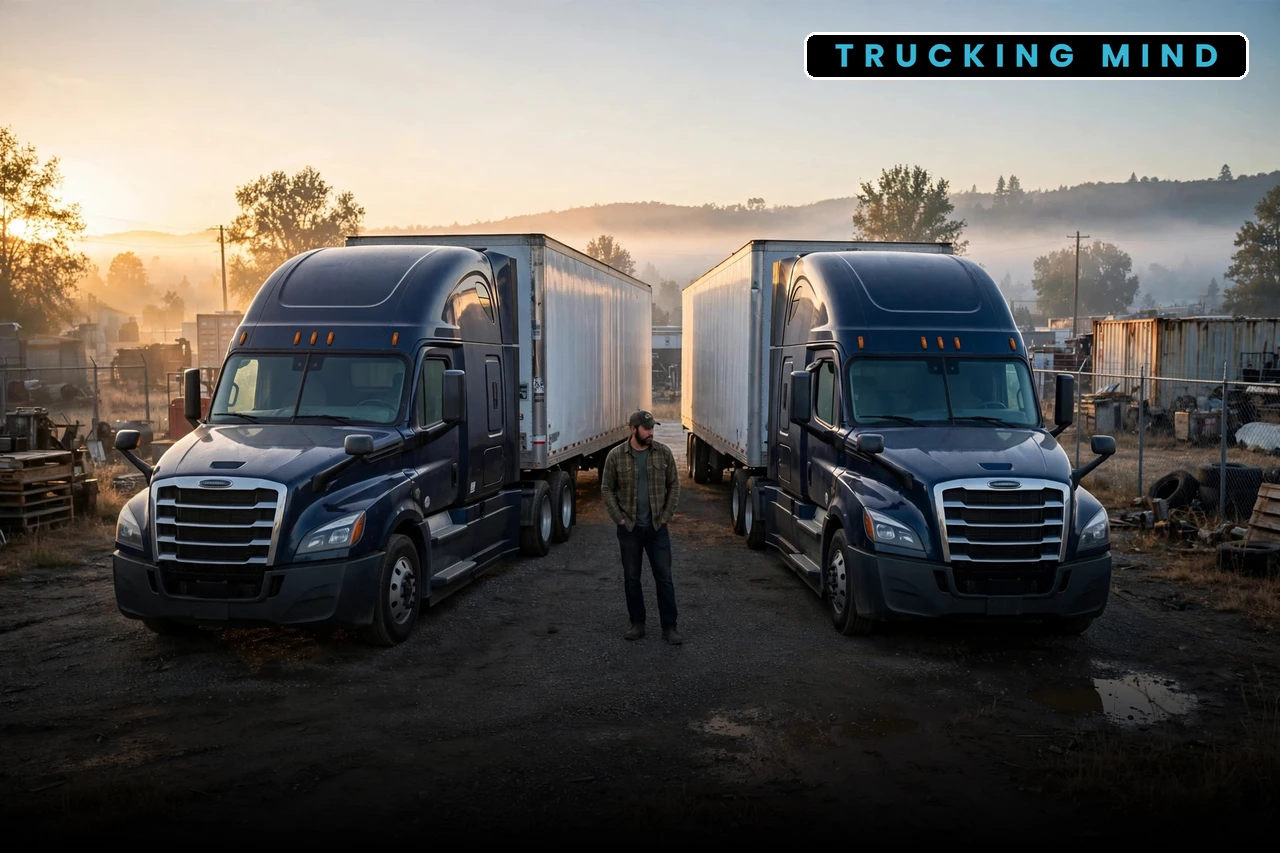
Every owner-operator reaches the same tempting moment: truck one is running well, brokers offer more freight than you can cover. A second truck looks like doubling the business. Sometimes it is. Often it doubles the costs while revenue stays uncertain — and the difference is decided before you visit a dealer lot.
A second truck changes what you do all day: instead of driving and dispatching yourself, you manage a driver, a second maintenance schedule, a second insurance unit, twice the compliance paperwork and payroll on slow-freight weeks. That can be profitable, but only if truck one has already proved three things: real profit, freight beyond one good month and time and systems to manage another unit.
This guide gives you the tests, the honest costs and the warning signs that mean wait. It assumes you already hold your own authority; if not, start with How to Start a Trucking Company in 2027: Complete Step-by-Step Guide before planning expansion.
Test One: Is Truck One Actually Profitable?
Revenue is not profit. A second truck scales whichever one you actually have. A truck grossing $8,000 a week while spending $7,700 to run it is a $300-a-week business carrying a large amount of risk — and two such trucks are a $600-a-week business with twice the exposure. Before you expand, you need a profit record, not a revenue story.
Pull at least six months of real numbers for truck one and longer if your freight is seasonal. For each month, record gross revenue, fuel, truck and trailer payments, insurance, maintenance and tires, tolls, permits, ELD and software, factoring or quick-pay fees if you use them and your own pay as the driver. Many owners skip that last line. It distorts everything: if you pay yourself nothing, the business looks more profitable than it is. There will be no money left to pay a hired driver later. Industry cost benchmarks put the average marginal cost of running a truck above $2.30 per mile in recent data, with driver wages and benefits alone above $1.00 per mile of that total — a useful reminder of how large the driver line becomes the moment you hire. Your own cost per mile, on your own lanes, is the number that matters.
Then ask the hard questions: revenue per mile on all miles, loaded and empty; deadhead percentage; profit per mile after every cost, including your own driver pay; and whether that profit is positive in ordinary months, not just peak months. Freight guides commonly advise consistent, preferably double-digit, margins before expansion. If your margin is thin or negative in normal months, a second truck will not fix it; it will copy it. Fix the lane, the rate, or the costs first.
Also check utilization honestly. A truck running four days a week for lack of freight does not justify a second truck. A truck running six days a week and turning down profitable, repeatable loads is a different story — but only if those loads would still be there for truck two, on the same lanes, at the same rates.
Test Two: Is the Freight Real, Repeatable and Priced Right?
The most common expansion mistake is buying a truck for freight that was never committed. A broker who offered you extra loads last month, a shipper who said "we'll have more soon," and a hot spot-market week are not a freight base. A second truck needs freight that survives a slow week.
Score your freight on three points. First, commitment: contracted, recurring, or reliably repeat loads — direct shipper work, dedicated lanes, or broker relationships that regularly produce freight you cannot cover — or load boards alone? Load boards keep trucks moving, but small-fleet guides warn plainly that boards alone are not enough for a second truck, because the best freight rarely reaches them and spot rates swing. Second, lane fit: can truck two run the same lanes, equipment, backhauls and home-time pattern, or a different operation you have not run? Third, rate durability: does the freight pay enough at truck two's full cost, including a hired driver's pay and benefits, to leave profit after deadhead?
Write the case as a sentence you can defend: "We turn down X loads per week on Y lane at $Z per mile, from customers A and B, recurring for N months." If you cannot fill in those blanks, you have optimism, not a freight case — and optimism does not make a truck payment. Beware customer concentration, too: if one customer would fill truck two, losing that customer leaves a payment with no freight.
Test Three: Do You Have the Cash to Survive the Bad Weeks?
A second truck needs cash before it needs freight, because its costs start immediately and its revenue does not. Experienced fleet advisors warn that a new unit's fixed and operating costs may need support without new revenue for up to 120 days while the truck is acquired, insured, staffed and worked into freight. Plan for that window even if you hope for better.
Build a cash test with four buckets: acquisition cash (down payment, taxes, title and registration, initial insurance payment, day-one maintenance and tires); operating float (fuel, payroll and tolls for several weeks before customer payments arrive, especially on net-30 terms); breakdown reserve (a major repair on either truck); and payroll reserve (paying a driver on time in a slow, breakdown, or late-payment week). If buying truck two empties every bucket, you are not ready — one repair from missing payroll or a truck payment. Keep the buckets separate in your accounts: raiding the maintenance reserve to cover payroll turns the next breakdown into a crisis.
What a Second Truck Really Costs
Prices vary by market, age and condition, so treat every figure here as a planning range to confirm with written quotes, not as a price you will pay. New Class 8 tractors commonly run roughly $170,000 to $225,000, while clean late-model used tractors commonly list roughly $65,000 to $130,000 depending on age, mileage and condition, with older high-mileage units below that range. Financing guides commonly describe down payments of 10 to 20 percent for buyers with fair or better credit, higher for weaker credit or older trucks, with terms typically 36 to 84 months and many owners choosing around 60 months. Rates vary widely with credit, time in business and the truck itself; get at least three written offers and compare total cost, not just the monthly payment. A low payment stretched over a long term on an aging truck can leave you owing money on a truck that needs an overhaul.
New Class 8 tractors commonly run roughly $170,000 to $225,000, while clean late-model used tractors commonly list roughly $65,000 to $130,000 depending on age, mileage and condition, with older high-mileage units below that range.
Do not stop at the truck. Add a trailer if you need one, insurance for the additional unit and driver, IRP and IFTA administration for the expanded fleet, an additional ELD subscription, drug-testing consortium enrollment for the new driver and any increase in your back-office costs. Then add the driver: pay per mile or salary, payroll taxes, workers' compensation, unemployment insurance and any benefits. That driver line is the largest new cost. It is the line most expansion plans underestimate.
Work the example backwards. Suppose truck two runs 2,500 miles a week. At a hired-driver rate within the typical 45 to 75 cents per loaded mile range, driver pay alone is a large weekly sum before taxes and benefits — and that is before fuel, the truck payment, insurance and maintenance. Price the truck's weekly break-even point: the revenue it must earn every week, in ordinary weeks, to cover all of its costs including the driver. If your realistic freight for truck two does not clear that break-even with room to spare, the truck is a liability, not an asset.
The Driver Question Comes Before the Truck Question
Fleet advisors repeat one piece of advice so often it should be printed on the dealer lot: find the driver before you find the truck. A truck without a driver is a payment without revenue. A driver without a truck is a hire you can still walk away from.
Hiring for truck two is the subject of How to Hire Your First Truck Driver: Pay, Paperwork and Red Flags and its warnings apply in full here: complete the driver qualification file, Clearinghouse query and verified negative pre-employment drug test before the first load; classify the driver correctly as a W-2 employee if they drive your truck under your dispatch; and confirm insurer approval before promising the job. For a second truck, add one more test: can you keep this driver busy and paid during a slow month? A good driver who sits unpaid will leave. You will repeat the hiring cycle with a truck payment still due.
Consider a trial period with a clear structure: a defined lane, a defined pay basis, written detention and layover terms and a 30-day and 90-day review. Consider, too, whether you should keep driving truck one while managing truck two, or step out of the seat to dispatch both. Many owners try to do both — drive full-time and manage a second truck at night — and discover that neither job gets done well. If you stay in the seat, who dispatches truck two when you are driving, sleeping, or out of signal? Answer that before the hire, not during the first breakdown.
Run the Numbers Before You Shop
Use this simple model for truck two, with your own figures in every line. Do not borrow another carrier's numbers.

| Line | Your figure |
|---|---|
| Realistic weekly miles, all miles | |
| Realistic revenue per all miles | |
| Gross weekly revenue | |
| Fuel | |
| Driver pay, taxes, workers' compensation | |
| Truck and trailer payment | |
| Insurance for unit and driver | |
| Maintenance and tires reserve | |
| Tolls, permits, ELD, software, factoring | |
| Weekly profit or loss |
Run it three ways: a good week, an ordinary week and a bad week with a breakdown or slow freight. If the ordinary week is thin and the bad week deeply negative with no reserve, wait. Also model a month where you must cover truck two yourself because the driver quits. If survival depends on everything going right, the plan is fragile.
A simpler test: for 90 days, track every profitable load you turn down because truck one is busy, with lane, rate and customer. If those loads, at truck two's full cost, would not have covered its costs with profit left over, demand was not enough. If they would have, you have evidence, not hope, for yourself and any lender.
Buy, Lease, or Lease On: Three Ways to Add Capacity
Buying suits owners who plan to keep the truck well beyond the loan term and build equity; its risks are the down payment, long commitment and repair exposure. Leasing lowers upfront cash and sometimes the monthly payment, suiting owners who swap equipment on a cycle — but a lease with a large end-of-term buyout can cost more than financing if you intend to keep the truck, so read the end-of-term math, not just the monthly figure.
A third option is often overlooked: lease an owner-operator onto your authority instead of buying and hiring. The operator brings their own truck and bears much of the equipment risk, while you provide freight and authority under a compliant lease. It adds capacity with less capital, but it is not free: you still owe safety oversight, settlement accuracy and honest dispatch under FMCSA truth-in-leasing rules. You are recruiting a business owner, not hiring an employee.
Whichever path you choose, inspect before you commit. For a used truck, pay for an independent inspection, pull its maintenance history where available, check for oil and coolant issues, aftertreatment problems, tire condition and prior accident or flood history and budget for the items the inspection finds. The cheapest truck on the lot frequently becomes the most expensive truck in the fleet, because its repair bills arrive in the same months as its payments.
Systems You Need Before Truck Two Rolls
One truck can run on memory, phone calls and a spreadsheet. Two trucks cannot, not without costly errors. Before truck two rolls, put these systems in place: dispatch and communication in one place where loads, times, driver hours and customer updates are visible without calling the driver; a maintenance file per truck with inspections and upcoming work; compliance tracking for qualification files, medical expirations, annual reviews, Clearinghouse queries and random testing for every driver, including you; financial tracking per truck per week, so you can see whether truck two is profitable or being carried by truck one; and invoicing that bills promptly and chases late payers, because two trucks double the receivables that can go stale.
You do not need expensive software on day one — one consistent system, used every day, beats a powerful system nobody updates. Add technology when a specific pain justifies it, such as ELD hours integrated with dispatch so you stop assigning loads a driver cannot legally run.
When to Wait: Five Honest No-Go Signs
Wait if any of these is true, however good the last month felt. First, truck one's profit is thin, inconsistent, or dependent on you taking no driver pay. Second, the freight case is one customer, one broker, or one hot month. Third, buying truck two empties your reserves or leaves no payroll and breakdown cushion. Fourth, you have no driver lined up, no insurer approval for that driver and no plan for who dispatches when you are driving. Fifth, your back office is already behind — unbilled loads, expired paperwork, maintenance overdue on truck one. A second truck multiplies a messy back office; it does not organize it.
Waiting is not standing still. While you wait, you can build the case properly: track turned-down loads for 90 days, build the cash reserve, clean up truck one's costs, develop a second freight source and line up a driver candidate. Owners who wait well often buy later, better and cheaper — with a driver, freight and reserves already in place.
A Sensible Timeline for Adding Truck Two
Months one to three: track turned-down loads, build truck one's profit record and separate reserves. Months three to four: confirm the freight case, get insurance indications and get written financing offers. Month four to five: recruit and screen the driver, complete qualification and testing and confirm insurer approval. Only then acquire and inspect the truck and start it on a lane you already know, with a driver you have tested. Starting on an unfamiliar lane with an untested driver and a new customer stacks three risks at once; stack one at a time.
Frequently Asked Questions
When is the right time to add a second truck?
When truck one shows consistent profit after paying yourself, you turn down repeatable, profitable freight you cannot cover, you have cash reserves for acquisition, payroll and breakdowns and you have a driver and a dispatch plan ready. Strong performance over a sustained period — guides commonly cite at least 18 months of stable operation as a benchmark — is a safer signal than one strong month.
How much does a second truck cost?
Beyond the truck itself — new tractors commonly around $170,000 to $225,000 and clean late-model used tractors roughly $65,000 to $130,000 — count the down payment, insurance increase, registration, ELD, compliance and the full cost of a hired driver including taxes and workers' compensation. Get written quotes for each line; published averages will not price your driver or your record. For the authority background, see MC Number vs DOT Number: What New Carriers Actually Need.
Should I buy new or used for truck two?
Used usually wins on monthly cash flow, which matters most for a second unit, provided you buy a well-inspected truck and budget honestly for maintenance. New wins on warranty, reliability and predictable early costs, but at a payment that demands consistently strong freight. Match the choice to your freight certainty, not to the truck you want to drive.
Do I need a second driver, or can I run two trucks myself?
You cannot drive two trucks at once. Truck two needs a driver — a W-2 company driver or a leased owner-operator — and you need a plan for dispatching and supporting that driver while you are driving, sleeping, or off duty. If you cannot staff and dispatch truck two properly, you are not ready for it.
What if freight slows down after I add truck two?
That is exactly what the reserves and the bad-week model are for. Cut discretionary costs, protect payroll and the truck payment, use truck one's freight to keep truck two moving where lanes fit and do not take unprofitable loads just to keep a truck moving — running at a loss burns fuel, hours and maintenance for no gain. If the slowdown is sustained and reserves run out, parking a truck early is cheaper than running it at a loss for months.
Is factoring more expensive with two trucks?
Fees scale with factored volume, so two trucks pay roughly twice the fees in absolute terms even if the percentage rate is unchanged. Price it per truck and do not let factoring hide an unprofitable lane.
Should I hire the driver before buying the truck?
Yes, in most cases. Recruit, screen, qualify and get insurer approval first, then acquire the truck. A truck payment without a driver is the most expensive idle asset in a small fleet.
The Bottom Line
Add a second truck when truck one is profitable, the freight is repeatable, the cash reserves are real and the driver is ready. Run the numbers for a good week, an ordinary week and a bad week and believe the ordinary and bad weeks more than the good one. Buy the truck last, not first: freight case, cash, driver, systems, then equipment. Done in that order, a second truck is growth. Done in reverse, it is a payment looking for a reason — and payments are very good at finding the weakest month to come due.
This guide was prepared in good faith from official sources, including FMCSA and state agency publications, and was checked at the time of writing. Fees, rules and procedures change. Errors and omissions are excepted. Please confirm current requirements with the relevant agency before filing or travelling. If you spot anything that needs correcting, email us at contact@truckingmind.com — we will verify it and update this page.