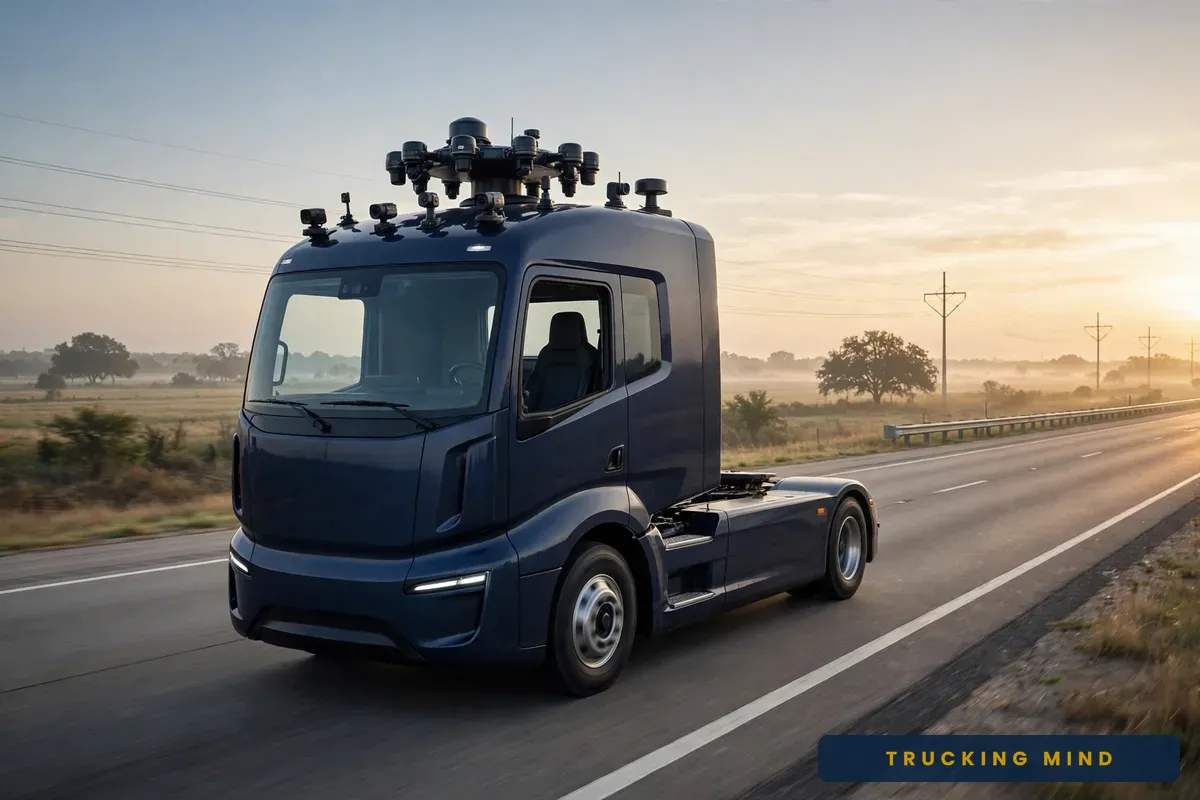
Yes. Driverless trucks are legal in Texas, and they are not a test programme any more: they are hauling commercial freight on public Texas highways today, with nobody in the cab. The state's commercial autonomous vehicle authorisation under SB 2807 has been enforceable since 28 May 2026, and the first fully driverless runs on the Dallas–Houston corridor started back in April and May 2025. If you run I-45, I-10 or I-20 in Texas, you will share the road with them in 2027. What has not happened is the takeover the headlines describe. The driverless fleet in Texas is a few dozen trucks on a handful of fixed corridors, and almost everything else you have heard — the hundreds of trucks, the coast-to-coast networks — is a target, a memorandum, or a supervised test with a driver still in the seat.
This guide separates the three things that get mixed up in every news story: what Texas law actually allows, where driverless trucks actually run today, and what changes for a working Texas driver in 2027. Every figure carries its source and date, because on this topic the gap between the announcement and the asphalt is the whole story.
Key Points
- Driverless trucks are authorised in Texas under SB 2807, enforceable since 28 May 2026. Texas is one of at least 16 states that permit autonomous trucks; 36 states plus DC allow AV testing or deployment in some form (Delaware Legislative Services report, February 2026).
- Aurora has run fully driverless freight on the Dallas–Houston I-45 corridor since April/May 2025, added Fort Worth–El Paso in October 2025 and Fort Worth–Phoenix in February 2026 — 10 routes, 500,000 driverless miles and more than 20 driverless trucks built, per its Q3 2026 shareholder letter of 28 October 2026.
- Kodiak's 37 driverless trucks (as of 30 September 2026) work off-highway in the Permian Basin oilfields for Atlas — industrial work, not public-highway freight. Its highway driverless launch on Dallas–Houston was targeted for end-2026 and had not launched.
- There is still no comprehensive federal law for driverless trucks. FMCSA's one concrete action of 2026 is the beacon exemption of 7 October 2026 (Federal Register doc 2026-20734): Level 4 trucks may use cab-mounted beacons instead of warning triangles when stopped, through 7 October 2031, hazmat excluded.
- Drivers rank autonomous trucks the number 4 concern in ATRI's Top Industry Issues 2026 survey (released 18–19 October 2026, about 3,100 respondents) — number 3 among company drivers — while BLS still projects heavy truck driver jobs to grow 4% from 2025 to 2035.
The Law: What SB 2807 Actually Did
Texas did not drift into driverless trucking by accident. SB 2807, passed in 2025, is the state's authorisation for commercial autonomous vehicles, and it became enforceable on 28 May 2026. In plain terms: an authorised driverless truck may run commercially on Texas roads with no driver in the cab.
Texas is not alone, but it is ahead. A Delaware Legislative Services report of February 2026 counts 36 states plus DC allowing autonomous vehicle testing or deployment in some form, with at least 16 states permitting autonomous trucks. What no state has behind it is a federal framework. There is no comprehensive federal AV statute; Congress has bills pending, including the SELF DRIVE Act, but none has been enacted. FMCSA listed a rulemaking for ADS-equipped commercial vehicles in the August 2026 Unified Agenda, but no proposed rule had been published in checks through 10 November 2026. For now, driverless trucking in 2027 is governed state by state. Check whether driverless operation is legal where you run with the Driverless State Law Checker.
Where Driverless Trucks Actually Run in Texas Today
Forget the network maps in the press releases. The verified Texas picture, from company filings and deployment records through November 2026, is a short list of fixed corridors — almost all hub-to-hub Interstate runs between transfer points.
| Route | Company | Status | Since |
|---|---|---|---|
| Dallas–Houston (I-45) | Aurora | Driverless | April/May 2025; night runs from July 2025 |
| Fort Worth–El Paso (I-20/I-10) | Aurora | Driverless | October 2025 |
| Fort Worth–Phoenix (I-10) | Aurora | Driverless | February 2026 |
| Houston–Dallas (I-45) | Bot Auto | Driverless — first fully humanless commercial truckload | 29 April 2026 |
| Texas routes | Gatik | Driverless, medium-duty box trucks | Operating in Texas (also Arizona and Arkansas) |
| Dallas–Houston (I-45) | Kodiak, with IKEA | Targeted driverless — not launched | End-2026 target |
| Dallas–Houston (I-45) | Waabi | Supervised — observer in the seat | 2026 (Warrior, October 2026) |
| Laredo–Temple (I-35) | PlusAI, with International and Ryder | Supervised only — no driverless road miles | March 2026 |
| Permian Basin oilfields (off-highway) | Kodiak, with Atlas | Driverless, industrial — not public-highway freight | December 2024 |
Three patterns in that table matter more than any single row. First, everything driverless on a public highway is a fixed Interstate corridor between hubs — the truck drives the easy middle of the trip, and humans still handle the ends. Second, I-45 between Dallas and Houston is the centre of the industry: Aurora launched there, Bot Auto made its first humanless run there, and Kodiak and Waabi test there. Third, half the names you hear are still supervised — a truck with a trained observer in the seat is a test vehicle, whatever the press release calls it.
The Permian Exception: Driverless, but Not on Your Highway
Kodiak's operation deserves its own section because it is the most misreported fact in Texas driverless trucking. Kodiak has run driverless trucks in the Permian Basin since December 2024, working for Atlas in oilfield operations, and the fleet reached 37 trucks by 30 September 2026. That is a real driverless fleet, the largest single one in the state. It is also off-highway industrial work: short, fixed routes in the oilfield, not freight moving on public Interstates alongside your truck.
On the highway, Kodiak's position is different. Its driverless Dallas–Houston operation with IKEA was targeted for the end of 2026 and had not launched in the record through November 2026. What Kodiak runs on Texas highways today is supervised work: Roehl's Dallas–Houston operation from April 2026 and Charger's Dallas–Laredo runs from October 2026 both carry a safety driver. Kodiak also signed the segment's most serious fleet deal in late October 2026 — a binding 75-truck agreement with DTL, reported by FreightWaves on 28–29 October 2026. So when someone quotes you a driverless truck count for Texas, ask one question: on the highway, or in the oilfield?
Who Runs Them — and Who Is Still Testing
Aurora is the only company running driverless Class 8 freight on Texas highways at any scale. It launched driverless on Dallas–Houston in April/May 2025, passed 250,000 driverless miles in January 2026 and 500,000 by its Q3 2026 letter of 28 October 2026, with 10 routes and more than 20 driverless trucks built. The same letter carries the honest detail: Aurora's 200-truck target has slipped to February 2027, and its targets of 1,000 or more trucks by the end of 2027 and 30,000 by 2030 are targets, not trucks. Aurora also carries the segment's cautionary tale: in May 2025 its truck partner PACCAR asked for an observer back in the cab, and only the second-generation trucks of July 2026 resumed running without one. Driverless, in this industry, has already gone backwards once.
Bot Auto is the small Houston company that took the purest step: on 29 April 2026 it ran a commercial truckload from Houston to Dallas with nobody in the truck and no remote operator — the first fully humanless run of its kind. Gatik runs driverless medium-duty box trucks in Texas, Arizona and Arkansas — regional retail and grocery freight, a different segment from Class 8 long-haul; PepsiCo announced 41 driverless Gatik box trucks in June 2026.
Behind them, Waabi (driverless targeted for 2027 with Volvo), Torc (driver-out targeted for end-2026, first freight in 2027) and PlusAI (supervised only, no public-road driverless miles yet) are all still developing.
What Changes for a Texas Driver in 2027
Start with what does not change. A driverless truck on I-45 does not take your load unless your work is exactly what it does: repetitive, hub-to-hub, dry freight between transfer points on the Interstate. The work the technology cannot touch yet is everything with a human problem in it: flatbed and oversize, hazmat, local and multi-stop, jobsite deliveries, and any load where the driver is also the lumper, the inspector, and the customer relationship.
The economics underneath explain the targeting. Aurora's September 2026 investor material claims about $0.85 or more per mile for its driver system against about $1.03 per mile for driver wages and benefits in ATRI's figures — a company claim, made to investors. The honest version lives in your own numbers: work out your cost per mile the way our cost per mile guide does, and you will see which of your lanes a driverless truck could price against.
Two practical changes are real. First, you will meet these trucks: no driver to wave to, and a truck that drives exactly by its programming — predictable, and occasionally cautious in ways that frustrate the traffic behind it. Second, the industry is already creating driving jobs around the trucks. October 2026 job ads offered $37 an hour for a Kodiak safety driver in Lancaster, Texas, and $31–43 an hour for Waabi vehicle operators, all on a Class A CDL with a clean record. The CDL is not being deleted from these operations; it is being moved to a different seat — and your medical card still matters for those roles, as the DOT physical rules set out.
Stopped Trucks, Beacons and Tickets: the Enforcement Picture
The most concrete 2026 development for a working driver is not a launch — it is a roadside detail. A stopped truck must warn traffic, and a driverless truck has no driver to walk triangles down the shoulder. On 7 October 2026 FMCSA granted a five-year exemption (Federal Register doc 2026-20734, running to 7 October 2031) allowing Level 4 driverless trucks to use cab-mounted beacons instead of warning triangles when stopped. The exemption excludes hazmat and passenger carriers, and it was contested: the docket drew 402 public comments, with OOIDA opposing. From 2027 on, beacons on the cab of a stopped driverless truck are its warning devices — treat them exactly as you would a triangle set.
Beyond that, enforcement around driverless trucks is still being written. FMCSA's ADS-equipped commercial vehicle rulemaking was listed in the August 2026 Unified Agenda but no proposed rule had appeared by November 2026, and the questions drivers ask most — who gets the ticket when there is no driver, how an inspection works on an empty cab — sit today with the state authorisation framework and the operating company behind the truck, not with a single federal rulebook. What is settled is your side of it: nothing in the Texas authorisation adds a duty, a document, or an endorsement to the human driver's job.
Common Mistakes and Watch-Outs
Believing every "driverless" headline. Supervised is not driverless. Waabi's Dallas–Houston trucks and PlusAI's I-35 loop run with a trained observer in the seat, and PlusAI has no public-road driverless miles at all. If a story does not say the cab was empty, assume it was not.
Counting memorandums as trucks. The loudest numbers of 2026 — Hirschbach's 500 trucks and Charger's 500 — are non-binding memorandums of understanding. Kodiak's 75-truck DTL deal is binding. Only a binding order puts trucks on I-45.
Reading targets as fleets. Aurora has more than 20 driverless trucks built and 500,000 driverless miles — and a 200-truck target that slipped to February 2027, a 1,000-truck target for the end of 2027, and a 30,000 figure for 2030. Targets in this industry are fundraising documents. The fleet is the number with a date and a filing behind it.
Assuming your freight is next. The driverless map of Texas is a few Interstate corridors between hubs. If your work involves a dock, a jobsite, a crane, or a placard, you are in a different line entirely — and the technology's own launch order proves it.
Paying for "driverless-proof" career advice. ATRI's 2026 survey puts autonomous trucks at number 4 on drivers' worry list, and fear sells courses. The sourced facts — a few dozen driverless trucks against 2,221,200 heavy truck driver jobs in BLS's count — justify watching your lane and your costs, not panic spending.
Frequently Asked Questions
Are driverless trucks legal in Texas?
Yes. Texas authorises commercial autonomous vehicles under SB 2807, enforceable since 28 May 2026. A properly authorised driverless truck may run commercially on Texas public roads with nobody in the cab, and Aurora, Bot Auto and Gatik all operate driverless in the state.
Where do driverless trucks run in Texas?
On fixed Interstate corridors, above all I-45 between Dallas and Houston, where Aurora launched driverless service in April/May 2025 and Bot Auto ran its first fully humanless truckload on 29 April 2026. Aurora also runs Fort Worth–El Paso and Fort Worth–Phoenix driverless. Kodiak's 37 work off-highway in the Permian Basin.
Will driverless trucks take Texas trucking jobs in 2027?
Not at a scale the numbers support. The verified Texas driverless presence is a few dozen trucks on hub-to-hub corridors, against 2,221,200 heavy truck driver jobs nationally in BLS's 2025 count — a count BLS projects to grow 4% by 2035, with about 214,500 openings a year. Hub-to-hub linehaul is exposed first; local, flatbed, hazmat and multi-stop work is not on the driverless map.
What do the beacons on a stopped driverless truck mean?
They are its warning devices. Under FMCSA's exemption of 7 October 2026 (Federal Register doc 2026-20734), Level 4 driverless trucks may use cab-mounted beacons instead of warning triangles when stopped, through 7 October 2031; hazmat and passenger carriers are excluded.
Do I need anything extra on my CDL because of driverless trucks?
No. The Texas authorisation adds no endorsement, document or duty for human drivers. The new roles the industry is hiring for — safety drivers and vehicle operators at $31–43 an hour in October 2026 job ads — require a standard Class A CDL with experience and a clean record.
Bottom Line
Driverless trucks are legal in Texas under SB 2807, enforceable since 28 May 2026, and they are real: Aurora runs them on I-45 and beyond, Bot Auto has run a fully humanless truckload, and Kodiak's 37 work the Permian oilfields. They are also few — a few dozen trucks on fixed corridors, inside an industry of 2.2 million driving jobs that BLS still projects to grow. For a Texas driver, 2027 is not the year the work disappears; it is the year to know which of your lanes look like a Dallas–Houston linehaul and which do not. Watch the corridor announcements, read targets as targets, and keep your own house — authority, medical card, cost per mile — in order.
Related Guides
- MC Number vs DOT Number: What's the Difference?
- DOT Physical in 2027: Cost, Requirements, and What Actually Disqualifies You
- How to Calculate Cost Per Mile
- MCS-150 Biennial Update in the Motus Era
- How Many Driverless Trucks Are Really on the Road in 2027?
- The New CDL Jobs Driverless Trucks Are Creating: Safety Driver and Remote Operator Roles in 2027