
Key Points:
- Intrastate common carriers hauling general commodities for hire in Washington must hold a UTC permit before hauling; household-goods carriers and freight brokers use different applications.
- File completely: complete UTC applications usually take about one day to process, incomplete ones an average of nine days; the fee is $275 for a new permit and $100 for an extension of existing authority.
- Insurance must be filed on Form E with the UTC as certificate holder: $300,000 combined single limit under 10,000 pounds, $750,000 at 10,000 pounds or more, and $1,000,000 or $5,000,000 for hazardous materials.
- Washington requires a USDOT number for common carriers at 16,001 pounds GVW or more, and for hazardous materials at any weight; all other UTC-regulated carriers need one regardless of weight.
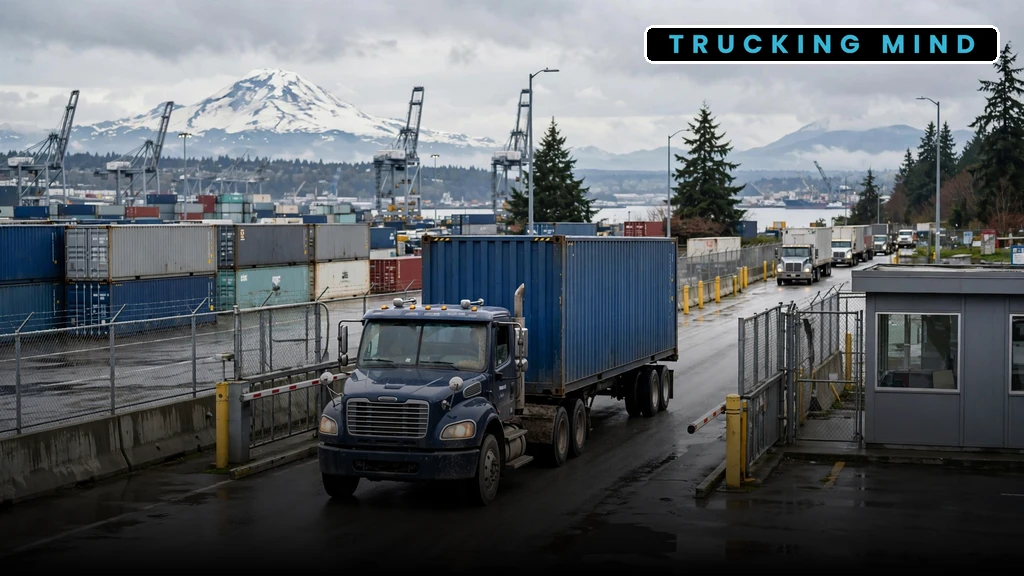
- Port drayage is a second credential stack: terminal registration, a TWIC for unescorted access, one registered RFID tag per truck, and a 2007-or-newer engine under the NWSA Clean Truck Program.
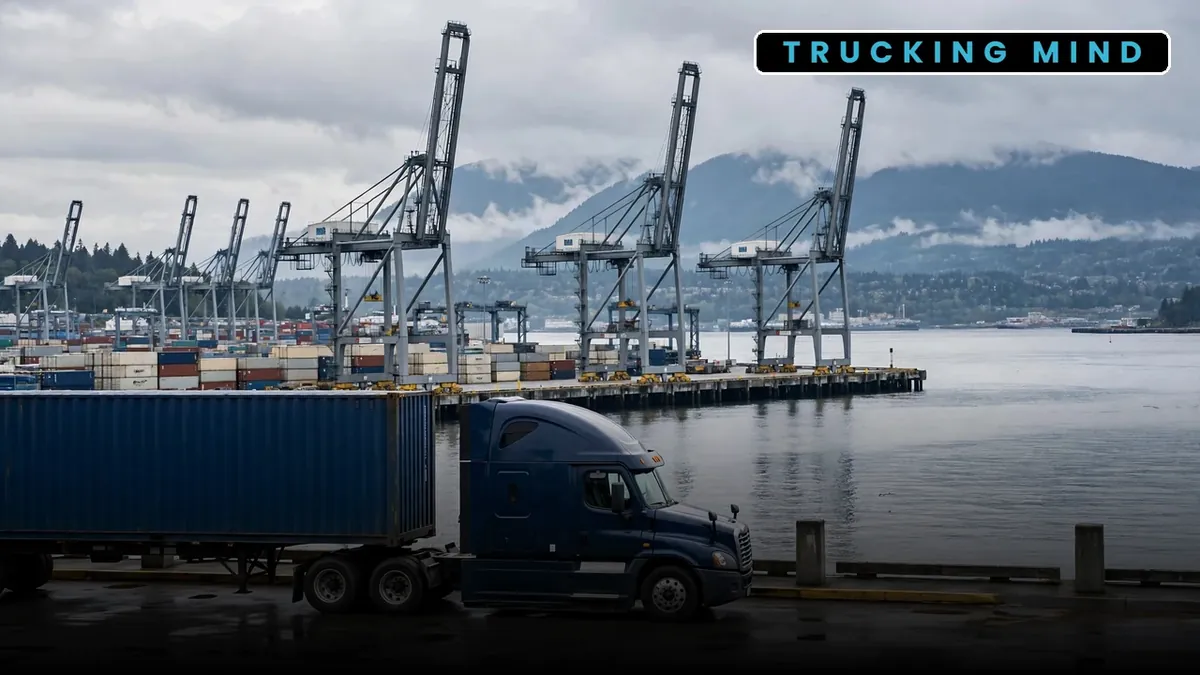
Washington offers a new owner-operator two businesses in one state: a statewide intrastate freight market anchored by Seattle, Tacoma, Spokane, and the agricultural east, and one of America's great port gateways, where containers arriving from across the Pacific become drayage loads bound for warehouses across the Northwest. Both businesses are worth pursuing, but they run on different credentials. The statewide business runs on a Washington Utilities and Transportation Commission (UTC) permit. The port business runs on that permit plus terminal access, a federal security credential, and a clean-truck standard that decides whether your truck is even allowed through the gate. This guide covers both, in the order you need them.
Start with the state permit, because no port credential substitutes for it. Intrastate common carriers hauling general commodities for hire in Washington must apply for and receive a UTC permit before hauling. Household-goods carriers and freight brokers use different applications, so classification matters from the first form. The UTC's own guidance is encouraging for planners: complete applications usually take about one day to process, while incomplete applications take an average of nine days. That gap is the whole story of Washington permitting — file completely, with insurance in the right form, and the state moves fast; file incompletely, and the delay is measured in days you could have been hauling.
Then comes the port layer, and it is where Washington diverges most sharply from an inland state guide. The Ports of Seattle and Tacoma operate together as the Northwest Seaport Alliance (NWSA), with a North Harbor in Seattle and a South Harbor in Tacoma, each with its own terminals, gate patterns, and appointment behaviour. A container discharging in Seattle is a different pickup from a container discharging in Tacoma, roughly 30 miles south, and a carrier strong in only one harbor leaves money — and importer goodwill — on the table in the other. Add the Transportation Worker Identification Credential (TWIC), terminal registration, and the NWSA Clean Truck Program's engine standard, and port drayage becomes a credential stack to build deliberately, not a load type to drift into.
Intrastate vs. Interstate: The Distinction That Decides Which Authority You Need
Intrastate commerce in Washington means pickup and delivery both inside Washington, with no crossing into Oregon, Idaho, or any other state and no part in a longer interstate movement. A Seattle warehouse to Spokane delivery is intrastate. A Seattle pickup delivered to Portland, Oregon, is interstate. A Tacoma port pickup delivered to a Seattle-area warehouse is intrastate in the movement sense — both points are in Washington — but it is still port drayage in the operational sense, with terminal rules layered on top of state rules. Keep those two questions separate: where does the freight move, and where does it touch a terminal? Each question adds its own credentials.
Federal interstate authority comes from FMCSA. Washington intrastate authority comes from the UTC. A carrier with federal authority but no UTC permit may not haul for hire intrastate in Washington as a common carrier, and a carrier with a UTC permit but no federal authority may not cross into Oregon or Idaho for hire. Port work adds a third layer that is neither federal authority nor state authority: terminal access and security credentials controlled by the port and the terminal operator. A new carrier should budget time and money for all three layers before promising a port customer a start date.
If you are still working through the federal side of the business, start with How to Start a Trucking Company and MC Number vs. DOT Number. Those guides explain the USDOT number, the MC number, and the federal filings in plain language. This guide then adds the state layer on top of that foundation, so you do not mistake a federal approval for a state approval, or the other way around. That mistake is one of the most common — and most expensive — errors new carriers make, because it usually surfaces at a roadside inspection or during an insurance filing review, long after the load has already been accepted.
Who Needs Intrastate Authority in This State
Any person who conducts operations as a common carrier in Washington intrastate commerce must have a permit from the commission. The UTC defines a common carrier as a company or person that moves property — not household goods as in an individual's personal belongings — for pay in Washington State. That definition covers the general-freight owner-operator who is the core reader of this guide. Household-goods carriers, who move an individual's personal belongings for pay on public roads in Washington, apply under a separate household-goods permit process with its own attachments, including a statement of support. Freight brokers, who arrange transportation without taking possession of the freight, also use a different application. File under the right category; a common-carrier permit does not cover household-goods work, and vice versa.
Step by Step: How to Get Your State Authority
File through the UTC's electronic system where possible. Complete applications are typically processed in about a day; incomplete applications average nine days, so completeness is speed.
- Confirm your category. Decide whether you are a common carrier of general commodities (excluding household goods), a household-goods carrier, a contract carrier, or another UTC category. Household-goods and broker applicants must use their own forms, not the common-carrier form. If you haul hazardous materials, flag that now, because it changes insurance levels and adds a supplemental safety survey.
- Get a USDOT number where Washington requires one. Washington requires a USDOT number for common carriers operating vehicles of 16,001 pounds gross vehicle weight or more, or hauling hazardous materials at any weight. All other motor carriers regulated by the UTC — including household-goods carriers, solid-waste carriers, and bus categories — require a USDOT number regardless of weight. Even if the FMCSA website suggests you do not need a USDOT number, Washington law requires one for intrastate operations as described here. For USDOT questions, the UTC directs carriers to the Washington State Patrol.
- Complete the UTC permit application. Download or complete the common-carrier application online, fill it out completely, save it, and file it electronically; if you cannot e-file, email the form to the UTC transportation address. Pay the fee online through the UTC's payment page. The application fee is $275 for a new permit and $100 for an extension of existing authority, as shown on the UTC application form; reinstatement is handled through a separate UTC process, so confirm that fee with the UTC before paying.
- File insurance in the correct form. A permit will not be issued until acceptable insurance is received. Your insurance company must file proof on Form E (or a temporary certificate or binder, good for only 60 days, replaced by Form E within that period), with the UTC listed as certificate holder and the name matching your company's legal name exactly. See the insurance section below for the dollar levels, which depend on vehicle weight and hazardous-materials status.
- Complete hazardous-materials steps if they apply. Hazardous-materials applicants complete the supplemental Hazardous Materials Safety Fitness Survey and meet the higher insurance levels. Do not add hazardous freight to a general-commodities permit informally; the permit, the insurance, and the survey must align before the first hazardous load.
- Register for port access separately if you will haul drayage. UTC authority alone does not grant terminal entry. Register with the terminal system, obtain any port-issued access credential, secure a TWIC for drivers who need unescorted terminal access, and confirm your truck meets the NWSA Clean Truck Program standard. Details are in the port section below; start this process weeks before your first planned port pull, because security enrolment is measured in weeks, not days.
Once the permit issues, keep the permit document, the insurance filing confirmation, and the payment receipt together, and note the permit number wherever dispatch records live. If you later change your legal name, trade name, or corporate structure, the UTC has separate processes to update, transfer, or reinstate a permit — use them promptly rather than operating under a stale name while the correction waits.
Insurance: What Must Be on File Before Authority Is Issued
Washington UTC insurance is specific, and the specificity is a gift: a carrier who reads the table knows exactly what to buy. For common carriers hauling general commodities, the minimum combined single limit is $300,000 for vehicles under 10,000 pounds gross vehicle weight rating hauling nonhazardous property, and $750,000 for vehicles of 10,000 pounds or more hauling nonhazardous property. Household-goods carriers add cargo insurance: $10,000 for vehicles under 10,000 pounds and $20,000 for vehicles over 10,000 pounds, on Form H, alongside liability coverage. Those figures come from UTC insurance guidance and the common-carrier application itself, and they are state minimums — brokers, shippers, and port customers routinely require $1,000,000 in combined single limit liability regardless of what the state minimum allows, so buy to the market you intend to serve, not only to the state floor.
Hazardous materials raise the floor sharply. For common carriers hauling oil and certain hazardous wastes and materials, the minimum is $1,000,000 combined single limit; for bulk hazardous substances, explosives, poison gas, compressed gas, and highway-route-controlled radioactive materials, the minimum is $5,000,000 combined single limit. Proof must be on Form E, or on a temporary certificate or binder good for only 60 days, after which Form E must replace it or the permit will be cancelled. Electronic insurance filings carry no fee to file, and approved insurers send filings by email to the UTC insurance address, with staff review within two business days. Ask your insurer to confirm the filing in writing and to list the UTC as certificate holder, because a certificate naming anyone else does not satisfy the requirement even if the coverage amount is correct.
Vehicle Registration, Plates, and Markings
Vehicle licensing, titles, and registrations in Washington run through the Department of Licensing, while prorate, IRP reciprocity, IFTA, fuel bonds, and fuel permits also sit with the Department of Licensing's prorate and fuel-tax functions. Oversize and overweight permits and log-tolerance questions run through the Washington State Department of Transportation (WSDOT), and commercial vehicle size and weight, driver and equipment safety, hazardous-materials regulations, ports of entry, and scales run through the Washington State Patrol. Keep that map of agencies in your contacts: a carrier who asks the UTC about a title, or WSDOT about a permit, loses days that a carrier who calls the right office never loses.
The Federal Companions: USDOT, MC, UCR, IRP, and IFTA
The federal companions for a Washington carrier are the familiar set: USDOT number, MC number for for-hire interstate authority where required, BOC-3 process-agent filing, UCR annual registration with fees based on fleet size, IRP apportioned registration, and IFTA quarterly fuel-tax reporting. Washington's Department of Licensing handles IRP and IFTA functions for Washington-based carriers, so a carrier expanding from intrastate to interstate work should contact that office early, before the first interstate dispatch, to set up prorate and fuel-tax accounts. A single interstate load without IRP and IFTA in order can create a registration and tax problem that costs more than the load paid.
Seattle and Tacoma Port Drayage: TWIC, Terminal Access, and the Clean Truck Program
The Northwest Seaport Alliance is the marine cargo operating partnership of the Ports of Seattle and Tacoma. Its North Harbor terminals in Seattle include Terminal 18, the largest container terminal in the Seattle harbor, along with the modernised Terminal 5 and Terminals 30 and 46. Its South Harbor terminals in Tacoma include Husky Terminal, Washington United Terminals, Pierce County Terminal, and West Sitcum Terminal. Each harbor publishes its own truck guide, with its own gate schedules, appointment behaviour, chassis start and stop locations, and gate hours. A drayage carrier needs vetted capacity and appointment discipline in both harbors, because the harbors do not share a single gate pattern and an importer with volume in both will not accept a carrier who serves only one well.
Terminal access starts with people and trucks, not with freight. Drivers who need unescorted access to secure marine terminal areas need a Transportation Worker Identification Credential (TWIC), issued through the federal enrolment process involving an application and identity checks, with a wait measured in weeks rather than days. Budget that lead time before promising a port start date, and remember that TWIC alone does not grant a gate appointment: the carrier must also be registered with the terminal's system, and the truck must carry the terminal's required identification. The NWSA Clean Truck Program now uses RFID tags for terminal entry — purchased and registered through eModal at $103 per tag plus additional fees — and a truck carrying more than one tag can be given a red light and turned away at the gate, while Clean Truck Program stickers are no longer required for entry.
Costs, Renewals, and Keeping Authority in Good Standing
The Clean Truck Program's engine standard is the credential that most directly decides whether a truck can work the ports. Starting in 2019, the NWSA required that all trucks serving its international container terminals have a 2007 or newer engine, and that requirement has since been extended to domestic container terminals as well, as part of the Northwest Ports Clean Air Strategy adopted by the Ports of Tacoma, Seattle, and Vancouver, B.C. The alliance states that it has committed to maintaining the current 2007-engine-or-equivalent standard to create stability for the independent business owners who serve the gateway. For a new owner-operator, the message is blunt: buying an older, cheaper truck to start drayage can mean buying a truck the terminals will not admit. Price the truck to the gate standard, not just to the purchase budget, and confirm the engine model year and emission controls in writing before you buy for port work.
A Practical First-Load Checklist
Before your first Washington load — and before your first port pull — confirm each item below.
- UTC permit granted for the correct category (common carrier, household goods, or contract), with the permit document saved.
- USDOT number on file as Washington requires for your category and vehicle weight, including for hazardous materials at any weight.
- Form E insurance filed with the UTC as certificate holder, at the correct minimum for your vehicle weight and cargo, with any binder replaced by Form E within 60 days.
- Vehicle registration, IRP, and IFTA set up through the Department of Licensing if you run interstate; oversize permits through WSDOT where needed.
- For port work: carrier registered with the terminal system, driver TWIC in hand, RFID tag correctly registered (one tag per truck), and truck meeting the 2007-or-newer engine Clean Truck standard.
- Harbor-specific plan for the terminal involved — Seattle North Harbor or Tacoma South Harbor — including gate hours, appointment, and chassis location.
- Workers' compensation coverage through Washington industrial insurance or approved self-insurance before any employee driver starts.
Frequently Asked Questions
Do I need a UTC permit for intrastate trucking in Washington?
Yes, if you operate as a common carrier moving property for pay inside Washington. Intrastate common carriers hauling general commodities (excluding household goods) must apply for and receive a UTC permit before hauling for hire. Household-goods carriers and freight brokers use different applications.
How much is the Washington UTC common-carrier permit?
The UTC application fee is $275 for a new common-carrier permit and $100 for an extension of existing authority. Electronic insurance filings themselves carry no fee to file. Confirm the current reinstatement fee with the UTC before paying, as reinstatement is handled separately.
How long does a Washington UTC permit take?
Complete applications usually take about one day to process, while incomplete applications take an average of nine days. Filing completely, with insurance in the correct Form E form, is the fastest way to get permitted.
What do I need to haul containers from Seattle or Tacoma?
In addition to UTC authority and insurance, you need carrier registration with the terminal system, a TWIC for any driver needing unescorted terminal access, a correctly registered RFID tag, and a truck meeting the NWSA Clean Truck Program standard of a 2007 or newer engine or equivalent. TWIC enrolment takes weeks, so start early.
Final Word: Build the Paperwork Once, Then Protect It
Washington rewards carriers who build credentials in layers: UTC permit first, insurance in the exact form the UTC requires, federal companions for any interstate work, and then the port stack of terminal registration, TWIC, RFID, and a clean-truck-compliant tractor. Each layer is controlled by a different body and each can block the next, so the planning order matters as much as the paperwork itself. Respect that order and you can move from a statewide intrastate start to a two-harbor drayage business without being turned away at a gate for a credential that should have been secured weeks earlier.
This guide was prepared in good faith from official sources, including FMCSA and state agency publications, and was checked at the time of writing. Fees, rules and procedures change, and errors and omissions are excepted. Please confirm current requirements with the relevant agency before filing or travelling. If you spot anything that needs correcting, email us at contact@truckingmind.com — we will verify it and update this page.
