
Key Points:
- Utah centralizes trucking in one agency: the UDOT Motor Carrier Division handles permits, registration credentials and size and weight enforcement.
- Every commercial motor vehicle operator needs a USDOT number, including carriers operating solely intrastate. Utah does not issue a separate state-only DOT number.
- Intrastate vehicles register for their true combined gross weight through the TC-853 series. Under-registering is a violation that surfaces at ports of entry and in audits.
- Oversize permits must be obtained before operating in Utah, except at the St. George, Echo and Wendover ports of entry, where the permit may be obtained at the port itself.
- Oversize travel is restricted on listed Wasatch Front highways on weekdays from 6:00 AM to 9:00 AM and 3:30 PM to 6:00 PM for loads over 10 feet wide, 105 feet long, or 14 feet 6 inches high, under rule R909-2-12.
- Longer combination vehicles run only on designated interstate routes with division approval, up to 95 feet of cargo-carrying length under rule R909-2-23.
Utah is a crossroads state in the most literal sense. Interstate 15 runs the length of it from Arizona to Idaho, Interstate 80 crosses it from Nevada to Wyoming. Interstate 70 cuts through its red rock country toward Colorado. A new owner-operator based in Salt Lake City, St. George, or Ogden will cross Utah's regulatory system constantly. A carrier passing through will meet Utah's ports of entry whether it plans to or not. Utah's system is centralized in one agency, the Utah Department of Transportation (UDOT). Its Motor Carrier Division handles permits, registration credentials and size and weight enforcement. That centralization makes Utah easier to navigate than states that split the job across three agencies, but it does not make the requirements optional.
This guide covers the Utah system in the order a new carrier encounters it: intrastate versus interstate authority, USDOT registration, vehicle registration and the TC-853 series, IRP and IFTA, oversize and overweight permits, ports of entry, longer combination vehicles and the compliance habits that keep a small fleet legal. The federal launch sequence is covered in How to Start a Trucking Company. The USDOT versus MC distinction is explained in MC Number vs DOT Number.
Intrastate vs Interstate in Utah
The distinction is the same as everywhere else. It decides which authority you need. Intrastate operations stay entirely within Utah: pickup, delivery and every mile in between inside the state. Interstate operations cross a state line, or move freight as part of an interstate journey.
For Utah, the practical points are:
- Every commercial motor vehicle operator needs a USDOT number, including carriers operating solely intrastate. UDOT states this directly: companies operating commercial vehicles transporting passengers or hauling cargo in intrastate or interstate commerce must be registered with FMCSA and must hold a USDOT number, including freight brokers in their own registration category. The number is free, obtained by filing Form MCS-150 through FMCSA's registration system. It must be updated every two years or whenever company information changes.
- Interstate for-hire carriers need federal operating authority (an MC number) in addition to the USDOT number.
- Intrastate for-hire carriers register through the state process described below, distinct from federal interstate authority: vehicle registration in the TC-853 series, a USDOT number and state safety compliance. UDOT's published guidance lists no separate intrastate operating-authority application or fee for general freight.
A common source of confusion is the phrase "Utah DOT number." Some third-party guides describe intrastate operations as needing a Utah DOT number separate from the federal USDOT number. UDOT's own published guidance frames the requirement as FMCSA registration with a USDOT number for both intrastate and interstate commerce, with interstate operating authority added for interstate for-hire work. Utah does not issue a separate state-only DOT identifier. The safest way to handle the terminology is to confirm, in writing with the UDOT Motor Carrier Division, exactly which registration and authority documents your operation needs before your first intrastate for-hire load and to keep that confirmation with your authority file.
The business logic for a new carrier is the same as in other states. Intrastate-only authority fits a carrier serving only Utah customers: construction material in the Wasatch Front, agricultural freight in Cache Valley, or distribution work between Salt Lake City and St. George. The moment a broker offers a load to Idaho, Nevada, Arizona, or Wyoming, you need interstate authority, IRP and IFTA. Do not haul the interstate load on intrastate authority while the federal application is pending. Federal operating authority takes time to activate, including the protest period and the insurance filing, so start the upgrade before you need it.
Vehicle Registration and the TC-853 Series
Utah intrastate commercial vehicle registration centers on registering each power unit for its combined gross weight. The TC-853 series of state forms is used for intrastate commercial vehicle registration applications. The registration must reflect the weight the vehicle will actually operate at, not a lighter weight chosen to save fees. Under-registering a truck that then operates heavier is a violation. It creates problems at ports of entry and in audits that cost far more than the registration difference.
Registration also interacts with titling. Utah requires proper titling for commercial vehicles. The registration application must match the titled owner and the operating carrier, or reflect a valid lease arrangement where the carrier operating the vehicle is properly identified. Leased owner-operators should confirm whose registration the truck runs under and who holds the IRP and IFTA accounts, because a mismatch between the lease, the registration and the cab card is a common audit finding.
For interstate carriers, Utah registration runs through the International Registration Plan (IRP). Your IRP cab card lists the jurisdictions your registration covers. Utah must be listed for Utah operation. Keep the cab card in the truck, current and matching the vehicle's actual configuration. An expired cab card, a cab card for a different vehicle, or a cab card that omits Utah will all draw enforcement attention at a port of entry.
IRP, IFTA and UCR in Utah
Utah participates in both the International Registration Plan and the International Fuel Tax Agreement, so the standard interstate credential set applies:
- IRP: apportioned registration across member jurisdictions, with fees based on reported mileage by jurisdiction. Report your mileage accurately by state, because renewal fees and audits both depend on it.
- IFTA: quarterly fuel tax returns reporting miles and fuel purchases by jurisdiction. Utah fuel tax for IFTA-licensed vehicles is settled through the quarterly return. File every quarter, including quarters with low or zero Utah miles, if your license requires it.
- UCR: interstate carriers must register annually under the Unified Carrier Registration agreement, with fees in brackets based on fleet size. The smallest bracket, covering fleets of zero to two vehicles, has been published at $46 for a recent registration year. Confirm the current year's fee schedule before you pay, because UCR fees are adjusted annually.
- HVUT: federal Heavy Vehicle Use Tax must be paid on vehicles over 55,000 pounds gross vehicle weight before registration, proven with IRS Form 2290.
Utah intrastate-only carriers do not need IRP or IFTA, because those agreements exist for interstate apportionment. But an intrastate-only carrier that later takes an interstate load needs both before the load moves, plus federal authority. The upgrade path is well-trodden; the mistake is treating it as something that can be done after the truck is loaded.
Ports of Entry: Your First Utah Experience
Utah operates ports of entry on its major interstate corridors. They are the enforcement front door for the Motor Carrier Division. Ports of entry check credentials, weight, safety and permits. For a new carrier, the port of entry is where paperwork gaps become real: a missing cab card, an unfiled insurance certificate, or an oversize load without a permit will be found here, not discovered later in an audit.
Practical port-of-entry habits:
- Keep credentials in the truck and current. Cab card, IFTA license, insurance card, USDOT marking and any permits for the load.
- Know your weight. Ports weigh vehicles. An overweight vehicle faces enforcement, possible offloading and fines. Register at your true operating weight.
- Use the port for permits when allowed. Single-trip, semi-annual and annual oversize permits can be purchased at ports of entry by cash, check, or credit card. Permits can also be purchased online with a major credit card or by calling the Motor Carrier Division. The division's published numbers are (801) 965-4892 and (866) 215-5399.
- Respect the bypass rules. Utah offers a Port Bypass Program for qualifying carriers. Bypass eligibility depends on safety and compliance history. Do not bypass a port unless you are properly enrolled and the bypass signal authorizes it.
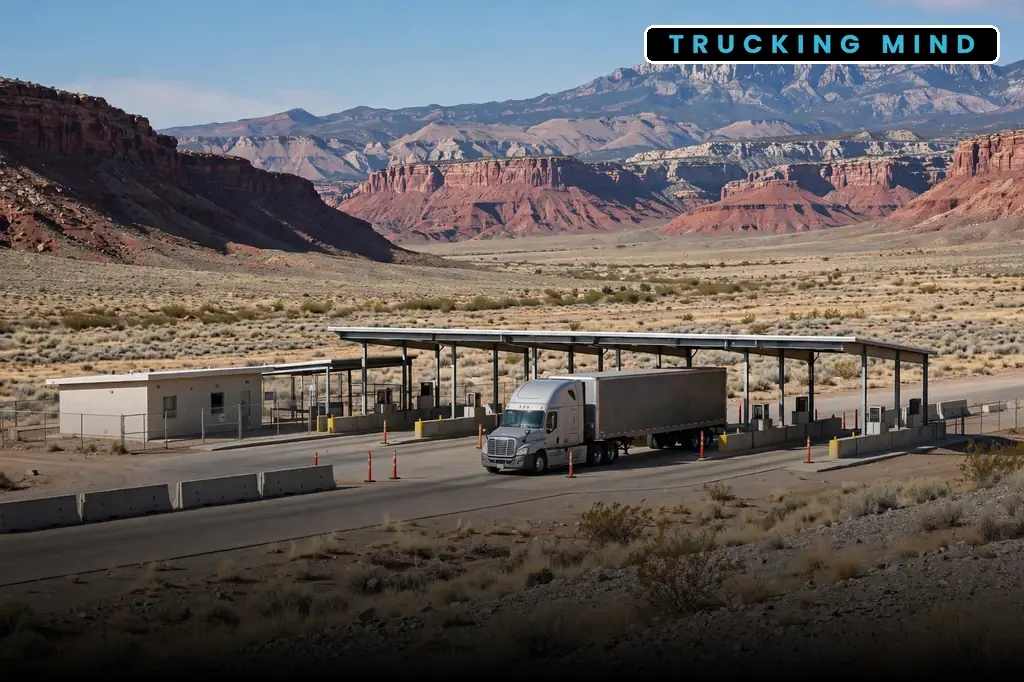
There is one important exception to the buy-before-you-enter rule that applies to oversize permits: the appropriate permit for oversize vehicles and loads must be obtained before operating within Utah, except when entering on I-15 from Arizona at the St. George Port of Entry, westbound I-80 from Wyoming at the Echo Port of Entry and eastbound I-80 from Nevada at the Wendover Port of Entry. At those three entry points, the permit may be obtained at the port itself. Everywhere else, the permit comes first. Do not generalize the exception into a habit of buying permits after entry.
Oversize and Overweight Permits
Utah's oversize and overweight permitting runs through the Motor Carrier Division under Utah Administrative Rule R909-2. The permit types will be familiar to any carrier that hauls specialized freight:
- Single-trip permits for one journey, one route, one load.
- Semi-annual permits for repeated moves over a six-month period within the permit's terms.
- Annual permits for frequent moves over a year within the permit's terms.
The application requires carrier and vehicle information: USDOT number, address, contact details, license number and state, expiration date, vehicle make, year, registered weight, unit number and VIN, plus detailed load information including dimensions and the requested route. The division reviews the application, notifies the affected UDOT region or district permit officials and obtains authorization for the route. If a department employee and vehicle must accompany the move, the permittee pays the cost, with a published minimum of $40 or the full cost of the employee and vehicle, whichever is greater, plus charges for moving utility lines, traffic control devices, or roadway appurtenances and for any damages caused by the operation.
Travel restrictions apply to oversize loads. Rule R909-2-12 prohibits travel for loads more than 10 feet wide, 105 feet in overall length, or 14 feet 6 inches in height on listed highways — including those in Weber, Davis and Salt Lake counties — Monday through Friday between 6:00 AM and 9:00 AM and between 3:30 PM and 6:00 PM, plus restrictions in certain areas to protect infrastructure. Read the permit itself for the restrictions that apply to your move, because permit conditions override general guidance.
Overweight non-divisible loads have their own provisions. Movement of overweight non-divisible loads must meet rail-crossing requirements. Loads exceeding 125,000 pounds fall under additional provisions in R909-2. Loads more than 17 feet 6 inches in height, 17 feet in width, or over 300,000 pounds are processed only Monday through Friday from 8 AM to 5 PM Mountain Time and may take up to 14 days for approval. If your freight is anywhere near those thresholds, apply early. A superload application submitted the week of the move is a scheduling failure, not a permitting delay.
Police escorts are a separate requirement. Loads over 175 feet in length require a minimum of one police escort. Loads over 200 feet require a minimum of two. Escort costs and scheduling are the permittee's responsibility. Utah Highway Patrol escort arrangements require advance notice. Build escort lead time into the quote, not into the driver's day.
Longer Combination Vehicles (LCVs)
Utah authorizes longer combination vehicles on designated routes on the interstate system. LCV operation requires specific approval. Motor carriers operating LCVs must apply and be approved to operate on designated routes. Authorized carriers may operate interstate LCVs within defined cargo-carrying length limits, including tractor-trailer combinations up to 95 feet of cargo-carrying length and truck-and-two-trailer combinations within the same overall limit, subject to height and width limits of 14 feet 6 inches and 8 feet 6 inches respectively.
LCV operating conditions include placing the longer trailer ahead of the shorter trailer in combinations. Non-divisible dimensions wider than 8 feet 6 inches or taller than 14 feet 6 inches may not be transported on LCVs. A truck and single trailer exceeding legal length may be permitted up to 88 feet. LCV authority is required beyond 88 feet up to 92 feet. Trailers exceeding 53 feet but not exceeding 57 feet may acquire single-trip, semi-annual, or annual permits. Trailers over 53 feet require LCV authority for semi-annual and annual permits.
For a new owner-operator, the LCV section is mostly a warning: do not assume a double-trailer setup that is legal in a neighboring state is legal in Utah and do not accept an LCV load without confirming your LCV authority, your route designation and your trailer-length permits. LCV work is profitable for carriers set up for it. It is a violation trap for carriers who drift into it.
Insurance, Safety and Compliance Habits
Utah intrastate carriers must maintain proper insurance coverage, meet vehicle safety standards and keep accurate records of operations. Interstate carriers must additionally satisfy federal insurance filings, including the BMC-91 or BMC-91X filing through their insurer and the BOC-3 process agent designation. Insurance is not a one-time purchase; it is a filing that must remain continuously in force and on file with the right agency. A policy that lapses, even briefly, can suspend authority and registration. Reinstatement takes longer than the lapse did.
Safety compliance in Utah follows the federal motor carrier safety regulations as adopted by the state, plus state-specific requirements. That means driver qualification files, hours-of-service compliance, vehicle inspection and maintenance records and drug and alcohol testing programs all apply to Utah intrastate carriers in substantially the same way they apply to interstate carriers. A carrier that treats intrastate operation as lightly regulated will fail a Utah compliance review the same way it would fail a federal one.
Recordkeeping should cover mileage by jurisdiction for IRP and IFTA, hours of service, inspection reports, maintenance records and permit copies. Keep permits in the truck for the move they authorize and keep copies in the office file for the vehicle. When a permit question arises months later, the office copy is the answer.
Utah Checklist for New Owner-Operators
- Get a USDOT number through FMCSA and update the MCS-150 every two years or when information changes.
- Confirm intrastate authority requirements in writing with the UDOT Motor Carrier Division before your first intrastate for-hire load.
- Register intrastate vehicles for their true combined gross weight through the TC-853 series, or through IRP for interstate operation.
- Set up IFTA, UCR and HVUT credentials before interstate operation.
- Buy oversize and overweight permits before operating in Utah, except at the three designated entry ports.
- Apply early for superloads near the 17-foot-6-inch height, 17-foot width, or 300,000-pound thresholds.
- Confirm LCV authority, route designation and trailer permits before accepting LCV work.
- Keep insurance filings continuously in force and on file with the right agency.
- Keep mileage, inspection, maintenance and permit records organized by vehicle.
- Stop at ports of entry as required and never bypass unless properly enrolled and authorized.
Frequently Asked Questions
Do I need a USDOT number if I only operate inside Utah?
Yes. UDOT guidance states that companies operating commercial vehicles in intrastate commerce must be registered with FMCSA and hold a USDOT number.
What is the difference between Utah intrastate authority and interstate authority?
Intrastate authority covers for-hire work entirely inside Utah under the state process. Interstate authority is federal FMCSA operating authority for for-hire work across state lines. They are separate permissions. One does not substitute for the other.
Can I buy an oversize permit at the port of entry?
Yes, at ports of entry and online or by phone through the Motor Carrier Division. For entry at St. George from Arizona, Echo from Wyoming and Wendover from Nevada, permits may be obtained at the port itself. Elsewhere, obtain the permit before operating in Utah.
What permits do I need for a load over 300,000 pounds?
Superload processing applies: loads over 300,000 pounds, or over 17 feet 6 inches high or 17 feet wide, are processed weekdays only and may take up to 14 days for approval. Apply well in advance.
Do trailers over 53 feet need special permits in Utah?
Trailers over 53 feet up to 57 feet may acquire single-trip, semi-annual, or annual permits. Semi-annual and annual permits for trailers over 53 feet require LCV authority.
Does Utah require IFTA for intrastate-only carriers?
No. IFTA and IRP are interstate apportionment systems. Intrastate-only carriers do not need them, but must obtain them before taking an interstate load.
Where do I get help with a Utah permit question?
The UDOT Motor Carrier Division handles permit requests, routing assistance, LCV applications, port bypass information and UCR information. Contact the division directly and keep the answer in your authority file.
Trucking Mind: practical guides for owner-operators and small fleets.
This guide was prepared in good faith from official sources, including FMCSA and state agency publications, and was checked at the time of writing. Fees, rules and procedures change. Errors and omissions are excepted. Please confirm current requirements with the relevant agency before filing or travelling. If you spot anything that needs correcting, email us at contact@truckingmind.com — we will verify it and update this page.