
For more than 50 years, federal law has said you must be 21 to drive a commercial truck across state lines. In 2021, Congress created a narrow exception: the Safe Driver Apprenticeship Pilot Program (SDAP). It let 18-, 19- and 20-year-olds with a CDL drive interstate — but only as apprentices, under tight supervision, in trucks fitted with safety technology.
The program ended on November 7, 2025. A Congressional Research Service report updated November 3, 2026, gives the final count: 76 apprentices were approved out of the 3,000 the law allowed. That is 2.5% of the target. Only 42 finished the full training.
Here is what the program was, what the numbers show, what is still unknown about safety — and what comes next for young drivers and the carriers that trained them.
What SDAP was, and the law behind it
The age-21 rule comes from 49 CFR 391.11(b)(1), in place since 1970. Drivers under 21 can hold a CDL, but their license carries a K restriction that limits them to driving within their home state. Congress had tried one under-21 pilot before — a military-driver pilot authorized by the FAST Act in 2015, which ran from 2019 to 2022.
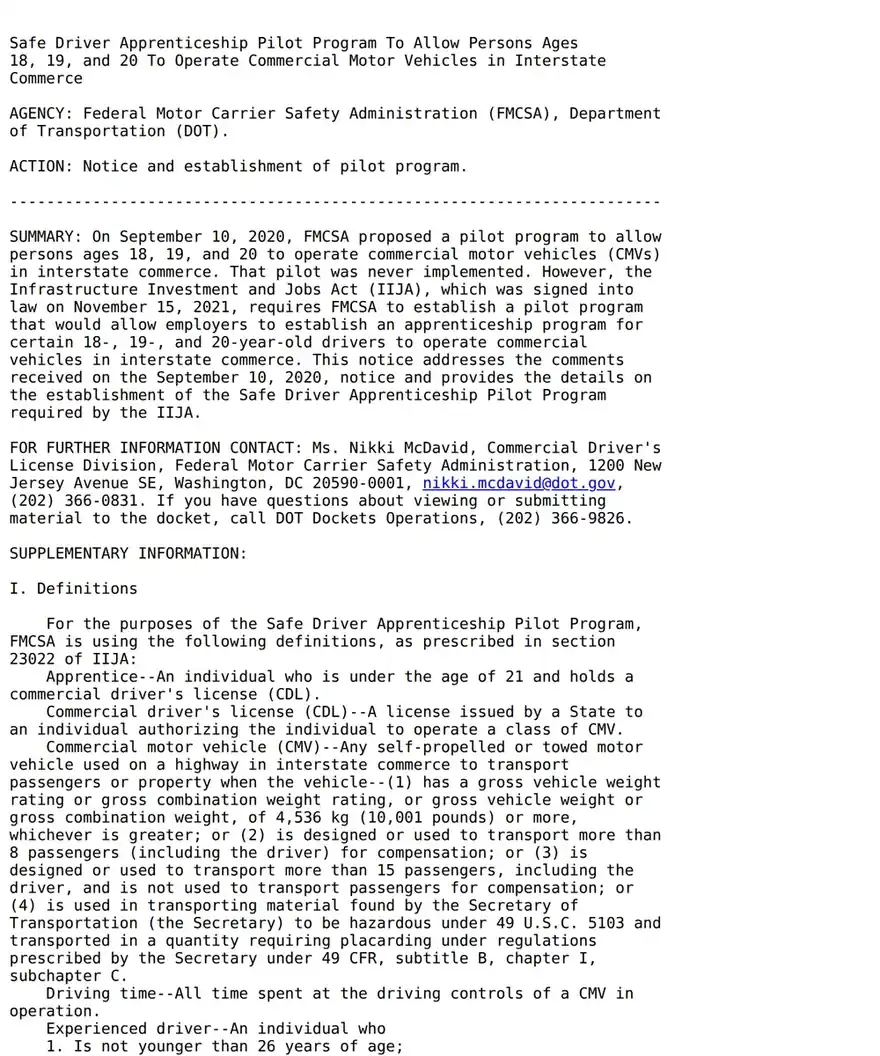
The Infrastructure Investment and Jobs Act (IIJA), signed November 15, 2021, went further. Section 23022 ordered the Secretary of Transportation to set up an apprenticeship pilot program within 60 days. FMCSA established it on January 14, 2022.
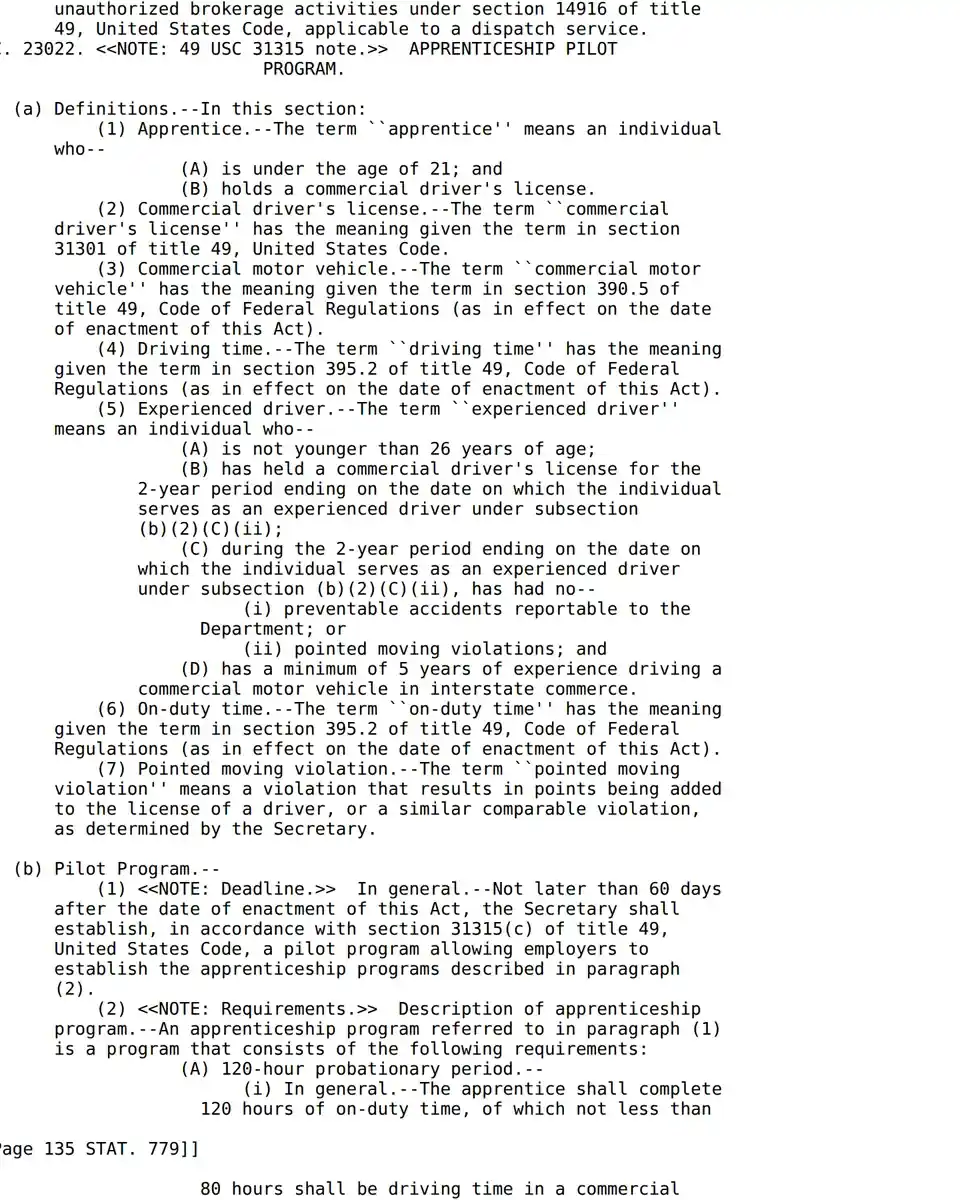
The law defined the two roles. An apprentice was a driver under 21 who held a CDL. An experienced driver was at least 26, had held a CDL for two years, had no preventable accidents or pointed moving violations in the previous two years, and had at least five years of interstate driving experience.
Training came in two probationary periods. The first was 120 hours of on-duty time, at least 80 of them driving. The second was 280 hours on duty, at least 160 driving. Each period had performance benchmarks the apprentice had to meet — from interstate, city and rural two-lane driving in the first period to backing, pretrip inspections, weighing loads and trip planning in the second.
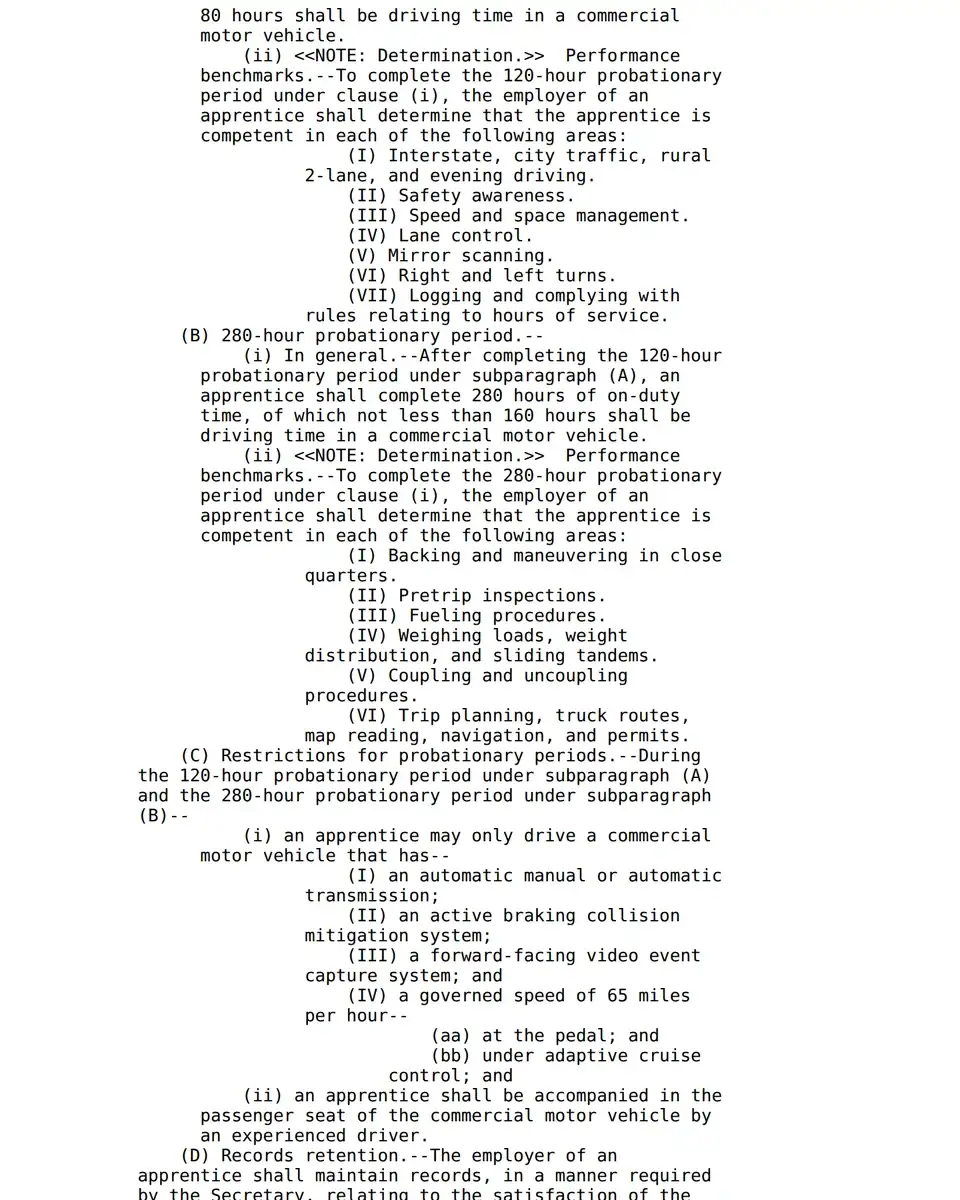
During both periods, the rules were strict. The truck had to have an automatic or automated manual transmission, an active braking collision mitigation system, a forward-facing video event capture system, and a governor set at 65 mph — at the pedal and under adaptive cruise control. The experienced driver rode in the passenger seat. Apprentices could not carry passengers or hazardous cargo, could not drive a special-configuration vehicle, and could not operate anything over 80,000 pounds gross vehicle weight.
The law capped the program at 3,000 apprentices at any one time. It also set a three-year life for the pilot, and required FMCSA to send Congress a report within 120 days of its conclusion — including a recommendation on whether under-21 drivers could operate interstate with a level of safety at least equivalent to drivers 21 and older.
What happened: the numbers
Carrier applications opened July 26, 2022. Driver and apprentice applications followed in November 2022. Interest started low and fell from there.
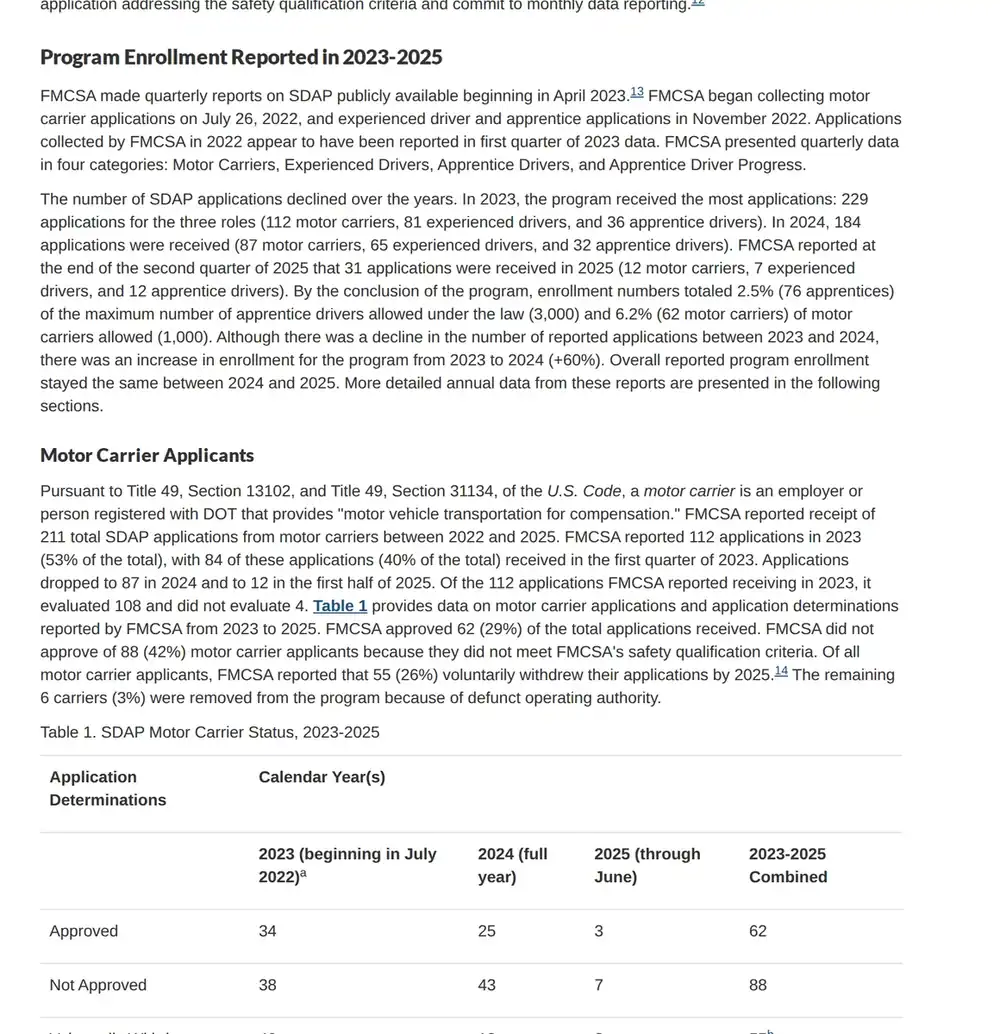
- Apprentices: 76 approved out of 3,000 allowed — 2.5% of the cap. Only 80 apprentice applications were filed in total.
- Motor carriers: 62 approved out of 1,000 allowed — 6.2%. Of 211 carrier applications, 88 (42%) were rejected for failing FMCSA's safety qualifications, 55 (26%) were voluntarily withdrawn, and 6 were removed because the carrier's operating authority had lapsed.
- Experienced drivers: 141 approved out of 153 applicants (92%).
- Completions: 42 apprentices finished both probationary periods by June 2025 — 55% of those approved, and 1.4% of the 3,000 target. Another 30 did not complete the program, and 4 were still in progress.
- Applications fell every year: 229 in 2023, 184 in 2024, and 31 in the first half of 2025.
Why did so few carriers join? The CRS report points to the safety bar. FMCSA turned away more than four in ten carrier applicants for not meeting its safety qualifications. Carriers also had to apply, commit to monthly data reporting, and put an experienced driver in the passenger seat for hundreds of hours — a real cost for a small fleet.
Congress loosened two requirements partway through. The Consolidated Appropriations Act, 2024 (Section 422) barred FMCSA from requiring inward-facing cameras or Department of Labor apprenticeship registration as a condition of participation. FMCSA revised the program in May 2024. Enrollment did not recover.
One carrier tried a different route. Pitt Ohio asked FMCSA in February 2023 for an exemption to run its own under-21 program outside SDAP. FMCSA denied the request in May 2024, saying the company had not provided enough information about the safety implications.
The safety question — and the overdue report
The program's whole purpose was to answer one question: can under-21 drivers operate interstate as safely as drivers 21 and older? Three years and 76 apprentices later, the evidence is thin.
What exists leans positive, with a large caveat. In a report to Congress dated May 21, 2026, covering fiscal years 2023 and 2024, FMCSA said it "has observed no adverse impacts on CMV safety from the use of waivers, exemptions, and pilot programs." That report covers all of FMCSA's waivers, exemptions and pilots — not SDAP alone — and the SDAP sample was tiny.
The American Trucking Associations, which supports the program, says there were no reportable truck-involved crashes among SDAP apprentices, and points to an FMCSA note that apprentices drove more than 2.3 million safe miles. The Owner-Operator Independent Drivers Association calls the program a failure. Safety groups, citing Insurance Institute for Highway Safety data, note that drivers aged 19 and 20 are six times more likely to be involved in fatal truck crashes than drivers 21 and older.
The report that was supposed to settle the question is late. Under IIJA Section 23022(g), FMCSA's final report to Congress was due March 7, 2026 — 120 days after the program concluded. As of September 2026, it had not been published, according to the Congressional Research Service. No publication has been identified since.
What happens next
Three efforts could keep some form of under-21 interstate driving alive.
The ATA petition. On November 14, 2025, the American Trucking Associations asked FMCSA for a five-year exemption from the age-21 rule for carriers that had already been approved under SDAP. FMCSA opened the request for public comment from January 28 to February 27, 2026. The Commercial Vehicle Training Association, the Truckload Carriers Association and the Next Generation in Trucking Association supported it. OOIDA, the Truck Safety Coalition and other safety groups opposed it. No final FMCSA decision had been announced as of the latest check.
The DRIVE-SAFE Act. H.R. 5563, introduced September 26, 2025 by Rep. Rick Crawford (R-Arkansas), would create a permanent apprenticeship program along the lines of SDAP, with regulations due within one year of enactment. It has 24 cosponsors and was referred to the House Subcommittee on Highways and Transit on December 1, 2025. It remains in committee.
The BUILD America 250 Act. Section 5401 of H.R. 8870 would extend the pilot for former apprentice participants. The bill was ordered reported in the House in May 2026.
For the 42 drivers who completed the program, the law already answers one question: under Section 23022(c), they may keep driving interstate after the pilot ends, unless the Secretary finds a safety concern. For everyone else under 21, the age-21 rule is back in full force — intrastate driving only, until Congress or FMCSA acts.
For carriers, the practical lesson is narrower. The program showed that a tightly supervised under-21 driver can complete hundreds of hours of interstate work without a reportable crash — but only 62 carriers cleared the bar to try, and the pipeline of applicants dried up. Any future program will have to answer why so few carriers signed up in the first place.
Bottom line
SDAP was a serious test of a real idea: the trucking workforce is aging — workers 55 and older made up 30% of the truck transportation workforce in 2025 — and the industry needs younger drivers. But the test never reached scale. Seventy-six apprentices out of a 3,000-driver allowance is not enough to prove safety, and the report Congress ordered to judge the results is overdue. Until FMCSA publishes it, or Congress passes a follow-up, under-21 interstate driving remains closed — except for the 42 drivers who finished the program.
This article is a news summary based on the sources listed below. It is not legal advice. Check the current regulations and FMCSA guidance before making hiring or operating decisions.
Sources
- Congressional Research Service, "Safe Driver Apprenticeship Pilot Program: In Brief" (R48244, updated November 3, 2026) — congress.gov/crs-product/R48244
- Infrastructure Investment and Jobs Act, P.L. 117-58, Section 23022 — govinfo.gov
- FMCSA, "Safe Driver Apprenticeship Pilot Program To Allow Persons Ages 18, 19, and 20 To Operate Commercial Motor Vehicles in Interstate Commerce," 87 FR 2477 (January 14, 2022) — govinfo.gov
- FMCSA, Safe Driver Apprenticeship Pilot (SDAP) Program page — fmcsa.dot.gov
- FMCSA, "Waivers, Exemptions, and Pilot Programs Report to Congress, Fiscal Years 2023 and 2024" (May 21, 2026) — fmcsa.dot.gov (PDF)
- Consolidated Appropriations Act, 2024, P.L. 118-42, Section 422 — govinfo.gov
- FMCSA, notice of ATA exemption application, 91 FR 3772 (January 28, 2026), Docket FMCSA-2025-1117 — govinfo.gov
- DRIVE-SAFE Act, H.R. 5563, 119th Congress — congress.gov