
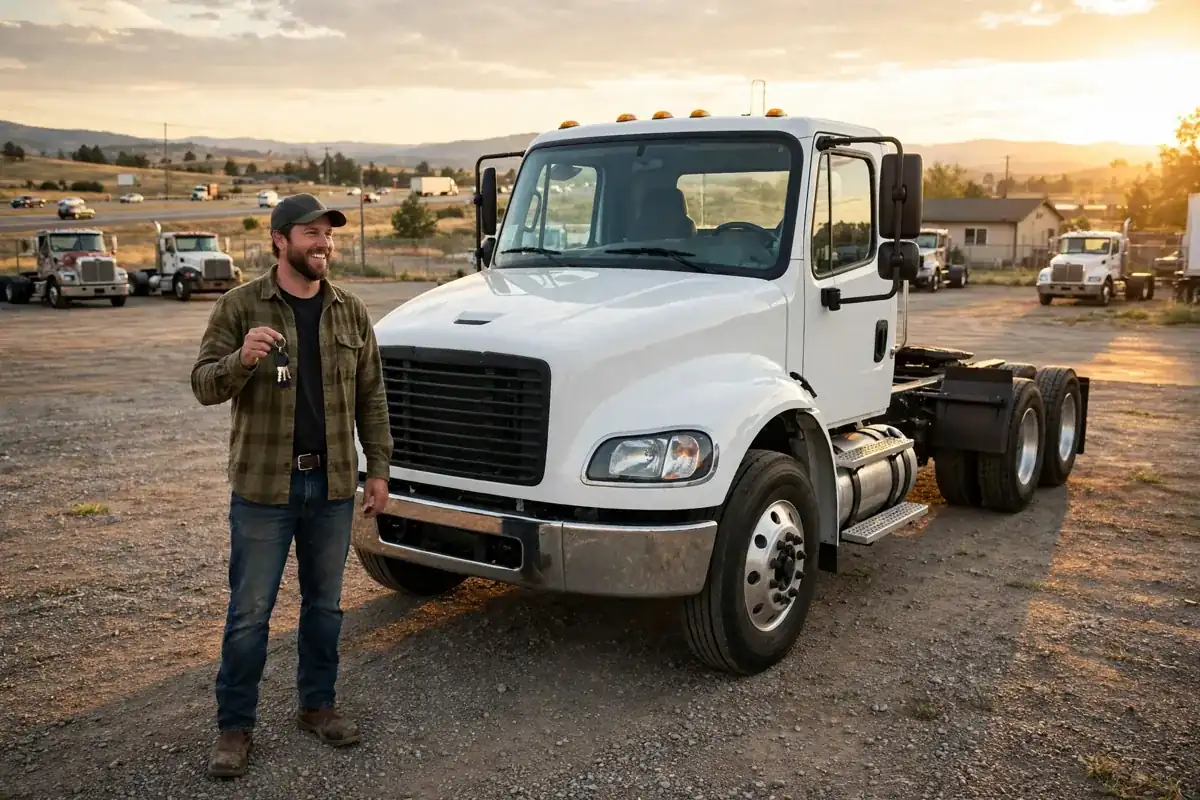
An SBA Microloan will not buy you a new sleeper and anyone who tells you otherwise is selling you something. What it will do in 2027 is put up to $50,000 into the hands of a carrier who cannot get a bank loan — through a nonprofit community lender, at rates generally between 8 and 13 percent, with terms up to 7 years — and it will do it without the credit-score screen that blocks most small borrowers from the SBA’s bigger programs.
The average microloan is only about $13,000, according to the SBA, so the honest question is not whether a microloan buys a truck. It is whether $50,000, used well, gets a one-truck carrier on the road — and for a used day cab, a trailer, or the working capital to run a truck you already own, the answer is yes.
This guide explains the Microloan Program as it actually works for a trucking business in 2027: who makes the loan, what the money can and cannot buy, the real cost with the maths shown, the application in order and the myths that cost new carriers money. If you are a new authority with thin credit, a driver buying your first truck, or an owner-operator who needs working capital more than a new tractor, this is the smallest SBA program — and for many carriers, the most reachable one.
Key Points
- The SBA Microloan Program provides loans up to $50,000 to small businesses and certain nonprofit child care centres, through nonprofit intermediary lenders — not directly from the SBA. The average microloan is about $13,000, according to the SBA.
- Interest rates generally fall between 8 percent and 13 percent, depending on the intermediary lender and the maximum repayment term is 7 years, according to the SBA. Payments are monthly and balloon payments are not allowed.
- The SBA does not review microloans for creditworthiness — that is 13 CFR 120.707. The intermediary lender makes its own credit decision, and its standards are generally more flexible than a bank’s, weighing character and cash flow alongside the score.
- Microloan money can be used for working capital, inventory, supplies, furniture and fixtures and machinery and equipment. It cannot be used to pay off existing debts or to purchase real estate.
- Funding typically takes 1 to 3 months from application, according to SBA intermediary guidance — slower than a dealer loan, faster than a 7(a).
- Intermediaries are community-based nonprofit organisations, often Community Development Financial Institutions (CDFIs) and they also provide free business training and technical assistance with the loan.
What an SBA Microloan Actually Is
The Microloan Program is the SBA’s smallest loan program and the only one where the SBA never touches your application. The SBA provides funds to specially designated intermediary lenders — nonprofit, community-based organisations with experience in lending and in management and technical assistance — and those intermediaries make the loans.
You never apply to the SBA. You apply to a local intermediary and the intermediary decides.
That structure is the whole point of the program. The intermediaries exist to lend to borrowers the banks turn away: startups, borrowers with limited credit history, and very small businesses in underserved communities.
Their underwriting is deliberately different from a bank’s. Where a bank runs a score screen and a rigid debt service test, an intermediary reads the borrower — the business plan, the operating history, the character references, and the cash flow — and decides whether the loan will be repaid.
The SBA’s rulebook backs that up: the SBA does not review microloans for creditworthiness, under 13 CFR 120.707. The credit decision belongs entirely to the intermediary.
For a trucking business, the microloan sits in a specific place in the money map. Our overview of SBA loans for trucking companies compares all the programs side by side and our step-by-step 7(a) guide explains the credit rules in detail. The microloan is the program for the carrier who is too small, too new, or too thin-filed for the 7(a) and who needs $50,000 or less — which, in trucking, means a used truck, a trailer, or the working capital to run the truck you already have.
What the Money Buys — and What It Does Not
The first question to settle is what a microloan can legally buy, because the restrictions are real and a carrier who plans around the wrong use wastes the application.
Microloan proceeds can be used for working capital, inventory, supplies, furniture and fixtures and machinery and equipment. For a carrier, that translates directly into: a used truck or trailer (machinery and equipment), the insurance and registration to put it on the road (working capital), fuel and maintenance reserves for the first months (working capital) and the tools and equipment for a small shop or yard (furniture, fixtures and equipment).
Microloan proceeds cannot be used to pay off existing debts or to purchase real estate. That is the rule as published by the SBA and it matters in two ways. First, you cannot refinance a truck loan, a credit card, or a factoring advance with a microloan — if the debt already exists, the microloan cannot pay it.
Second, you cannot buy a yard or a terminal with it. If the plan is to buy land, the program for that is the SBA 504, not the microloan.
The practical consequence is a limit on the truck itself. A $50,000 microloan buys a used day cab in the $35,000 to $65,000 range — the older-truck band where lenders typically require 15 to 25 percent down and cap terms at 36 to 48 months — or it covers most of the cost of a solid used trailer. It does not buy a $150,000 new day cab or a $190,000 new sleeper and it is not meant to.
A carrier who needs $120,000 for a truck should be looking at a 7(a) loan or at equipment financing, not at a microloan. A carrier who needs $25,000 to buy the truck that gets him started, or $15,000 of working capital to survive the first ninety days under his own authority, is exactly who the program was built for.
| Use of the money | Allowed? | What it looks like for a carrier |
|---|---|---|
| Buy a used truck or trailer | Yes — machinery and equipment | A used day cab at $35,000–$65,000, or a used dry van or reefer trailer |
| Working capital | Yes | Fuel, insurance, registration, and maintenance reserves for the first months |
| Inventory and supplies | Yes | Parts, tyres, chains, straps, and shop supplies |
| Furniture, fixtures, and equipment | Yes | Tools, a small office setup, or yard equipment |
| Pay off existing debts | No | Cannot refinance a truck loan, credit card, or factoring advance |
| Purchase real estate | No | Cannot buy a yard or terminal — the SBA 504 is the program for that |
The Real Cost: Rates, Terms and the Monthly Payment
The SBA does not set a single interest rate for microloans. Each intermediary sets its own rate, within limits the SBA sets and the rate depends on the intermediary’s cost of funds and on the borrower’s risk.
In practice, rates generally fall between 8 percent and 13 percent, according to the SBA and that range has held through 2026. The maximum repayment term is 7 years, according to the SBA and payments are monthly — balloon payments are not allowed, so the loan amortises fully over the term.
There is one more rate detail worth knowing, because it shows how the program is priced. The SBA sets the intermediary’s rate from the 5-year U.S. Treasury rate, rounded to the nearest one-eighth of one percent and if the intermediary’s average loan size is $10,000 or less, the rate is discounted by 2 percent. That is why the smallest microloans — the $5,000 and $8,000 loans to the smallest borrowers — sometimes carry the lowest rates in the program.
Here is what the payments look like at the middle of the range, 10 percent, over the full 6-year term most intermediaries actually write:
| Loan amount | Rate | Term | Monthly payment | Total paid | Total interest |
|---|---|---|---|---|---|
| $13,000 (the SBA average) | 10% | 6 years (72 months) | $241 | $17,341 | $4,341 |
| $25,000 | 10% | 6 years (72 months) | $463 | $33,348 | $8,348 |
| $50,000 (the maximum) | 10% | 6 years (72 months) | $926 | $66,696 | $16,696 |
| $50,000 (the maximum) | 13% | 6 years (72 months) | $1,004 | $72,286 | $22,286 |
| $50,000 (the maximum) | 8% | 7 years (84 months) | $779 | $65,465 | $15,465 |
The worked example, line by line, for the $25,000 loan: monthly rate = 10 percent divided by 12 = 0.8333 percent per month; 72 payments. Payment = $25,000 × 0.008333 ÷ (1 − 1.008333−72) = $463.17 per month. (1.00833372 is about 1.8175, so 1 − 1 ÷ 1.8175 = 0.4498 and $208.33 ÷ 0.4498 = $463.17.)
Total paid over 6 years: $463.17 × 72 = $33,348. Total interest: $33,348 − $25,000 = $8,348. You do not need the formula by hand: work out your own payment with the truck financing calculator before you meet the intermediary.
Put that payment in trucking terms. A carrier running 10,000 miles a month pays $463 a month on a $25,000 microloan — that is $0.046 per mile, less than five cents a mile.
The $50,000 loan at 10 percent costs $926 a month, or $0.093 per mile at the same mileage. Compare that with the industry benchmark: ATRI’s 2026 operational-cost report puts the 2025 average total cost at $2.336 per mile.
A microloan payment is a small fraction of the cost per mile, which is why the payment is rarely the problem. The problem is qualifying and the problem after that is having enough working capital left over to run the truck while the loan is being repaid.
Who Qualifies — and Why the Bar Is Lower Than the 7(a)
Eligibility for a microloan is simpler than for a 7(a) and the differences are the reason the program exists. The business must be a for-profit small business operating in the United States and it must meet the SBA’s size standards for its industry.
Certain nonprofit child care centres are also eligible. That is the SBA’s side and it is short.
The intermediary’s side is where the flexibility lives. Intermediaries are community-based nonprofits and many of them are Community Development Financial Institutions — CDFIs — whose mission is to lend where banks do not. They underwrite on the borrower’s character, the business plan and the cash flow, not on a score screen.
Merchant Maverick’s 2026 survey of microloan intermediaries found many targeting a score of around 640 or higher, but that is a target, not a rule and intermediaries regularly fund below it when the plan and the cash flow are sound. There is no SBA minimum score, because the SBA does not review microloans for creditworthiness at all.
Three things still matter and a carrier who walks in without them will be turned away. First, a business plan — not a fifty-page document, but a clear one: what you will haul, who will pay you, what the truck costs to run and how the loan is repaid. Second, some evidence of the ability to repay: rate confirmations, a lease agreement, a broker relationship, or a track record of driving for someone else.
Third, the ownership rule that now applies across the SBA’s programs: since 1 March 2026, 100 percent of a business’s ownership must be held by United States citizens or nationals living in the United States for 7(a) and 504 loans and intermediaries apply the same standard to microloans. Check the ownership structure before you apply.
One more qualification point that surprises carriers: a microloan is not only for startups. About 24 percent of all SBA microloans issued in fiscal year 2024 went to startups, according to SBA data — which means three-quarters went to existing businesses. An owner-operator who has been running for two years and needs $20,000 of working capital to get through a slow quarter is as much a microloan borrower as a driver buying his first truck.
How to Apply: The Steps in Order
The application runs through the intermediary, not through the SBA and the steps are shorter than a 7(a) application — but they are not instant. Funding typically takes 1 to 3 months, according to SBA intermediary guidance and most of that time is the intermediary’s underwriting and the training that comes with the loan.
- Step 1 — Find your intermediary. Use the SBA’s Lender Match tool at sba.gov/loans/lender-match, or search the SBA’s local assistance directory for a microloan intermediary near you. There are intermediaries in most states, but not in every county — if the nearest one is two hours away, call first, because many intermediaries work by phone and video now. Ask whether they have lent to trucking businesses before and how many microloans they made last year.
- Step 2 — Have the first conversation. The intermediary will ask what the money is for, how much you need, what the business earns or will earn and what your credit looks like. Bring the headline numbers: the truck or trailer you want to buy and its price, your expected monthly revenue and your monthly costs. Be honest about the credit history — the intermediary will pull your credit and a problem you disclose is a problem you can explain, while a problem it discovers is a reason to decline.
- Step 3 — Write the business plan. The intermediary will help you with this — free business training and technical assistance are part of the program, not an extra. The plan needs four things: what you will haul and for whom, what the truck costs to run per mile, what you expect to earn per mile and how the loan payment fits inside that arithmetic. Use the ATRI benchmark of $2.336 per mile as the cost reference and show your own numbers against it. A plan that says “I will run 10,000 miles a month at $2.50 a mile, my cost is $2.10 a mile and the loan payment is $463” is a plan an intermediary can approve. A plan that says “I will make good money” is not.
- Step 4 — Assemble the documents. The pack is smaller than a 7(a) pack, but it is real: personal and business tax returns if they exist, bank statements, a personal financial statement, the business plan and proof of the use of funds — a bill of sale or a dealer quote for the truck, or invoices for the equipment. A startup with no tax returns substitutes the owners’ personal returns and a stronger projection. Gather it all before you submit, because a complete file moves and a half-submitted file sits.
- Step 5 — Underwriting and training. The intermediary underwrites the file and, in most cases, requires the borrower to complete some business training — a budgeting workshop, a bookkeeping course, or a one-on-one counselling session. This is not a hurdle the intermediary invented to slow you down. It is part of the program’s design and it is also why microloan default rates are lower than the rates on comparable small loans: the borrower who has done the training understands the payment.
- Step 6 — Closing and funding. The intermediary prepares the loan documents, you sign and the money is disbursed — often paid directly to the seller or dealer for an equipment purchase. Keep every document, set a calendar reminder for the first payment date and remember that the intermediary is also your ongoing contact: if the business hits a slow month, call the intermediary before you miss a payment, not after.
Worked Example: A $25,000 Microloan for a First Used Truck
Take a real carrier. A company driver in Georgia has been driving for a fleet for four years, has his CDL-A and has just received his own MC authority. He finds a 2016 day cab with 480,000 miles for $38,000 at a small dealer and he needs $12,000 of working capital — insurance, registration, the first month of fuel and a maintenance reserve — for a total project of $50,000.
He has $25,000 saved. Here is the deal, with every number shown.
- Total project cost: $50,000 — $38,000 truck plus $12,000 working capital.
- His cash: $25,000, which is half the project cost. He borrows $25,000 as a microloan, so the loan is exactly half the project — a structure any intermediary can defend.
- Loan terms: $25,000 at 10 percent over 6 years, from a nonprofit intermediary in his state. Monthly payment: $463.17, as calculated above. Total paid: $33,348. Total interest: $8,348.
- Revenue: he signs on with a broker he has worked with for two years, running regional dry van at $2.40 a mile. At 9,000 miles a month, gross revenue is $21,600 a month.
- Costs: his cost per mile, worked out with the intermediary’s counsellor, is $2.05 a mile — fuel, maintenance, insurance, the truck payment and the microloan payment. At 9,000 miles, that is $18,450 a month. The microloan payment inside that figure is $463, or $0.051 per mile.
- Net: $21,600 minus $18,450 = $3,150 a month before taxes. That is the margin the intermediary underwrites and it is the margin that pays the driver, covers the slow weeks and builds the reserve for the next repair.
Now the sensitivity, because the rate is the variable. At 13 percent — the top of the SBA’s general range — the same $25,000 over 6 years costs $501.97 a month, $38.80 more.
At 8 percent it costs $438.34 a month, $24.83 less. Over 72 months, the difference between the best and worst rate in the range is about $4,600.
That is worth asking the intermediary about, but it is not the number that decides whether this carrier succeeds. The number that decides it is the $12,000 of working capital: a carrier who spends the whole $50,000 on the truck and has nothing left for fuel, insurance and the first repair is a carrier who will be parked in week three, whatever the rate is.
Microloan vs 7(a) vs Equipment Financing: Which One Fits
The three programs answer different questions and the wrong choice costs months. The table below is the decision in one place.
| SBA Microloan | SBA 7(a) | Equipment financing | |
|---|---|---|---|
| Maximum amount | $50,000 | $5,000,000 | Varies; usually up to the truck’s value |
| Typical rate | 8%–13% | Roughly 10%–13.5% | 7%–12% strong credit; 12%–20% fair credit |
| Maximum term | 7 years | 10 years (25 for real estate) | 24–72 months |
| Who lends | Nonprofit intermediary (CDFI) | SBA-approved bank or non-bank lender | Specialist equipment lender or dealer |
| Credit screen | Intermediary’s own; SBA does not review creditworthiness | No SBA minimum; lender’s own policy, usually 650+ | Lender’s own; score matters more |
| Speed to funding | 1–3 months | 30–90 days | Days to 2 weeks |
| Best for | First truck, trailer, or working capital up to $50,000 | Larger purchases, business buys, working capital over $50,000 | A single truck, fast, when the rate is acceptable |
| Training included | Yes — free business training and counselling | No | No |
The rule of thumb: if the amount you need is $50,000 or less and your credit or your operating history would make a bank hesitate, start with the microloan. If the amount is over $50,000, the microloan cannot do the job and the 7(a) is the program — our step-by-step 7(a) guide is the place to start. If speed matters more than rate and the truck is the whole purchase, equipment financing is the fastest path, but compare its rate against the microloan’s 8 to 13 percent before you sign, because a 20 percent equipment loan on a $50,000 truck costs roughly twice the interest of a 10 percent microloan on the same truck.
Common Mistakes and Watch-Outs
Thinking $50,000 buys a new truck. It does not and a plan built on that assumption fails at the dealer.
A microloan buys a used day cab, a trailer, or working capital. Price the truck first, then choose the program — not the other way round.
Spending the whole loan on the truck and keeping nothing for running it. The most common microloan failure in trucking is not a missed payment.
It is a carrier who buys the truck, has no working capital left and cannot pay for fuel, insurance and the first repair. Keep at least $10,000 to $12,000 of the project in working capital, or do not do the project yet.
Using the money to pay off an old debt. Microloan proceeds cannot be used to pay off existing debts.
An intermediary that discovers the money went to a credit card or a factoring advance has a compliance problem and so does the borrower. Plan the use of funds honestly and document it with the bill of sale or the invoices.
Applying to the SBA instead of an intermediary. The SBA does not make microloans and does not take microloan applications.
Every day spent trying to apply to the SBA directly is a day the intermediary could have been underwriting. Start at Lender Match or the SBA’s local assistance directory and start with the intermediary.
Paying a broker who promises a guaranteed microloan. No one can guarantee an SBA loan of any kind, because the lender underwrites it. Anyone selling guaranteed approval, a paid list of intermediaries, or a fee to move your application forward is running a scam pattern.
Lender Match is free, the SBA charges no application fee and the intermediary is a nonprofit. The same warning applies to grant brokers — our guide to grants for trucking companies names the pattern there too, because it is the same operators selling the same promise to the same carriers.
Skipping the training. The free business training and counselling that come with a microloan are not a formality.
They are the reason the program’s loans perform and they are also the cheapest education a new carrier will ever get: a counsellor who has seen a hundred one-truck failures can spot the hole in your plan in an afternoon. Take the training seriously and ask the counsellor to challenge the numbers, not just approve them.
FAQ
How much can I borrow with an SBA Microloan in 2027?
Up to $50,000, through a nonprofit intermediary lender. The average microloan is about $13,000, according to the SBA and most borrowers receive significantly less than the maximum. The amount depends on the intermediary’s assessment of the business plan and the cash flow, not on the maximum the program allows.
What is the interest rate on an SBA Microloan?
Rates generally fall between 8 percent and 13 percent, depending on the intermediary lender, according to the SBA. Each intermediary sets its own rate, within limits the SBA sets, based on its cost of funds and the borrower’s risk. The smallest loans sometimes carry the lowest rates, because the SBA discounts the rate by 2 percent when an intermediary’s average loan size is $10,000 or less.
Can I use a microloan to buy my first truck?
Yes, if the truck costs $50,000 or less — which means a used day cab or an older tractor, not a new sleeper. A microloan can also buy a trailer, or provide the working capital to run a truck you already own.
It cannot be used to pay off existing debts or to purchase real estate. For a truck over $50,000, the 7(a) loan or equipment financing is the program to use.
Do I need good credit for an SBA Microloan?
Not in the way a bank requires it. The SBA does not review microloans for creditworthiness, under 13 CFR 120.707, and the intermediary lender makes its own credit decision, weighing character, the business plan, and cash flow alongside the score. Many intermediaries target a score around 640, but that is a target, not a rule, and they regularly fund below it when the plan and the cash flow are sound.
How long does it take to get a microloan?
Typically 1 to 3 months from application to funding, according to SBA intermediary guidance. Most of that time is underwriting and the business training that comes with the loan. It is slower than dealer financing and faster than a 7(a) and the training is part of the program, not a delay added to it.
Can I get a microloan and a 7(a) loan?
Yes, in sequence. A carrier commonly starts with a microloan for the first truck or the working capital, builds operating history and a payment record and then applies for a 7(a) loan for a larger purchase — a second truck, a trailer fleet, or a business acquisition. The microloan’s payment history becomes part of the 7(a) file and a clean record on it is one of the strongest compensating strengths a borrower with a thin file can offer a 7(a) lender.
The Bottom Line
An SBA Microloan is the smallest SBA program and, for many carriers, the most reachable one: up to $50,000 through a nonprofit lender, at 8 to 13 percent, over up to 7 years, with no SBA credit screen and free business training included. It will not buy a new sleeper and it is not meant to. It buys a used day cab, a trailer, or the working capital that keeps a new authority running through its first ninety days — and the monthly payment on the average $13,000 loan is about $241, or less than three cents a mile at 9,000 miles a month.
Find your intermediary through Lender Match, bring a business plan with real per-mile numbers, keep at least $10,000 of the project in working capital and take the training seriously. If the amount you need is over $50,000, the 7(a) is the next step — and the microloan’s clean payment history is the best argument you can bring to it.
