Key Points:
- Iowa's farm exemptions turn on the operation — who is driving, what is hauled and where the trip starts and ends — not on the commodity. A farmer hauling his own corn may be exempt where a for-hire carrier hauling the same corn is not.
- Most intrastate for-hire carriers in Iowa need a USDOT number, entered on the Iowa intrastate application or obtained through FMCSA's MCSA-1 process.
- Self-propelled implements of husbandry are exempt under Iowa Code section 321.453 at 35 miles per hour or less and off the interstate. Farmer-driven trucks hauling implements need no permit for in-state, non-interstate travel.
- The section 321.176 licensing exemption is narrow: farm tractors and implements moving between the home farm and nearby farmland for farm purposes only.
- Iowa Code section 321.449 gives private carriers engaged exclusively in intrastate commerce a 12-hour driving and 16-hour on-duty framework, with 70 hours in seven days or 80 hours in eight days.
- Harvest proclamations are temporary and commodity-specific: the 2026 proclamation allowed listed commodities up to 90,000 pounds gross without a permit on non-interstate highways, with axle weights no more than 12.5 percent over standard and a 20,000-pound single-axle cap.
Iowa is farm country at a scale that shapes its trucking rules. Corn, soybeans, hogs and cattle move in enormous volumes. Much of that freight moves short distances: field to elevator, elevator to processor, farm to market and farm to farm. Iowa law recognizes that reality with a set of farm exemptions and permit rules that are genuinely different from general-freight rules, but the exemptions are narrower than most people assume. They depend on who is driving, what is being hauled, where the trip starts and ends and whether the trip crosses a state line. Get one of those factors wrong and the exemption disappears.
This guide is written for two readers at once: the new owner-operator who wants to haul agricultural freight in Iowa and the farmer or farm-service carrier who already runs trucks and wants to know where the legal lines are. It covers Iowa intrastate authority, the permits that apply to ordinary trucking, the farm exemptions for implements of husbandry, the driver licensing and hours-of-service exemptions for farm operations, the rules for hauling grain and livestock, overweight permits and harvest proclamations and the mistakes that turn an exempt farm move into a violation.
The federal foundations, including USDOT registration and operating authority, are covered in How to Start a Trucking Company. The USDOT versus MC distinction is explained in MC Number vs DOT Number. Iowa's rules sit on top of those requirements. The farm exemptions modify them only in the specific ways described below.
Iowa Trucking Permits: The General Framework
Start with the ordinary system, because the farm exemptions only make sense against it. Iowa trucking permits and authority run primarily through the Iowa Department of Transportation (Iowa DOT), Motor Vehicle Division and the federal systems that every state shares.
Intrastate for-hire authority. Most intrastate motor carriers operating for hire in Iowa are required to have a USDOT number. If the carrier already has one, it enters the number on the intrastate application. If it does not, it must complete the MCSA-1 online application through FMCSA. Iowa DOT publishes an intrastate for-hire authority process built around that federal identification. The application is the entry point for a carrier that will haul other people's freight for pay entirely inside Iowa.
Interstate authority. A carrier performing interstate transportation for compensation on Iowa highways must first register its federal authority with the Iowa DOT, under Iowa Code section 327B.1, or show evidence that federal authority is not required. Interstate carriers also participate in the Unified Carrier Registration (UCR) plan. Iowa DOT administers UCR information for carriers. UCR applies to interstate carriers, leasing companies, brokers and freight forwarders operating vehicles that meet the federal thresholds: a gross vehicle weight rating or gross vehicle weight of at least 10,001 pounds, a design capacity over 10 passengers, or placarded hazardous materials.
IRP registration. Interstate carriers register apportioned vehicles through Iowa DOT's IRP program. New IRP customers complete a set of forms, including an estimated distance schedule, a vehicle schedule, a record retention statement and copies of vehicle titles and bills of sale, plus IRS Form 2290 proof for power units over 54,999 pounds GVWR. New IRP accounts cannot be processed in person; paperwork is submitted by email or mail. The physical address on the application must be in Iowa, with the Iowa county number included.
IFTA. Interstate carriers file quarterly IFTA returns for fuel tax across member jurisdictions. Iowa is an IFTA member, so Iowa fuel tax for IFTA-licensed vehicles is handled through the quarterly return.
Oversize and overweight permits. Loads beyond legal limits need Iowa DOT permits. The system distinguishes divisible loads, which can be broken down, from non-divisible loads, which cannot; divisible loads face stricter treatment because the state expects them to be split rather than permitted overweight. Harvest loads are the major exception, covered below.
For a general-freight owner-operator running through Iowa on I-80 or I-35, this framework is the whole story: federal authority, USDOT number, IRP, IFTA, UCR and permits for anything oversize or overweight. The farm rules that follow change the story only for genuinely agricultural operations.
What Counts as a Farm Operation
Iowa's farm exemptions turn on definitions. The definitions are worth reading carefully. The Iowa DOT's farmer's guide to transportation, "Plowing Through the Regulations," is the state's own plain-language reference for these rules. It organizes the exemptions around the vehicle, the driver and the trip.
Key concepts include:
- Farm. In the relevant Iowa statutes, a farm is the land and operation engaged in agricultural production. The farm site includes places where agricultural vehicles are used or intended to be used in agricultural operations.
- Implement of husbandry. A vehicle principally designed for agricultural purposes, such as a farm tractor, combine, or other farm implement. Implements of husbandry are treated differently from ordinary commercial motor vehicles. Many of the permit rules for them are exemptions rather than permits.
- Farmer. The person engaged in the farm operation, as opposed to a for-hire carrier hauling farm freight for pay. Many exemptions apply only when the vehicle is driven by a farmer, or operated for the farm's own purposes. They do not extend to a commercial carrier hauling the same commodity for hire.
- Farm operation and agricultural interest. The statutes use these terms to define the movements that qualify: between the farm and another farm, between the farm and a market for farm products, or between the farm and an agribusiness location.
The practical consequence is that two trucks hauling identical corn can be treated differently. A farmer hauling his own corn from his field to the elevator in his own truck, driven by himself or a farm employee, may be inside an exemption. A for-hire carrier hauling another farmer's corn for pay on the same road may be outside it and must hold the ordinary authority and permits. The commodity does not create the exemption. The operation does.
Implements of Husbandry: Permit Rules
The Iowa DOT farmer's guide lays out permit requirements for hauling implements of husbandry in a simple chart. The chart's message is reassuring for farmers moving their own equipment:
- On the farm: no permit is needed, for any type of implement movement.
- Truck tractor, farm tractor, or straight truck hauling an implement of husbandry, leaving the farm in-state: if driven by a farmer, no permit is needed for non-interstate travel.
- The same movement leaving the farm out of state: for Iowa, no permit is needed for non-interstate travel if driven by a farmer, but the other state's laws must be checked.
- Self-propelled implements of husbandry, leaving the farm in-state: no permit is needed, because the movement is exempt under Iowa Code section 321.453, subject to conditions including a speed limit of 35 miles per hour or less and no travel on the interstate.
- Self-propelled implements leaving the farm out of state: no permit is needed in Iowa under the same exemption, again at 35 miles per hour or less and off the interstate, with other states' laws to be checked.
Section 321.453 is the statutory anchor for the self-propelled implement exemption. The conditions matter as much as the exemption itself. A self-propelled implement traveling over 35 miles per hour, or on an interstate highway, is outside the exemption's terms. A farmer moving a combine on a lowboy behind a truck tractor is in a different category from a farmer driving the combine down the road. The permit analysis differs accordingly.
For a for-hire carrier, hauling a farmer's tractor or combine on a lowboy is ordinary for-hire trucking needing ordinary authority, registration and oversize permits. The farmer's exemption does not transfer to the carrier; in most cases it covers only his own movement of his own equipment.
Driver Licensing and Hours-of-Service Exemptions for Farm Hauling
Iowa law exempts certain farm drivers from ordinary commercial driver licensing and hours-of-service rules. These exemptions are among the most misunderstood rules in agricultural trucking.
Driver's license exemption. Under Iowa Code section 321.176, a person operating a farm tractor or implement of husbandry to or from the home farm buildings to adjacent or nearby farmland, for the exclusive purpose of conducting farm operations, is exempt from driver's licensing requirements. That exemption is narrow: it covers farm tractors and implements of husbandry, moving between the home farm and nearby farmland, for farm purposes. It does not exempt a driver operating a semi truck hauling grain to an elevator 60 miles away. It does not exempt a for-hire driver hauling farm freight.
Hours-of-service exemption. Iowa's commercial vehicle rules do not apply in the same way to a driver for a farm operation, or for an agricultural interest, when the commercial vehicle is operated between the farm and another farm, between the farm and a market for farm products, or between the farm and an agribusiness location. Separately, Iowa rules provide that commercial vehicle rules do not apply to a driver of a commercial vehicle engaged exclusively in intrastate commerce when the vehicle's gross vehicle weight rating is 26,000 pounds or less, unless the vehicle hauls placarded hazardous materials or is designed for more than 15 passengers. Private carriers engaged exclusively in intrastate commerce have their own hours provisions under Iowa Code section 321.449, including a 12-hour driving, 16-hour on-duty framework in a 24-hour period, with 70 hours in seven days or 80 hours in eight days.
The federal farm exemption overlay. Federal hours-of-service rules also contain an agricultural exemption, generally covering drivers transporting agricultural commodities or farm supplies within a 150 air-mile radius of the source, during state-defined planting and harvesting periods. Iowa's state rules and the federal rules overlap but are not identical. A driver must satisfy both systems where both apply. A movement that is exempt under Iowa law but crosses into interstate commerce may still need to satisfy federal requirements. A movement that is exempt federally may still face state requirements for the intrastate portion.
Document the exemption for every trip: commodity, farm, destination, driver and exemption basis. If a driver cannot explain it at a roadside inspection, it is not helping.
Hauling Grain, Livestock and Farm Inputs
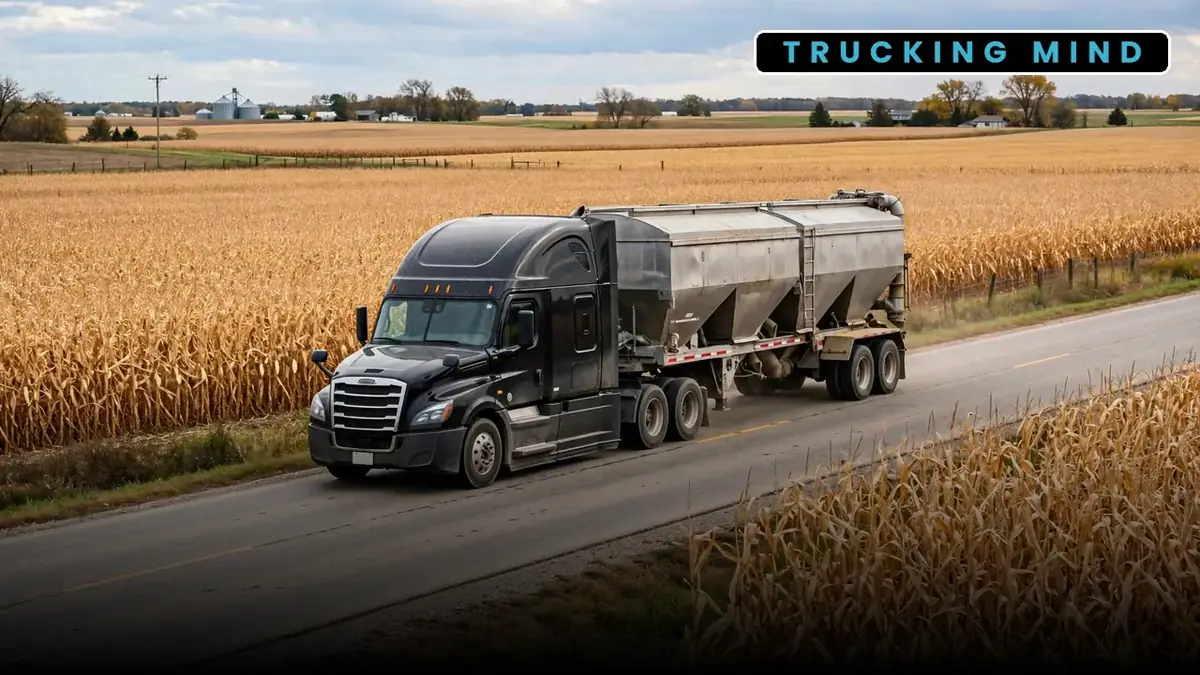
Grain hauling is the largest agricultural trucking market in Iowa. It splits into two worlds. Farm-owned grain trucks, often straight trucks or semi tractors with hopper-bottom trailers, move grain from field to on-farm storage or to the local elevator. For-hire grain carriers move grain from elevators to processors, ethanol plants and river terminals and from farms to elevators under contract.
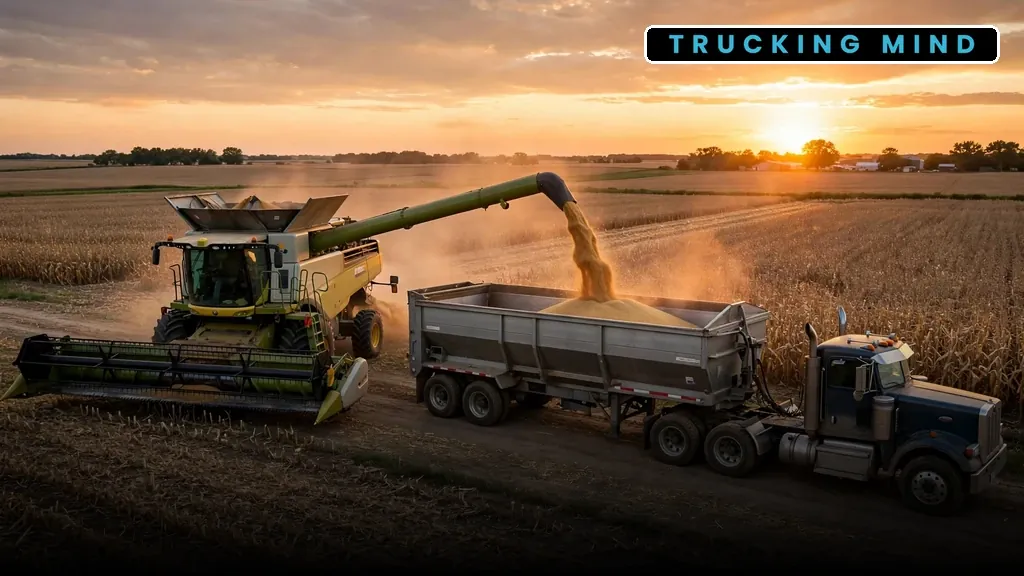
For a farm-owned truck, the exemptions above may cover short farm-to-market movements. For a for-hire carrier, the ordinary rules apply: intrastate or interstate authority, USDOT number, IRP and IFTA if interstate and overweight permits beyond legal limits. Assuming the farm exemption covers for-hire work is the most common compliance error in Iowa agricultural trucking.
Livestock hauling adds animal-welfare and hours considerations, but a commercial livestock hauler running interstate is an ordinary interstate carrier for authority and registration purposes, regardless of cargo.
Farm inputs move in the other direction: fertilizer, seed, chemicals and feed move from agribusiness locations to farms. Fertilizer in dry, liquid and gaseous forms, manure in dry and liquid forms and distillers grains are among the commodities Iowa has specifically listed in harvest-season weight proclamations, which shows how central these movements are to the state's agricultural economy. A carrier hauling fertilizer must also consider hazardous materials rules: anhydrous ammonia and certain other fertilizers are hazardous materials. Hazmat registration, placarding and driver endorsement requirements apply regardless of any farm exemption. Check the material, not just the customer, before accepting a fertilizer load.
Overweight Permits and Harvest Proclamations
Iowa's ordinary overweight permit system requires permits for loads beyond legal weight limits. The system expects divisible loads to be split rather than permitted overweight. Harvest season changes that calculus temporarily. Iowa governors have repeatedly issued disaster emergency proclamations suspending weight restrictions for agricultural trucks during harvest.
A recent harvest proclamation illustrates the pattern: effective for a defined window in September and October, trucks carrying corn, soybeans, hay, straw, silage, stover, fertilizer in dry, liquid and gas forms, manure in dry and liquid forms and distillers grains were permitted to weigh up to 90,000 pounds gross weight without a permit, on all Iowa highways except interstates. Axle weights could exceed standard limits by no more than 12.5 percent, no single axle could carry more than 20,000 pounds. All vehicles still had to obey posted weight limits on roads and bridges. The proclamation suspended the sections of Iowa Code and administrative rules governing overweight divisible loads for the listed commodities, on the stated ground that strict compliance would prevent or hinder time-sensitive harvest activities.
A recent harvest proclamation illustrates the pattern: effective for a defined window in September and October, trucks carrying corn, soybeans, hay, straw, silage, stover, fertilizer in dry, liquid and gas forms, manure in dry and liquid forms and distillers grains were permitted to weigh up to 90,000 pounds gross weight without a permit, on all Iowa highways except interstates.
Lessons for planning around harvest:
- Proclamations are temporary and commodity-specific. A proclamation covers listed commodities for a defined window. It does not create a permanent 90,000-pound limit. It does not cover commodities outside the list.
- Interstates are excluded. The harvest suspension described above applied to all Iowa highways except interstates. An overweight load on I-80 or I-35 during harvest still needs the ordinary permit treatment.
- Posted limits still apply. Bridge and road postings override the proclamation. A route that crosses a posted bridge at a lower limit cannot use the proclamation to exceed the posting.
- Axle limits still bind. The 12.5 percent axle tolerance and the 20,000-pound single-axle cap mean the gross weight allowance is not a license to load axles without limit.
- The proclamation does not waive other rules. Authority, registration, insurance, driver licensing and hours rules outside the suspended sections remain in force.
Watch for the harvest proclamation each year, confirm its commodities, dates and exclusions in the actual text and do not quote a rate that assumes it will be issued or cover your commodity.
Intrastate Authority for Agricultural Carriers: Putting It Together
- Farmer hauling his own products and equipment. Likely covered by farm exemptions for many movements, subject to the driver, vehicle, distance and route conditions described above. Still needs proper vehicle registration and insurance and must respect the limits of each exemption.
- Farm-service or agribusiness carrier hauling for others intrastate. Needs Iowa intrastate for-hire authority, a USDOT number and proper registration and insurance. Farm exemptions may cover some movements, but the carrier should not assume they cover for-hire work.
- Interstate agricultural carrier. Needs federal operating authority, USDOT number, IRP, IFTA and UCR, plus Iowa registration of that authority. Farm exemptions may modify hours-of-service treatment for qualifying movements, but they do not replace authority or registration.
A farmer who sometimes hauls a neighbor's grain for pay should confirm where the line falls for that paid work; the moment freight moves for compensation for another person, the for-hire framework presumptively applies.
Iowa Checklist for Agricultural Carriers
- Determine your box: own-farm, intrastate for-hire, or interstate and hold the authority that matches it.
- Get a USDOT number and enter it on the Iowa intrastate application if you operate for hire intrastate.
- Register interstate authority with Iowa DOT and maintain IRP, IFTA and UCR if you cross state lines.
- For implements of husbandry, apply the Iowa DOT farmer's guide chart: driver, vehicle type, in-state versus out-of-state and the 35-mile-per-hour and no-interstate conditions for self-propelled implements.
- Document every farm-exempt trip: farm, commodity, destination, driver and exemption basis.
- Never assume a farmer's exemption transfers to a for-hire carrier hauling the same load.
- Check hazmat rules for fertilizer and chemical loads regardless of farm status.
- Watch for the annual harvest proclamation, confirm its commodities and dates and remember that interstates and posted bridge limits are excluded.
- Keep authority, registration, insurance and permit documents in the truck and organized by vehicle.
Frequently Asked Questions
Does a farmer need a permit to move a tractor on the road?
For movement on the farm, no permit is needed. For a truck tractor, farm tractor, or straight truck hauling an implement of husbandry off the farm in-state, no permit is needed if driven by a farmer for non-interstate travel. Self-propelled implements are exempt under Iowa Code section 321.453, at 35 miles per hour or less and off the interstate.
Does the farm exemption cover a for-hire carrier hauling a farmer's grain?
Generally no. The exemptions are tied to the farm operation and, in many cases, to the farmer as driver. A for-hire carrier hauling another person's grain for pay needs the ordinary intrastate or interstate authority and permits.
What is Iowa's harvest weight allowance?
Harvest proclamations have allowed listed agricultural commodities up to 90,000 pounds gross weight without a permit on non-interstate highways, with axle limits of no more than 12.5 percent over standard and a 20,000-pound single-axle cap and posted limits still applying. Each proclamation is temporary and commodity-specific, so confirm the current proclamation text before relying on it.
Do Iowa intrastate carriers need a USDOT number?
Yes, in most cases. Most intrastate motor carriers operating for hire in Iowa are required to have a USDOT number, entered on the intrastate application or obtained through FMCSA's MCSA-1 process.
Can an overweight farm load use the interstate during harvest?
Under the harvest proclamation pattern described above, no. The suspension applied to all Iowa highways except interstates. Overweight interstate movements need ordinary permit treatment.
Do farm drivers need a CDL?
It depends on the vehicle and the movement. The licensing exemption in Iowa Code section 321.176 covers farm tractors and implements of husbandry moving between the home farm and nearby farmland for farm purposes. Operating a semi truck in commercial service generally requires the appropriate CDL. For-hire drivers should hold the CDL for their vehicle class regardless of cargo.
Where do I find Iowa's official farm transportation rules?
The Iowa DOT farmer's guide, "Plowing Through the Regulations," is the state's plain-language reference. The underlying rules are in Iowa Code chapters 321 and 327B and related administrative rules. Confirm any exemption against the current statute and guide before relying on it.
Trucking Mind: practical guides for owner-operators and small fleets.
This guide was prepared in good faith from official sources, including FMCSA and state agency publications, and was checked at the time of writing. Fees, rules and procedures change. Errors and omissions are excepted. Please confirm current requirements with the relevant agency before filing or travelling. If you spot anything that needs correcting, email us at contact@truckingmind.com — we will verify it and update this page.