Key Points:
- Colorado-only for-hire work needs PUC authority, not an MC number: a certificate for common carriers serving the public and a permit for contract carriers serving specific customers.
- PUC applications run through the online E-filings portal and are noticed to the public for 30 days; filing costs $36.00, a $5.00 issuance fee may apply and vehicle stamps cost $51.00 each.
- The 72-hour laden weight permit, the special fuel tax permit and the 60-day harvest permit are bought online through CDOT's COOPR system, not at ports of entry.
- Oversize fees are published and specific: $30 for a single-trip oversize permit, $30 plus $10 per axle for overweight, $250 for an annual oversize permit and $400 for an annual overweight or combined permit.
- From September 1 to May 31, commercial vehicles over 16,000 pounds must carry chains on the designated mountain highways. CDOT's fines reach $1,000 plus a $156 surcharge for blocking the road unchained.
Colorado is the state where a paperwork mistake and a mountain mistake can both stop a truck on the same day. A new owner-operator who plans to haul only inside Colorado needs intrastate authority from the Colorado Public Utilities Commission (PUC), not federal authority — but that authority alone does not get a load over Vail Pass in a snowstorm. Colorado also runs an online permit system for weight and fuel permits, charges its own oversize fees and enforces one of the strictest commercial vehicle chain laws in the country. This guide covers all of it for 2027 operations: who needs PUC authority, how to apply, what it costs, which online permits replace the old port-of-entry purchases and how to run the mountain corridors legally and safely.
Intrastate vs. Interstate in Colorado
The test is the same as in every state, but Colorado carriers trip over it more often than most, because Denver, Colorado Springs and the Front Range sit close to Wyoming, Kansas, Nebraska and New Mexico. A load picked up and delivered inside Colorado is intrastate. A load that crosses a state line, or forms part of a through interstate movement, is interstate — even if your truck only runs the Colorado leg. Do not use intrastate authority to cover a leg of an interstate shipment.
Interstate for-hire work requires federal operating authority from the FMCSA, an MC number, a BOC-3 filing and FMCSA insurance filings. Intrastate for-hire work in Colorado requires PUC authority instead. No MC number is needed for that intrastate work alone. A USDOT number is still required: intrastate commercial vehicle operators in Colorado need a USDOT number. Enforcement officers check it alongside PUC credentials and Unified Carrier Registration (UCR) status at the roadside. If you plan to run both kinds of freight, get both authorities before you haul the loads that need them and keep the two compliance calendars separate.
Private carriers hauling their own goods do not need PUC for-hire authority, but they still need a USDOT number where thresholds are met, proper vehicle registration and compliance with size, weight, chain and safety rules. If you haul for others for pay, even for one regular customer, you are in for-hire territory and should apply.
Who Needs PUC Authority — and Which Kind
Colorado requires intrastate for-hire carriers to obtain authority from the PUC. The system draws a line between two kinds of carrier. A common carrier serves the general public and applies for authority (a certificate). A contract carrier serves specific customers under contract and applies for a permit. The distinction matters because the application forms differ and because existing carriers may object during the public-notice period. It does not change the basic point: hauling for hire entirely within Colorado without PUC authorization is a separate violation from missing a USDOT number. It catches new carriers off guard.
Household goods movers are a special case within PUC regulation, with their own consumer-protection rules, including a requirement to include the PUC permit number, true name and physical address in advertisements and a consumer advisement process for household moves. If household goods are your niche, read the PUC's household goods rules in full before quoting a move; this guide covers general freight authority. Household goods work carries additional duties that general freight does not.
Applying for PUC Authority: Steps and Fees
Applications for common and contract carriers are submitted through the PUC's online E-filings portal, using the current application form for a new or extended permanent authority or permit, a temporary authority or permit, or an emergency temporary authority or permit, as the situation requires. A new general freight carrier ordinarily applies for permanent authority or a permanent permit. Temporary and emergency temporary options exist for time-limited needs and transfers, suspensions and abandonments each have their own forms, so choose the form that matches what you are actually asking for.
After filing, applications are noticed to the public for a 30-day period, during which existing common or contract carriers may have a right to object, known as an intervention. If no objection is filed, the Commission may issue the authority or permit directly. If an objection is filed, the matter may be referred to an Administrative Law Judge for disposition. That notice period is the reason PUC authority cannot be promised on a same-week timeline: even an unopposed application needs its notice window. An opposed one takes longer. Do not sign a Colorado-only shipper contract with a start date inside the notice period.
The filing fees are modest and published by the PUC. The filing cost for a common or contract carrier application is $36.00, a $5.00 issuance fee may also be required if the authority or permit is granted and vehicle stamps cost $51.00 each. Budget for one stamp per vehicle you will operate under the authority and confirm the current stamp requirement for each unit before you add a truck mid-year. Common carrier authorities and contract carrier permits are issued for an indefinite period unless revoked, suspended, cancelled, or abandoned, which makes the upfront wait a one-time cost for a carrier that stays in good standing.
The filing cost for a common or contract carrier application is $36.00, a $5.00 issuance fee may also be required if the authority or permit is granted and vehicle stamps cost $51.00 each.
Insurance is part of the issuance process, not an afterthought. Your insurance company files a copy of the required commercial motor vehicle liability policy on your behalf through the PUC's online insurance portal. The minimum levels sit in the PUC's motor carrier rules at 4 CCR 723-6, Rule 6008, as combined single limits proved by a Form E certificate of insurance or a Form G surety bond filed with the Commission. The rule sets $750,000 for movers operating vehicles of 10,000 pounds GVWR or more and $300,000 below that weight. Towing carriers sit at $750,000 at any GVWR. Passenger carrier minimums rise by seating capacity from $500,000 to $5,000,000. Colorado has also adopted the federal financial responsibility rules in 49 CFR Part 387 for intrastate carriers, so the federal schedule is the floor a general freight carrier works from. Do not treat the filing as complete because you bought a policy; confirm with the insurer that the PUC filing was actually made and in the exact legal name on the application. Shippers and brokers will usually require higher limits than any state minimum in any event, so price the coverage the freight demands.
Vehicle Registration, IRP, IFTA and UCR
A Colorado-only carrier registers its trucks in Colorado and does not need International Registration Plan (IRP) apportioned plates or an International Fuel Tax Agreement (IFTA) license, because both programs are triggered by interstate operation. The saving is real, but it ends at the state line. A qualifying vehicle that begins running interstate needs IRP registration apportioned by miles in each jurisdiction and IFTA licensing with quarterly fuel tax returns through the base jurisdiction. Interstate carriers must also register annually under UCR, a federally mandated program administered in Colorado through the PUC, covering interstate motor carriers, private carriers, freight forwarders, brokers and leasing companies. A purely intrastate carrier does not file UCR; a carrier with interstate authority does. Roadside officers check UCR status during inspections.
Federal Heavy Vehicle Use Tax applies at 55,000 pounds taxable gross weight or more regardless of whether the operation is intrastate or interstate. File IRS Form 2290 and keep the stamped Schedule 1 with the vehicle record. Colorado registration itself is a separate step from PUC authority: the authority lets you haul for hire, the registration lets the truck run on public roads. Both must be current.
COOPR: Colorado's Online Permit System
Colorado has moved key commercial vehicle permits online. New carriers should build their dispatch routine around that fact rather than around port-of-entry stops. Certain permits that were once available at ports of entry must now be purchased online through the Colorado Department of Transportation's COOPR permitting system. The permits affected include the 72-hour laden weight permit, the special fuel tax permit and the 60-day harvest permit. If your dispatch plan still says "pick it up at the port," rewrite it.
The 72-hour laden weight permit is for a vehicle over 16,000 pounds when empty that is not registered in Colorado and is not apportioned for Colorado through IRP. Instead of registering in Colorado, the operator applies for the permit, stating the loaded weight, up to the legal maximum of 80,000 pounds. The special fuel tax permit is for a commercial motor vehicle with three or more axles, or weighing over 26,000 pounds when loaded, that must pay Colorado special fuel tax; in lieu of purchasing fuel in Colorado, the operator applies for the permit, supplying the entry point into the state, the destination and the total miles to be traveled in Colorado. The 60-day harvest permit is for a non-apportioned vehicle coming into Colorado for custom harvesting for a local farmer, allowing harvesting operations for up to 60 days at a lower rate than repeated 72-hour permits, with a limit of two such permits per vehicle in a 12-month period.
To use COOPR, fleets establish a CDOT account with verified business documentation, including a valid USDOT number. The system is accessible around the clock, but processing is not always instantaneous. Applications submitted over a weekend can face delays. Set the account up before you need a permit and apply before the truck reaches the state line, not while it is waiting there. A permit bought in a hurry at the roadside is a delay; a permit bought the day before is routine.
Oversize and Overweight Permits and Legal Limits
Colorado's legal limits for standard operations are a height of 14 feet 6 inches, a width of 8 feet 6 inches, a gross vehicle weight of 80,000 pounds on interstate highways and 85,000 pounds on non-interstate highways and, for tractor-semitrailer combinations, no overall length limit as long as the trailer does not exceed 57 feet 4 inches; other combinations are capped at 70 feet and four units. Loads beyond those limits need a CDOT permit. Non-divisible loads cannot exceed 200,000 pounds gross vehicle weight under standard permits.
Permit fees depend on type and duration. A single-trip oversize-only permit costs $30, a single-trip overweight-only permit costs $30 plus $10 per axle, an annual oversize permit costs $250 and an annual overweight or combined oversize and overweight permit costs $400. A superload single-trip permit — for loads over 500,000 pounds, or a double dolly wider than 15 feet — costs $800, while loads between 200,000 and 500,000 pounds require a special single-trip permit at $250. Fleet operators can buy CDOT's annual Company Fleet Permit, priced in statute at $3,000 for a fleet of two to ten vehicles plus $300 for each additional vehicle. The permit covers the fleet's oversize permits, overweight permits, or both. Order the permit before the move, follow its route and conditions and remember that a permit for one load, route and configuration does not transfer to a different load or route.
Mountain-State Operating Rules: Chains, Grades and Winter
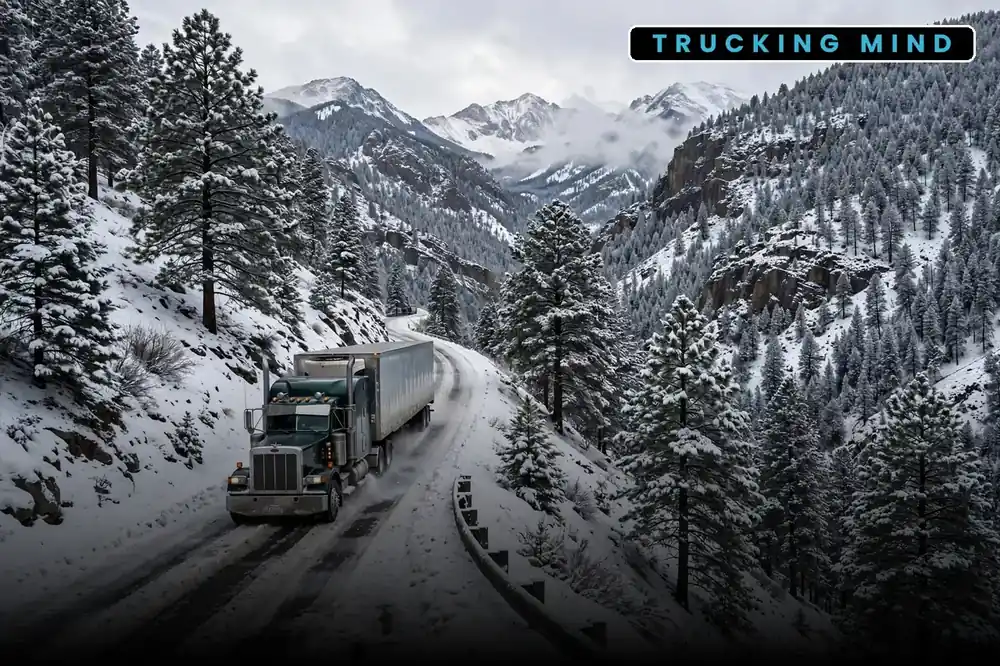
This is the section that separates a Colorado carrier from a flatland carrier. Colorado's commercial vehicle chain-carrying law applies to vehicles with a combined weight of more than 16,000 pounds on designated mountain highways. It runs from September 1 through May 31 each year. The designated network covers roughly 1,400 miles, including portions of Interstate 70 and U.S. highways 40, 50, 160 and 285, along with designated state highways. On I-70, the core corridor runs from mile marker 259 at Morrison westward. The mountain corridor between Dotsero and Morrison is the stretch every Colorado driver learns first. The requirement to carry chains applies regardless of road conditions during the season. Carrying chains is not optional because the sky is clear at the truck stop.
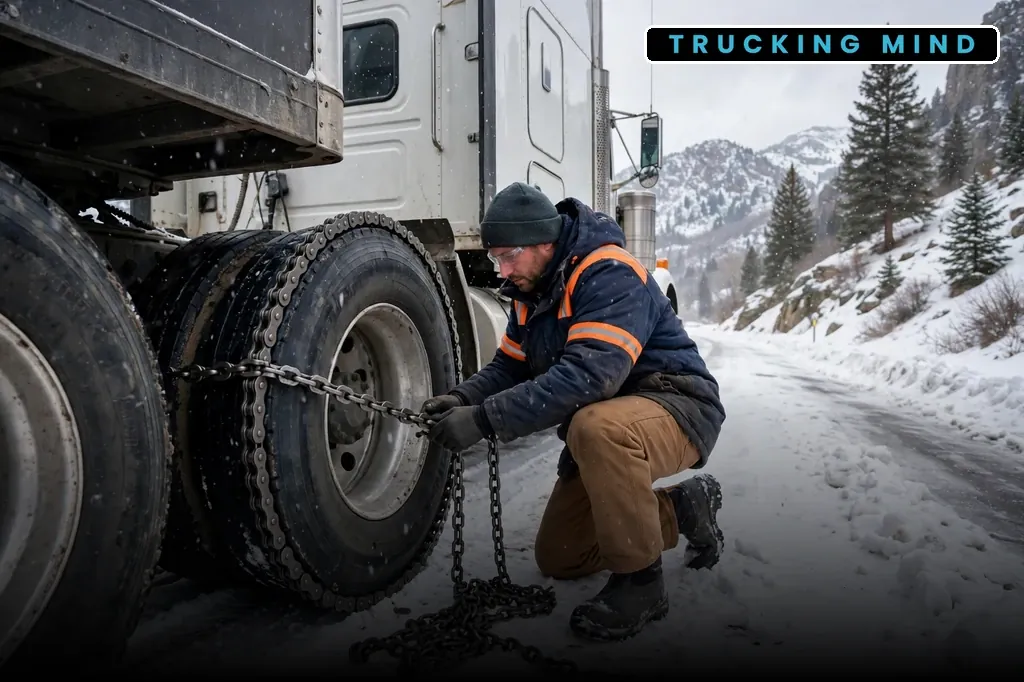
When CDOT or the Colorado State Patrol activates chain restrictions, drivers must install chains or approved alternative traction devices. The rules operate in levels: at the lower level, single-drive-axle combination commercial vehicles must chain all four drive wheels and cables are not permitted as alternative devices, while other commercial vehicles must have snow tires or chains; at the higher level, all commercial vehicles must chain up, with single- and tandem-drive-axle combinations chaining four drive wheels. The detailed placement rules depend on configuration. Straight trucks chain four drive tires, using chains, AutoSocks, cables of sufficient diameter, auto chains, or sanders. Single-drive-axle combinations chain four tires with chains, AutoSocks, auto chains, or sanders — no cables. Tandem-drive-axle combinations chain four tires with the same menu, including cable combinations of specified diameter. AutoSocks and tire cables cannot be used together. Auto transporters follow the same list but must not use chains where doing so risks hydraulic lines, using approved alternative devices instead. Travel is restricted if the vehicle cannot chain.
Fines give the law its teeth. CDOT's current published schedule sets the penalty for not carrying chains on the designated corridors in season at $100 plus a $32 surcharge. Statewide, noncompliance with winter driving restrictions draws up to $500 plus a $78 surcharge. Blocking a traveled portion of the roadway draws $1,000 plus a $156 surcharge. Use only designated chain-up and chain-down stations; stopping in a live lane to install chains is itself a serious violation and a safety hazard. Check conditions before entering the mountains through CDOT traveler information and electronic message signs and build weather delays into mountain delivery promises. A dispatcher who promises a mountain delivery time without a weather contingency is promising something the road may not deliver.
Grades deserve the same respect as snow. The I-70 mountain corridor includes long, steep descents, notably around the Eisenhower Tunnel and Vail Pass, where brake management decides whether a descent is routine or an emergency. Descend in a low gear, use engine braking, check brakes at the top and never ride the service brakes all the way down. Mountain driving also means altitude: a truck that pulls strongly at Denver elevation will pull less at 11,000 feet. A driver new to altitude should expect slower climbs and plan passing and merging accordingly. Carry extra food, water, warm clothing and a charged phone on mountain runs in winter and know where the next safe parking is before the weather closes in, not after.
Safety, Inspections and Records
Colorado adopts federal safety standards for commercial vehicles in large part. Intrastate carriers should build their programs to the federal standard: driver qualification files, medical certificates, hours-of-service records, daily vehicle inspections, maintenance records and drug and alcohol testing for CDL drivers. Keep medical certificates current, keep inspection and repair records complete and keep hours records in the form required for your operation. The PUC's transportation rules also govern household goods movers and other regulated carriers in detail, so a carrier in a regulated niche should read the applicable PUC rule chapter, not just the general safety rules.
Vehicle marking matters at every inspection: display the legal company name and USDOT number as required, keep markings legible and keep the PUC credential information available for the vehicle. A carrier whose paperwork is right but whose markings are missing or mismatched will still be stopped. A stop that begins with markings often becomes a full inspection. The cheapest inspection is the one your own pre-trip catches before you leave the yard.
Common Mistakes New Colorado Carriers Make
The first mistake is hauling intrastate freight without PUC authority, on the theory that a USDOT number is enough. It is not. The second is the opposite: buying federal authority, BOC-3 and UCR for a business that will only run Colorado freight. The third is waiting until a load is booked to apply for PUC authority and then discovering the 30-day notice period. The fourth is planning to buy a weight or fuel permit at a port of entry that no longer sells it. The fifth is entering the mountains in October without chains because the weather was fine in September — the carry season starts September 1. The first mountain storm does not wait for a convenient date. The sixth is chaining incorrectly: wrong tires, cables where cables are not allowed, or AutoSocks mixed with cables. Practice chaining in a yard, in daylight, before the first storm and carry the placement guide for your exact configuration in the cab.
Frequently Asked Questions
Do I need PUC authority if I only haul inside Colorado?
Yes, if you haul for hire. Colorado requires intrastate for-hire carriers to obtain PUC authority: a certificate for common carriers serving the public, a permit for contract carriers serving specific customers. Private carriers hauling their own goods do not need PUC for-hire authority.
What does PUC authority cost?
The application filing fee is $36.00, a $5.00 issuance fee may apply if authority or a permit is granted and vehicle stamps cost $51.00 each. Those are filing costs only; insurance, registration and operating costs are separate.
How long does PUC authority take?
Applications are noticed to the public for 30 days, during which existing carriers may object. An unopposed application may then be issued directly, while an opposed one may go to an Administrative Law Judge. Plan for at least the notice period and do not promise a start date inside it.
Do I need an MC number for Colorado-only work?
No. An MC number is federal interstate authority. For Colorado-only for-hire work you need PUC authority and a USDOT number. The difference between the two numbers is explained in MC Number vs DOT Number.
What is COOPR and what permits must I buy there?
COOPR is CDOT's online permitting system. The 72-hour laden weight permit, the special fuel tax permit and the 60-day harvest permit must now be purchased online rather than at ports of entry. Set up a COOPR account with your USDOT number before you need a permit.
When must I carry chains in Colorado?
From September 1 through May 31, commercial vehicles over 16,000 pounds combined weight must carry chains or approved alternative traction devices on designated mountain highways, including much of I-70 and U.S. routes 40, 50, 160 and 285, regardless of current conditions. You must install them when CDOT or the State Patrol activates chain restrictions.
What are Colorado's legal size and weight limits?
Height 14 feet 6 inches, width 8 feet 6 inches, 80,000 pounds gross on interstates and 85,000 pounds on non-interstate highways, with a 57-foot 4-inch trailer limit for tractor-semitrailers. Beyond those limits, get a CDOT oversize or overweight permit before the move.
Where should a new owner-operator start?
Start with the operating plan — Colorado-only or interstate, general freight or household goods — and let it choose the authority. The step-by-step startup sequence is covered in How to Start a Trucking Company. This Colorado guide supplies the PUC, COOPR and mountain rules that sit on top of it.
This guide was prepared in good faith from official sources, including FMCSA and state agency publications, and was checked at the time of writing. Fees, rules and procedures change. Errors and omissions are excepted. Please confirm current requirements with the relevant agency before filing or travelling. If you spot anything that needs correcting, email us at contact@truckingmind.com — we will verify it and update this page.