
Key Points:
- Arizona does not issue a single, general intrastate authority certificate for property carriers: regulation runs through ADOT Motor Carrier Services registration, Arizona Corporation Commission business registration, vehicle registration and fuel tax credentials.
- Get the federal foundation first: USDOT number, MC operating authority active, insurance filings and a BOC-3 designation — ADOT requires operating authority to be active before you submit your application.
- ADOT requires a real, documentable Arizona place of business or Arizona residency proof and virtual offices are not accepted; qualifying units of 55,000 pounds or more need IRS Form 2290 filed before plates.
- Single-trip permits expire after 96 hours or on exiting Arizona, whichever comes first and are priced by mileage and axles — a five-axle vehicle pays $5 per 50-mile increment, up to $45 for 401 to 450 miles.
- For longer stays without full credentials, registration permits run 30, 60, or 90 days and use fuel permits run 30, 90, or 180 days at $130, $390 and $780 for qualifying diesel vehicles.
- Oversize loads follow the Class A limits — nonreducible, no more than 14 feet wide, 16 feet high, 120 feet long and 250,000 pounds combined — and anything beyond them needs a Class C permit through ADOT’s ePro system.
Arizona looks simple on a map: Phoenix and Tucson anchor the freight market, Interstate 10 and Interstate 40 carry the long-haul volume and the state’s ports of entry handle traffic from California, New Mexico, Nevada, Utah and Mexico. The permit system, however, has a quirk that confuses new carriers. Arizona does not issue a single, general “intrastate authority certificate” for property carriers in the way Tennessee does.
Instead, Arizona’s system is built around the Arizona Department of Transportation (ADOT) Motor Carrier Services registration, apportioned registration, fuel tax licensing, business entity registration and a detailed trip-permit system for carriers that enter without full credentials. If you arrive in Arizona looking for one intrastate authority form, you will not find it — and if you assume that means Arizona requires nothing, you will be wrong in a different and more expensive way.
For the full state-by-state picture, see our trucking permits by state hub.
This guide explains the Arizona system as a new owner-operator actually encounters it: the federal foundation, business and ADOT registration, the intrastate picture, IRP and IFTA, single-trip and use fuel permits, oversize and overweight permits, ports of entry and a step-by-step checklist. It is written for a carrier based in Arizona and for a carrier based elsewhere that runs into Arizona regularly, because both need to understand the same system from different starting points.
What “Intrastate Authority” Means in Arizona
Start by clearing up the terminology, because it drives every later decision. In some states, intrastate authority is a named operating certificate issued by a state agency to for-hire carriers that operate only within that state. Arizona’s property-carrier system does not work that way.
Arizona-based for-hire carriers in interstate commerce obtain federal operating authority from FMCSA. Carriers operating in Arizona must be properly registered, must hold the correct vehicle registration and fuel tax credentials for the operation they are performing and must comply with Arizona safety and commercial vehicle rules enforced by ADOT and law enforcement.
That does not mean intrastate-only Arizona carriers are unregulated. It means the regulation comes through different filings: business entity registration with the Arizona Corporation Commission for corporations, LLCs and similar entities; USDOT registration; ADOT Motor Carrier Services registration for apportioned and fuel tax accounts where applicable; Arizona vehicle registration; insurance; and safety compliance. Specialized operations can carry additional requirements that a general freight carrier does not face and the time to discover them is before your first load, not at a port of entry.
If you haul household goods, passengers, hazardous materials, or other specialized cargo, treat that as a separate research track. Confirm the current Arizona requirements for that cargo with ADOT and any other agency that regulates it and do not extrapolate from the general freight rules in this guide.
The general freight system is well documented. Specialized cargo systems are narrower, change more often and punish assumptions.
The Federal Foundation First
As in every state, start with the Federal Motor Carrier Safety Administration. You need a USDOT number if you operate a commercial motor vehicle, generally a vehicle with a gross vehicle weight rating or gross combination weight rating of 10,001 pounds or more, a vehicle designed to transport 16 or more passengers, including the driver, or a vehicle transporting hazardous materials in a quantity requiring placarding.
For-hire carriers in interstate commerce also need MC operating authority, insurance filings and a BOC-3 process agent designation. If you are still sorting out which federal number does what, read MC Number vs DOT Number before you file.
ADOT’s own motor carrier guidance reinforces the federal starting point: applicants for Arizona motor carrier accounts need a USDOT number and, where applicable, operating authority that is active before submitting the application. That sequencing matters.
A carrier that applies to ADOT before its federal authority is active will be sent back to complete the federal step first and the delay is entirely avoidable. Get the USDOT number, activate the authority, file the insurance and then approach ADOT with a complete package.
Insurance for for-hire general freight in interstate commerce is commonly maintained at a minimum of $750,000 in public liability coverage, with higher limits for hazardous materials and certain other cargoes and your insurer files proof with FMCSA. New interstate carriers enter FMCSA’s New Entrant Safety Assurance Program, monitored for the first 18 months with a safety audit during that period. Build your safety files from the first load: driver qualification files, drug and alcohol testing enrollment, hours-of-service records, vehicle inspection and maintenance records and an accident register.
Business Registration and the ADOT Established Place of Business
Arizona-based carriers that register as corporations, LLCs, partnerships, or similar entities must register with the Arizona Corporation Commission. ADOT Motor Carrier Services requires registration for the business license types it lists, including corporations, LLCs and professional LLCs, limited partnerships and limited liability partnerships and business trusts.
Keep the entity name consistent across the Corporation Commission registration, the USDOT registration, the ADOT application and the insurance filings. A name mismatch across filings is a routine cause of avoidable delay.
ADOT also requires evidence of an established place of business in Arizona or proof of Arizona residency for motor carrier account applicants. For an established place of business, acceptable evidence includes a business license, a commercial or real estate lease agreement that is not a short-term lease and includes dates for the length of registration, or a utility bill showing the business name and address.
Virtual offices are not accepted: ADOT states plainly that a virtual office is not a physical space you can visit or use as a workspace. For Arizona residency, applicants provide an Arizona driver’s license, commercial driver’s license, or identification card plus two additional documents from ADOT’s list, such as an Arizona personal vehicle registration, recent federal or state tax filings, a real estate or property tax assessment, a utility bill showing the service address, or a property rental, lease, or mortgage statement.
The practical lesson is to secure a real, documentable Arizona base before you apply. A mailbox, a virtual office address, or a friend’s address without supporting documentation will not satisfy the requirement and discovering that at application time costs weeks. Lease or document your base first, gather the supporting documents listed above and then file.
ADOT Motor Carrier Services forms can be emailed to mvdmcs@azdot.gov or mailed to MVD Motor Carrier Program, P.O. Box 2100, Mail Drop 527M, Phoenix, AZ 85001. Keep copies of everything you submit, note the date of submission and follow up if you do not receive confirmation within the expected window.
Arizona Vehicle Registration: IRP, Base Plates and the 2290
Arizona-based interstate carriers register through the Full Reciprocity Plan apportioned registration system, using the apportioned registration application and the title and registration application, with proof of vehicle ownership for each vehicle — a title, manufacturer’s certificate of origin, registration, or invoice or bill of sale. You also need a recordkeeping agreement and, for each unit with a gross vehicle weight rating of 55,000 pounds or greater, a copy of IRS Form 2290, the Heavy Highway Vehicle Use Tax Return.
File the 2290 before you apply for plates and keep the stamped Schedule 1 as proof of payment. A carrier that arrives at registration without the 2290 for a qualifying truck will be sent back for it.
Arizona intrastate-only carriers register their vehicles through the standard Arizona vehicle registration system rather than apportioned registration, but they still need to meet Arizona safety, insurance and commercial vehicle requirements. If you start intrastate-only and later take an interstate load, you need apportioned registration before that interstate trip, not after it. The same transition logic applies to fuel tax: intrastate-only operation does not need IFTA, but interstate operation in a qualifying vehicle does.
Your IFTA and IRP application in Arizona is filed on the combined IFTA/IRP application form (ADOT Form 70-0508). Keep an Individual Vehicle Mileage Record for every vehicle, keep fuel receipts and reconcile before each quarterly IFTA filing. Arizona, like every base jurisdiction, audits IRP and IFTA accounts and contemporaneous mileage and fuel records are the only records that audit cleanly.
Single-Trip Permits: Arizona’s Bridge Credential
Arizona’s single-trip permit system is one of the most detailed in the country and it is the credential that most often trips up out-of-state carriers entering Arizona without full credentials. For lawful travel to a destination within or through Arizona, foreign-based interstate carriers entering the state must provide evidence of a valid Arizona registration or IRP credential and fuel tax license. Carriers that do not possess the proper credentials must purchase the appropriate permits for travel in Arizona.
Single-trip permits expire after 96 hours, or four days, or upon exiting the state, whichever occurs first. That is a hard limit, not a guideline.
A carrier that enters Arizona on a single-trip permit and is still in the state after 96 hours without a new permit or full credentials is out of compliance. Plan the trip so the permit window covers the entire Arizona portion, including loading, unloading and any delays and do not assume an extension is available at roadside.
The cost of a single-trip permit is based on mileage increments and axle count, as published by ADOT. For a five-axle vehicle, the published schedule charges $5 for 1 to 50 miles, $10 for 51 to 100 miles, $15 for 101 to 150 miles, $20 for 151 to 200 miles, $25 for 201 to 250 miles, $30 for 251 to 300 miles, $35 for 301 to 350 miles, $40 for 351 to 400 miles and $45 for 401 to 450 miles, with lower charges for fewer axles and higher charges for six or more axles.
Calculate the permit cost from your actual Arizona mileage and axle count before you accept the load and include it in your rate. A permit fee discovered after the load is booked comes out of your margin.
ADOT’s single-trip page also lists separate fees that can apply on the same trip: a motor carrier permit fee of $12 for 0 to 50 miles or $48 for over 50 miles, for a commercial vehicle or vehicle combination with a GVWR of 12,000 pounds or more that is subject to Arizona registration and a use fuel permit fee of $16 for 0 to 50 miles or $65 for over 50 miles, for a qualifying diesel road tractor, truck tractor, truck, or passenger-carrying vehicle with a GVWR greater than 26,000 pounds and more than two axles.
Single-trip permits can be purchased online, through a national permit service, by mail using the address on the application form, in person at Arizona port of entry locations, or in person at the Central Commercial Vehicle Permit Office. Buying before you enter the state, online or through a permit service, is the smoothest path. Buying at a port of entry is possible, but it adds a stop, a queue and a risk of delay to a trip that may already be tight on hours.
Registration and Use Fuel Permits: The Longer Bridge
For carriers that need to operate in Arizona for longer than a single trip without full IRP or IFTA credentials, Arizona offers registration and use fuel permits for nonresident motor carriers. A 30-, 60-, or 90-day registration permit is issued to a commercial vehicle or vehicle combination, with the fee based on the declared gross vehicle weight rating, the year of the vehicle and the length of the permit period requested.
The vehicle must be currently registered in another state, jurisdiction, or country and the weight of the vehicle and load may not exceed the declared gross vehicle weight rating on the registration or permit while operating in Arizona. The permit can be verified against the registration at any Arizona port of entry or by law enforcement.
A 30-, 90-, or 180-day use fuel permit is issued to a use fuel (diesel) motor vehicle that is a road tractor, truck tractor, truck, or passenger-carrying vehicle with a gross vehicle weight rating greater than 26,000 pounds and more than two axles. The published permit fees are $130 for 30 days, $390 for 90 days and $780 for 180 days. These permits can be purchased online, through a national permit service, by mail, in person at port of entry locations, or in person at the Central Commercial Vehicle Permit Office.
The practical rule is the same as for single-trip permits: a bridge permit is a bridge, not a business model. If you run Arizona regularly, full IRP and IFTA accounts cost less per trip, create less paperwork per trip and eliminate the risk of a permit expiring mid-operation.
If you run Arizona occasionally, the bridge permits are a legitimate and well-designed way to stay legal without opening a full account for a handful of trips. Choose based on your actual frequency, not on a guess about next quarter’s freight.
Oversize and Overweight Permits: Class A, Envelope and Class C
Arizona requires a permit to move oversized or very heavy loads and its system distinguishes between permit classes based on the load. A Class A permit covers a load that is nonreducible, specifically described, no more than 14 feet wide, no more than 16 feet high, no more than 120 feet long and no more than 250,000 pounds combined vehicle and load weight. Envelope permits are issued for a nonspecific and nonreducible vehicle or cargo load that does not exceed 250,000 pounds gross weight, 14 feet in width, 16 feet in height, or 120 feet in overall length, with at least four axles unless otherwise approved by ADOT Enforcement and Compliance.
If your load exceeds any of the Class A criteria, you must seek a Class C permit, which is handled through ADOT’s ePro permitting system. ADOT’s ePro site is necessary for many permits and applications, including Class C permits, so set up ePro access before you need it under time pressure.
Measure the load accurately, plan the route ahead of time and confirm escort and travel restrictions for the exact dimensions. Oversize work rewards preparation and punishes improvisation and Arizona’s desert highways, with their long distances between services and their port of entry checks, are not the place to improvise. Part of that preparation is the price: work out the Arizona oversize permit cost for the load and route before you accept the load.
Ports of Entry and Enforcement
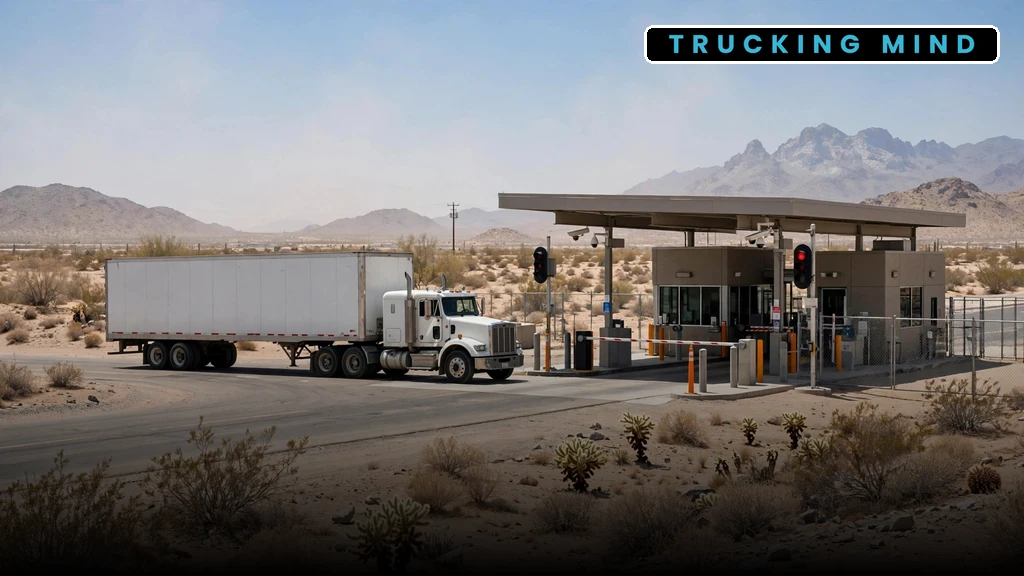
Arizona operates ports of entry where commercial vehicles are checked for registration, permits, weight and safety compliance. A single-trip, registration, or use fuel permit can be verified against the vehicle’s registration at any Arizona port of entry or by law enforcement, which means the permit must match the vehicle, the load and the route it actually covers.
Keep every permit in the cab, with the trip paperwork, where the driver can produce it immediately. A permit in the office, in an email inbox the driver cannot access, or in a different truck is not a permit at the port of entry.
Plan for port of entry stops in your dispatch times. Arizona’s distances are long, summer heat affects both drivers and equipment and a stop that was not planned becomes an hours-of-service problem on a tight schedule. Build the stop into the trip plan, keep the truck inspection-ready and treat the port of entry as a routine part of Arizona operations rather than an interruption to them.
Step-by-Step Checklist for a New Arizona Carrier
- Decide your operation type: for-hire or private, intrastate or interstate, Arizona-based or entering Arizona from another state and the cargo you will haul.
- Register with FMCSA for a USDOT number and, if you are a for-hire interstate carrier, apply for MC operating authority, file insurance proof and file your BOC-3 designation, with authority active before you approach ADOT.
- Register your business entity with the Arizona Corporation Commission if applicable and secure a real, documentable Arizona place of business — not a virtual office.
- Gather ADOT account documents: USDOT and authority evidence, Corporation Commission registration, established place of business or residency proof, vehicle ownership proof, Form 2290 for qualifying units and the recordkeeping agreement.
- Submit the ADOT Motor Carrier Services application, by email or mail and confirm the account is open before you operate under it.
- If you run interstate in a qualifying vehicle, complete IRP apportioned registration and the IFTA license, display plates and decals and set up mileage and fuel recordkeeping.
- If you enter Arizona without full credentials, purchase the correct single-trip, registration, or use fuel permit before entry, carry it in the cab and respect its expiration.
- If you haul oversize or overweight loads, confirm the permit class, fee, escort and route requirements for each load and set up ADOT ePro access for Class C permits.
- File IRS Form 2290 and keep the stamped Schedule 1 if your truck is 55,000 pounds or more.
- Calendar every renewal: IRP, IFTA, the biennial USDOT update, insurance filings and any ADOT account renewals.
Frequently Asked Questions
Does Arizona issue a separate intrastate authority certificate for general freight carriers?
Arizona does not operate a general intrastate authority certificate system for property carriers comparable to some other states. Arizona-based carriers obtain federal authority where applicable, register their business with the Arizona Corporation Commission and complete ADOT Motor Carrier Services registration, IRP and IFTA as their operation requires. Confirm with ADOT whether any specialized certificate applies to your exact cargo before operating.
What do I need to enter Arizona without IRP or IFTA credentials?
You need the appropriate Arizona permit purchased before travel: a single-trip permit, which expires after 96 hours or upon exiting the state, whichever occurs first, or a longer registration or use fuel permit for multi-trip operation over 30, 60, 90, or 180 days, depending on the permit type. The permit must match the vehicle, load and route and it must be carried in the cab.
How much does an Arizona use fuel permit cost?
ADOT publishes use fuel permit fees of $130 for 30 days, $390 for 90 days and $780 for 180 days for qualifying diesel vehicles. Confirm the current fees with ADOT at the time you purchase, as fee schedules can change.
What is a Class A permit in Arizona?
A Class A permit covers a nonreducible, specifically described load no more than 14 feet wide, 16 feet high and 120 feet long, with a combined vehicle and load weight of no more than 250,000 pounds. Loads exceeding any of those criteria require a Class C permit through ADOT’s ePro system.
Can I use a virtual office as my Arizona place of business for ADOT registration?
No. ADOT states that virtual offices are not accepted, because a virtual office is not a physical space you can visit or use as a workspace. Provide a business license, a non-short-term lease, or a utility bill showing the business name and address, or residency documentation from ADOT’s list.
Do I need IRP and IFTA if I only haul inside Arizona?
No. IRP and IFTA apply to interstate operations in qualifying vehicles. An Arizona intrastate-only carrier registers vehicles through the standard Arizona system and does not need apportioned plates or an IFTA license. If you later take an interstate load, open IRP and IFTA accounts, or obtain trip permits, before you cross the state line.
Where should I start if I am starting a trucking company in Arizona?
Start with the business and federal setup in How to Start a Trucking Company, then work through this guide in order: Corporation Commission registration, a real Arizona base, ADOT Motor Carrier Services registration with active federal authority, IRP and IFTA if you run interstate and trip permits only as a bridge for occasional Arizona entry. Getting the sequence right prevents the most common Arizona startup delays.
This guide was prepared in good faith from official sources, including FMCSA and state agency publications and was checked at the time of writing. Fees, rules and procedures change and errors and omissions are excepted.
Please confirm current requirements with the relevant agency before filing or travelling. If you spot anything that needs correcting, email us at contact@truckingmind.com — we will verify it and update this page.