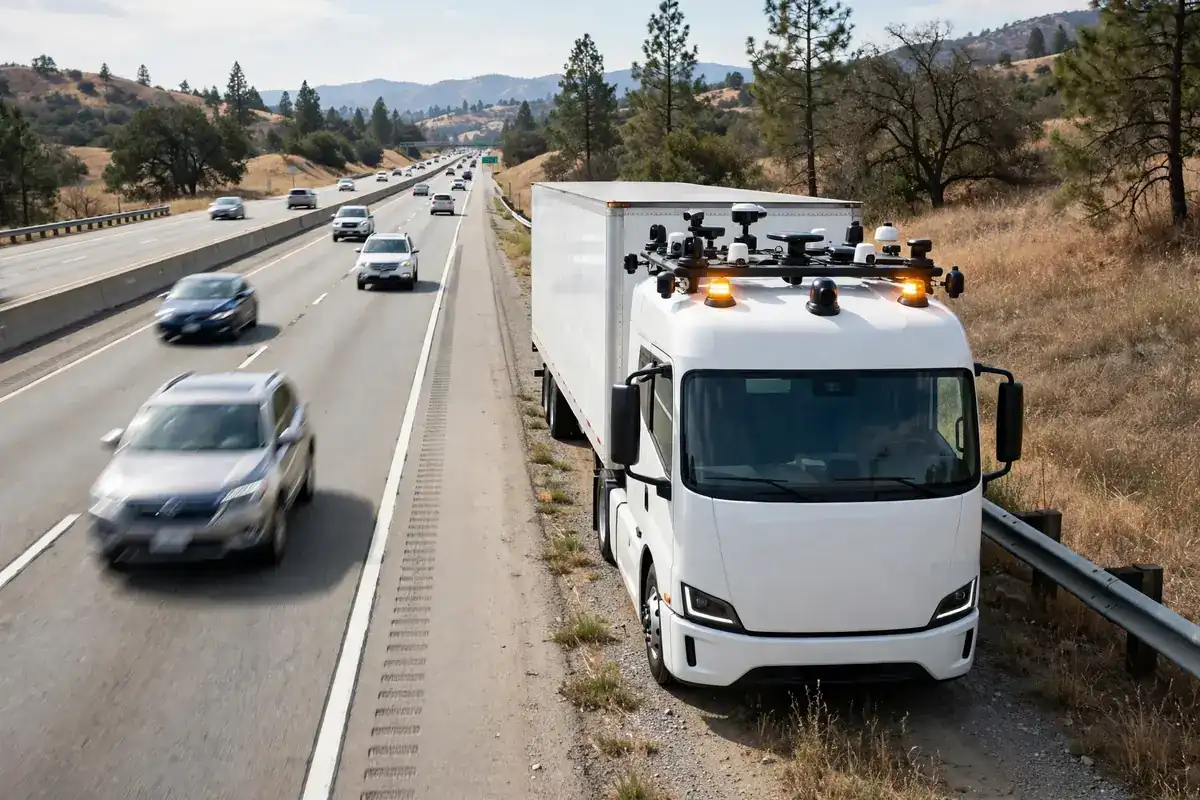
Sooner or later you will come up behind one: a semi stopped on the shoulder, no triangles out, no driver walking the line — just amber beacons flashing on the cab. Since 7 October 2026, that is legal and official: FMCSA has exempted Level 4 driverless trucks from the warning-triangle rule and allowed them to warn traffic with cab-mounted beacons instead, because a truck with no driver has nobody to walk triangles down the shoulder. This guide covers what those beacons mean, what a stopped driverless truck will and will not do, and the questions — including who gets the ticket — that do not have settled answers yet, said plainly where the rulebook runs out.
Key Points
- FMCSA's exemption of 7 October 2026 (Federal Register doc 2026-20734) lets Level 4 driverless trucks use cab-mounted beacons instead of warning triangles when stopped. It runs for five years, to 7 October 2031.
- Hazmat and passenger carriers are excluded from the exemption — it does not apply to a placarded driverless truck.
- The change was contested: the docket drew 402 public comments, with OOIDA opposing. Beacons are now a stopped driverless truck's warning devices — treat them exactly as you would a triangle set.
- Nobody will climb out of a stopped driverless truck. There is no driver to signal you, help you, or be helped — the human in the loop, where one exists, is remote.
- Who gets cited for a driverless truck's moving violation is not settled by any single federal rulebook: FMCSA's ADS-equipped vehicle rulemaking was listed in the August 2026 Unified Agenda and had not been published in checks through 10 November 2026.
The Rule That Changed: Beacons Instead of Triangles
The triangle rule exists for a simple reason: a stopped truck is a hazard, and the driver warns approaching traffic by placing warning devices behind it. A Level 4 driverless truck breaks the logic of the rule — the truck can stop itself, but no one is aboard to walk the shoulder with a triangle kit. FMCSA's answer, granted 7 October 2026 and running to 7 October 2031, is to let the truck warn traffic from the cab: mounted beacons, visible and flashing, in place of the triangles a driver would have set.
Three limits in the exemption matter. First, it covers Level 4 driverless trucks — genuinely driverless operations, not a supervised test truck with a safety driver aboard, who can still place triangles the ordinary way. Second, it excludes hazmat and passenger carriers entirely: the exemption is not a general permission, and it does not pretend a beacon solves the warning problem for a stopped placarded tanker. Third, it is an exemption, not a rewritten rulebook — a five-year bridge while the larger ADS rulemaking remains unpublished.
It was not uncontroversial. The docket drew 402 public comments, and OOIDA opposed the grant — the owner-operator argument being, in substance, that the device standard for a stopped truck should not bend around the absence of the driver. Whatever your view, the operational fact for 2027 is settled: on a stopped driverless truck, flashing cab beacons are the warning. Read them the way you read triangles.
What You Will See When One Stops
| At a stopped truck | Driver at the wheel | Driverless (Level 4) |
|---|---|---|
| Warning device | Triangles placed behind the truck by the driver | Cab-mounted beacons, under the FMCSA exemption of 7 October 2026 |
| Exemption ends | Not applicable | 7 October 2031 |
| Hazmat loads | Standard warning rules with the driver present | Excluded from the beacon exemption |
| Who gets out | The driver — to set devices, inspect, make calls | Nobody. No driver is aboard |
| Who is watching | The driver, on scene | The operating company, remotely where its system uses remote assistance |
| Roadside inspections | Driver presents documents and assists | The trucks are still inspected — 114 inspections in the tracked census |
The practical scene is this: the truck stops on the shoulder the way it was programmed to, beacons on, and it waits — for its own diagnostics, for remote assistance where the operator uses it, or for a human to be sent to it. It will not produce a driver to wave you past, and it will not pull back into traffic on a human's impulse: when it moves again, it moves on its system's decision. Give it the room you would give any stopped truck, pass it the way your state's rules require for a stopped vehicle on the shoulder, and do not read the beacons as a manned truck's four-ways about to merge — they are the equivalent of triangles, and they mean the truck is staying where it is.
Inspections Still Happen — the Record Is Public
A driverless truck is not outside the enforcement system that governs your truck. The Robotaxi Database's freight census, checked 11 November 2026, tracks five driverless carriers through the FMCSA record: 259 trucks, 4.2 million miles, and 114 roadside inspections, with an out-of-service rate of 1.8 percent against roughly 20 percent nationally, and no reportable crashes in the tracked set. Those are the census figures for a tiny, new, closely watched fleet — not a promise about every driverless truck — but they establish the working fact: these trucks enter scales, get inspected, and accumulate a public record like any carrier, under the operating company's authority. The paperwork lives with the company, because there is no driver to carry it.
Who Gets the Ticket? The Honest Answer
Here is where this guide refuses to do what much of the internet does, which is invent a confident answer. There is no comprehensive federal law for driverless trucks, and FMCSA's dedicated rulemaking for ADS-equipped commercial vehicles — the rulebook that would settle operating questions in one place — was listed in the August 2026 Unified Agenda but had not been published in checks through 10 November 2026. The beacon exemption settles the one roadside question it covers: how a stopped driverless truck warns traffic. It does not settle who is cited when a driverless truck commits a moving violation, and no source in our research establishes a settled procedure for it — in Texas or anywhere else. Anyone who tells you a specific, settled procedure is guessing.
Underneath the missing federal rulebook sits a patchwork: 36 states plus DC allow autonomous vehicle testing or deployment in some form, and at least 16 permit autonomous trucks (Delaware Legislative Services report, February 2026) — each with its own authorisation terms. California's heavy-duty testing rules of 28 April 2026 demand a safety driver first and 500,000 miles per phase. A practice that depends on which state the truck is standing in is, by definition, not a settled national procedure, and it will not become one until the federal rulemaking actually lands. Check whether driverless operation is legal where you run with the Driverless State Law Checker.
What is true today is structural: driverless trucks operate under a company's authority, inside a state authorisation framework — Texas's SB 2807 has been enforceable since 28 May 2026 — and the operating company is the legal person behind the truck. The questions drivers ask — the citation, the inspection conversation, the crash report — are being answered case by case inside that framework until a federal rulebook exists. For your own driving, nothing changes: no state authorisation adds a duty, a document or an endorsement to the human driver's side of an encounter with a driverless truck. Check which lanes driverless trucks are cleared to run with the Driverless Lane Checker.
What NOT To Assume
Do not assume there is a driver to signal you. No eye contact, no hand wave, no flash of the lights from a human being. If the truck is driverless, your communication with it is your position, your speed and your lights — drive so the machine's picture of you is simple and predictable.
Do not assume beacons mean a manned truck. Four-ways on a conventional truck usually mean a driver is present and may move. Beacons on a driverless truck mean the opposite arrangement: nobody aboard, truck staying put until its system or its company decides otherwise.
Do not assume someone will come out to help, or needs your help. A stopped driverless truck has no driver in trouble inside it. Its operator knows it has stopped. Roadside assistance, when it comes, comes from the company — your job is traffic safety around it, the same as any stopped vehicle.
Do not assume every driverless-looking truck is driverless. Supervised test trucks carry safety drivers who can and do place triangles and speak to officers. The beacon exemption belongs to genuinely driverless Level 4 operation; a person in the cab changes everything about the encounter, in your favour.
Common Mistakes and Watch-Outs
Crowding a stopped driverless truck. A truck that moves on programming moves when its conditions are met, not when a gap looks big enough to a human. Pass wide, pass once, and do not linger alongside it out of curiosity — the shoulder beside a beacon-lit truck is a work zone without workers, and it deserves the same discipline.
Waiting for a signal that is not coming. Drivers lose time and make late decisions sitting behind a stopped driverless truck expecting the wave-by a human would give. There is no human. Read the scene — beacons, shoulder, stopped — and make your own safe decision.
Repeating settled-sounding answers that do not exist. "The company just gets the ticket in the mail" and similar claims circulate in truck stops and forums as fact. The federal rulebook that would settle citation practice has not been published; the honest sentence is the one in this guide. Repeating invented procedure is how bad information becomes a driver's courtroom surprise.
Frequently Asked Questions
What do the flashing beacons on a driverless truck mean?
They are its warning devices. Under FMCSA's exemption of 7 October 2026 (Federal Register doc 2026-20734), a Level 4 driverless truck may use cab-mounted beacons instead of warning triangles when stopped, through 7 October 2031. Treat them exactly as you would a set of triangles: a stopped truck, warning traffic, staying put.
Does the beacon exemption cover hazmat trucks?
No. The exemption excludes hazmat and passenger carriers. It applies to Level 4 driverless trucks in ordinary freight — which is also one reason driverless hazmat operation is not a thing: the warning problem for a stopped placarded load has no beacon answer.
Who gets the ticket when a driverless truck breaks a traffic law?
It is not settled by any single federal rulebook, and this guide will not pretend otherwise. FMCSA's ADS-equipped vehicle rulemaking was listed in the August 2026 Unified Agenda and had not been published in checks through 10 November 2026. Driverless trucks operate under a company's authority within state authorisation frameworks; citation practice is being worked out inside that structure, case by case.
Do driverless trucks get inspected like mine?
Yes — the trucks, through the operating company's record. The Robotaxi Database census checked 11 November 2026 shows 114 roadside inspections across five tracked driverless carriers, with a 1.8 percent out-of-service rate against roughly 20 percent nationally, in a fleet of 259 trucks and 4.2 million miles.
What should I do when I come up on a stopped driverless truck?
What you do for any stopped truck, minus the human expectations: slow down, move over as your state's rules require, pass wide and once, and do not wait for a driver to signal you — there isn't one. The beacons are its triangles; read them that way and drive on.
Bottom Line
From 7 October 2026, a stopped driverless truck warns you with cab-mounted beacons instead of triangles — FMCSA's exemption, running to 7 October 2031, hazmat excluded, granted because there is no driver to walk the shoulder. Treat the beacons as triangles, expect nobody to climb out, pass with room, and do not build your understanding on anyone's invented answer to the ticket question: the federal rulebook that settles it has not been published yet. The truck may have no driver. The road rules around it are still yours.