
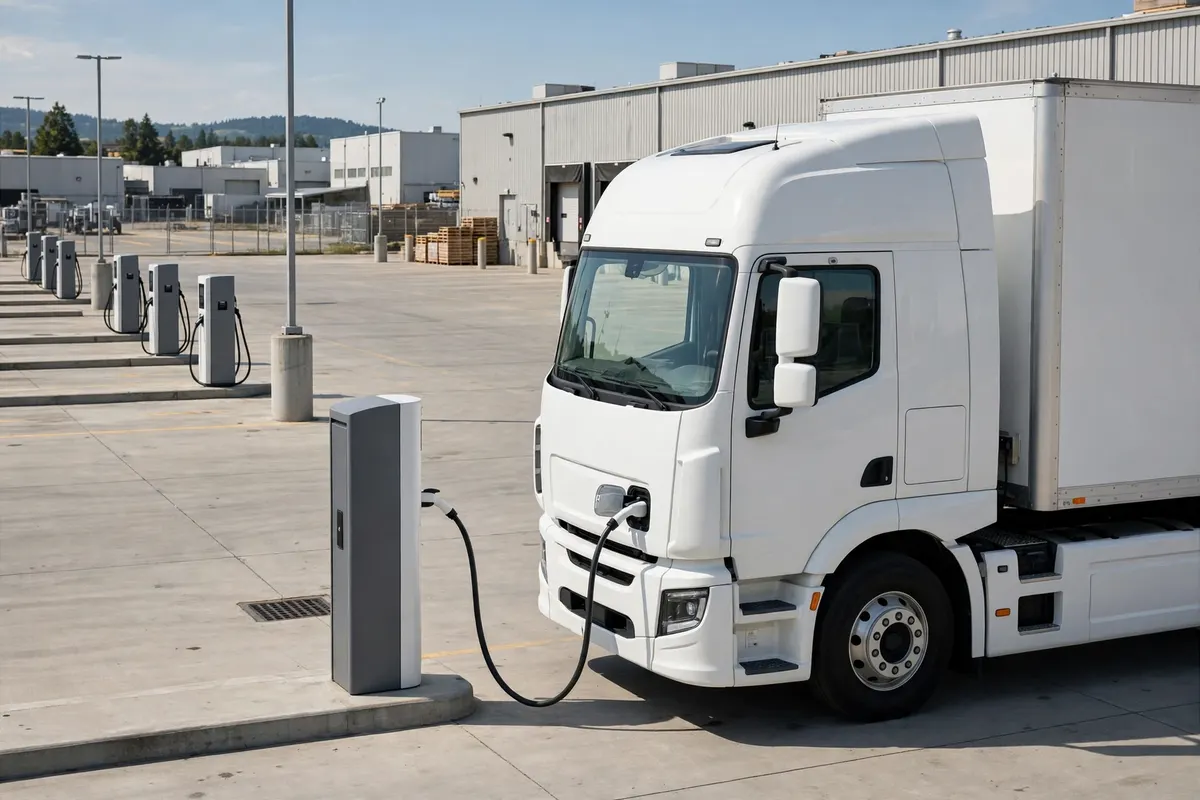
There is no federal tax credit for buying an electric truck in 2027. The commercial clean vehicle credit — Section 45W, the one that covered business vehicles and leases — ended for every vehicle acquired after 30 September 2025, along with the consumer credits and the charger credit that surrounded it. If you are pricing an electric semi or an electric box truck today, the credit is not part of the maths, and any dealer, article, or grant list that still shows it as available money is working from dead information.
That is the short answer and it is the whole point of this article. What follows is the detail that still matters: exactly what ended and when, the one narrow exception that lets a small group of buyers still claim, how the claim works for them, why the popular lease workaround died with the credits and what money actually replaces them in 2027 — because the replacement money is real, it is state-level and it is much bigger per truck than the federal credit ever was.
Key Points
- The One, Big, Beautiful Bill Act (P.L. 119-21, signed 4 July 2025) terminated the Section 45W commercial clean vehicle credit, the Section 30D new clean vehicle credit, and the Section 25E used clean vehicle credit for vehicles acquired after 30 September 2025, according to the IRS.
- The IRS states it directly on its Section 45W page: the Qualified Commercial Clean Vehicle Credit “is not available for vehicles acquired after Sept. 30, 2025.”
- The only exception is the transition rule: a buyer who signed a binding written contract and made a payment on or before 30 September 2025 can still claim the credit, even if delivery came later. The claim goes on Form 8936 with the tax return for the year the vehicle is placed in service.
- Section 30C, the charger credit, ran on a separate clock — property placed in service through 30 June 2026 — and that deadline has also now passed.
- While it lived, Section 45W was worth up to $7,500 for a vehicle under 14,000 lbs GVWR and up to $40,000 for a heavier vehicle, including a Class 8 electric truck. The lease route that let leasing companies claim 45W and pass the saving on is closed too.
- The money that replaces the credits in 2027 is state and port money, not federal: California HVIP vouchers up to $330,000, EPA DERA funding and the Port Authority’s new zero-emission vouchers worth up to $230,000 per Class 8 drayage truck.
What Actually Ended and When
Four federal provisions died in the same law, on two different clocks. The One, Big, Beautiful Bill Act was signed on 4 July 2025 and it pulled the termination dates of the clean-vehicle credits forward from their original 2032 expiry to 30 September 2025. The table below is the whole picture — if a guide you are reading shows any of these as live money in 2027, stop reading it.
| Credit | Section | Who it was for | What it was worth | When it ended |
|---|---|---|---|---|
| Commercial clean vehicle credit | 45W | Businesses, including owner-operators | Up to $7,500 under 14,000 lbs GVWR; up to $40,000 over | Vehicles acquired after 30 Sep 2025 |
| New clean vehicle credit | 30D | Individual buyers | Up to $7,500 | Vehicles acquired after 30 Sep 2025 |
| Used clean vehicle credit | 25E | Buyers of used EVs | Up to $4,000 | Vehicles acquired after 30 Sep 2025 |
| Alternative fuel refuelling property credit | 30C | Charger installation | Up to $1,000 for home charging; up to $100,000 commercial | Property placed in service after 30 Jun 2026 |
For a trucking business, Section 45W was the one that mattered. It was the commercial credit: it applied to vehicles bought for business use, it had no buyer income limit and no MSRP cap, and it covered the heavy vehicles the consumer credit never touched — up to $40,000 on a Class 8 electric truck. It was also the credit behind the lease workaround, because a leasing company could claim 45W on a leased vehicle and pass the saving through as a lower payment, with none of the battery-sourcing and assembly tests that limited the consumer credit.
That route mattered for trucks built outside the United States. It ended on the same date as everything else.
Two words in the law do most of the work and they are the two words buyers get wrong: the test is the acquisition date, not the delivery date. A truck ordered in November 2025 and delivered in January 2026 does not qualify, because it was acquired after the cutoff.
A truck ordered and paid for in September 2025 and delivered in 2026 can qualify, because it was acquired before the cutoff. The IRS confirmed this in its own guidance: no credit is available for any vehicle acquired after 30 September 2025, regardless of when the vehicle is placed in service.
The One Exception: The Binding-Contract Rule
The transition rule is narrow and it has two parts that must both be true. To count as having acquired a vehicle on or before 30 September 2025, a taxpayer must have entered into a binding written contract for the vehicle and made a payment on it, both on or before that date. A refundable reservation deposit, a waitlist sign-up, or an expression of interest that either side can walk away from does not count.
A signed purchase agreement with real consideration, plus a deposit or a down payment actually made — or a trade-in handed to the same seller — does count, according to the IRS guidance. The payment can be nominal; the contract cannot be.
If you meet both tests, the claim works like this: the vehicle is placed in service when you take possession of it and you claim the credit on Form 8936 with the federal tax return for the year you take possession — not the year you signed the contract. A buyer who signed and paid in September 2025 and took delivery in March 2026 claims the credit on the 2026 return. Every other eligibility requirement still applies: the vehicle itself must have qualified and for the consumer credits the income limits still apply.
Be honest with yourself about whether you are in this group. As of today, the group is closed: nobody can join it now, because both tests had to be met before 1 October 2025. If you did not sign a binding contract and make a payment before that date, the credit question is closed for you and anyone telling you otherwise is either mistaken or selling something.
Worked Example: Two Carriers, One Cutoff
Take two owner-operators who both wanted an electric Class 8 truck. Carrier A signed a binding written purchase agreement on 28 September 2025 for a battery-electric tractor priced at $380,000 and paid a $5,000 deposit the same day. The truck was delivered on 12 March 2026.
Carrier A acquired the vehicle on 28 September 2025 — before the cutoff — so the 45W credit of up to $40,000 is available, claimed on Form 8936 with the 2026 return, the year the truck was placed in service. The deposit was small, but the contract was binding and the payment was real and that is what the IRS test asks for.
Carrier B ordered the same truck on 15 October 2025, paid a $10,000 deposit the same day and took delivery in February 2026. Carrier B gets nothing — $0 — even though the deposit was twice as large and the delivery was earlier.
The acquisition date is 15 October 2025, after the cutoff and the credit is unavailable. The difference between the two carriers is $40,000 and it turns entirely on seventeen days.
Now the same comparison for a smaller truck, because 45W was not only for Class 8. A carrier buying an electric box truck under 14,000 lbs GVWR priced at $85,000 would have qualified for up to $7,500 under 45W before the cutoff. After the cutoff, that $7,500 is gone too and the truck costs $7,500 more in real terms than the same purchase would have cost a year earlier.
That is the number to carry into any 2027 electric truck decision: the federal credit is not a discount you forgot to claim. It is a discount that no longer exists.
The Lease Workaround Is Dead Too
Before October 2025, leasing was the clever route. When you leased a vehicle, the leasing company owned it and claimed the Section 45W commercial credit, which had no MSRP cap, no buyer income limit, and no battery-sourcing tests — so vehicles that could never qualify for the consumer credit could still generate savings through a lease, passed on as a lower monthly payment. It was the route that made foreign-built electric vehicles affordable, and it was widely used.
That door is shut. Section 45W was terminated on the same 30 September 2025 date as the other credits, so leases signed after that date carry no federal tax incentive at all, regardless of the vehicle’s sourcing or the lessee’s income.
A lease quote in 2027 that still shows a “federal EV credit saving” in the monthly payment is either quoting a pre-cutoff vehicle or quoting a saving that does not exist. Ask the leasing company to show you the credit on the paperwork — if they cannot, the saving is not real, and the payment is the payment.
What Replaces the Credits in 2027
The federal government stopped paying for electric trucks. The states and the ports did not.
The replacement money in 2027 is bigger per truck than the federal credit ever was, but it is local, it is competitive and it comes with its own rules — which is why it needs a guide of its own rather than a line in this one. The short map is below; each program has its own page on this site or its own official source to check before you plan around it.
California’s Hybrid and Zero-Emission Truck and Bus Voucher Incentive Project (HVIP) pays vouchers of up to $330,000 for a zero-emission truck, depending on the vehicle and the fleet — the largest single-truck voucher in the country and the closest thing to a replacement for the $40,000 federal credit. It is a California program, for trucks operating in California and its funding rounds open and close.
New York’s Truck Voucher Incentive Program and New Jersey’s Zero-Emission Incentive Program are both closed as of our last check, which is exactly why any guide that lists them as open money in 2027 is out of date. The Port Authority of New York and New Jersey launched its own zero-emission voucher program in fall 2026: up to $230,000 per Class 8 drayage truck through the Clean Truck Incentive, funded by a $451 million EPA Clean Ports grant.
And EPA DERA — the Diesel Emission Reduction Act — funds diesel replacement and clean-truck projects through state agencies, ports and nonprofits, with the 2026 national round closing on 22 January 2027. Our guide to EPA DERA grants in 2027 covers that round in full and our grants for trucking companies hub maps the whole money landscape, including which programs are genuinely open and which are closed.
One more thing that still exists, and it is not a credit: the tax treatment of the truck itself. A truck bought for business is depreciable equipment, and the Section 179 expensing rules still apply — for the 2026 tax year, businesses could expense up to $2,560,000 of qualifying equipment placed in service, with a phase-out beginning when total equipment purchases exceed $4,090,000, according to IRS limits. That is a deduction, not a credit: it reduces taxable income, it does not hand back $40,000.
It is real money all the same, and it is the part of the electric-truck maths that still works in 2027. Talk to your accountant about it before you buy, the same way you would about any semi truck purchase — and do not let anyone sell you a truck on the strength of a credit that ended last September.
Common Mistakes and Watch-Outs
Trusting a 2026 guide that lists the credits as available. The internet is full of EV credit guides written before July 2025 that were never updated.
If a page says you can claim up to $7,500 or $40,000 on a truck you buy today, check its date. If it predates the One, Big, Beautiful Bill Act, it is describing a world that ended on 30 September 2025.
Confusing delivery with acquisition. The cutoff turns on when you acquired the vehicle — binding contract plus payment — not when it arrived.
A truck delivered in 2026 is not automatically eligible and a truck delivered in 2026 is not automatically ineligible. The contract date and the payment date decide it.
Counting a refundable deposit as a payment. The transition rule needs a binding written contract and a payment actually made.
A refundable reservation, a waitlist fee you can get back, or a handshake deal does not meet the IRS test. If your 2025 paperwork is a reservation rather than a purchase agreement, talk to a tax professional before you file Form 8936 — claiming a credit you do not qualify for is a problem that arrives with interest.
Believing the lease still carries the credit. It does not. The 45W lease route ended with the credit itself and any 2027 lease quote that prices in a federal EV saving should be challenged in writing before you sign.
Paying for a “grant list” or a “credit recovery” service. There is no paid list of federal EV credits to buy in 2027, because there is no federal EV credit to list. The same scam pattern runs across trucking grants generally — anyone charging you to access money that does not exist is the scam and our grants hub names the pattern in detail.
Forgetting the charger credit ended too. Section 30C covered charger installation, and it ended for property placed in service after 30 June 2026.
A depot charging project priced in 2027 should not include a federal charger credit in its budget. State and utility incentives for charging still exist in many places — check your state energy office and your utility, not the federal code.
Frequently Asked Questions
Can I still claim the 45W credit on a truck I buy in 2027?
No. The Section 45W commercial clean vehicle credit is not available for vehicles acquired after 30 September 2025, according to the IRS. A truck bought in 2027 gets no federal EV credit, and there is no replacement federal credit.
I signed a contract and paid a deposit in September 2025 but the truck arrived in 2026. Can I claim?
Yes, if both the binding written contract and the payment were made on or before 30 September 2025. The IRS treats the vehicle as acquired on the contract-and-payment date and you claim the credit on Form 8936 with the tax return for the year you took possession — the year the vehicle was placed in service.
What about the $7,500 consumer credit — is that still available?
No. Section 30D, the new clean vehicle credit of up to $7,500, ended on the same date — vehicles acquired after 30 September 2025. The used-vehicle credit, Section 25E, up to $4,000, ended on the same date too.
Does leasing an electric truck still get the credit?
No. The lease route worked because the leasing company claimed Section 45W. That credit is terminated, so leases signed after 30 September 2025 carry no federal EV incentive. A lease quote showing a federal saving should be challenged before signing.
Is the charger credit still available?
No. Section 30C, the credit for charger installation, ended for property placed in service after 30 June 2026. State and utility charging incentives may still exist where you operate — check those instead.
What money is actually available for an electric truck in 2027?
State and port money: California HVIP vouchers up to $330,000, the Port Authority’s zero-emission vouchers up to $230,000 per Class 8 drayage truck and EPA DERA funding through state agencies and ports. None of these is federal, none is automatic and each has its own eligibility rules and funding rounds — check the program’s own pages before you plan around them.
Bottom Line
The federal EV credits are gone: 45W, 30D and 25E all ended for vehicles acquired after 30 September 2025 under the One, Big, Beautiful Bill Act and the 30C charger credit followed on 30 June 2026. The only people who can still claim are the ones who signed a binding contract and made a payment before the cutoff — they claim on Form 8936 in the year the truck is placed in service. Everyone else buying an electric truck in 2027 should price the truck without any federal credit, challenge any lease or dealer quote that still shows one and look instead at the state and port money that replaced it: California HVIP up to $330,000, the Port Authority’s zero-emission vouchers up to $230,000 and EPA DERA funding.
The federal credit was worth up to $40,000 on a Class 8 truck. The state vouchers are worth far more — but only if you apply for the right program, in the right place, while its round is open.
