
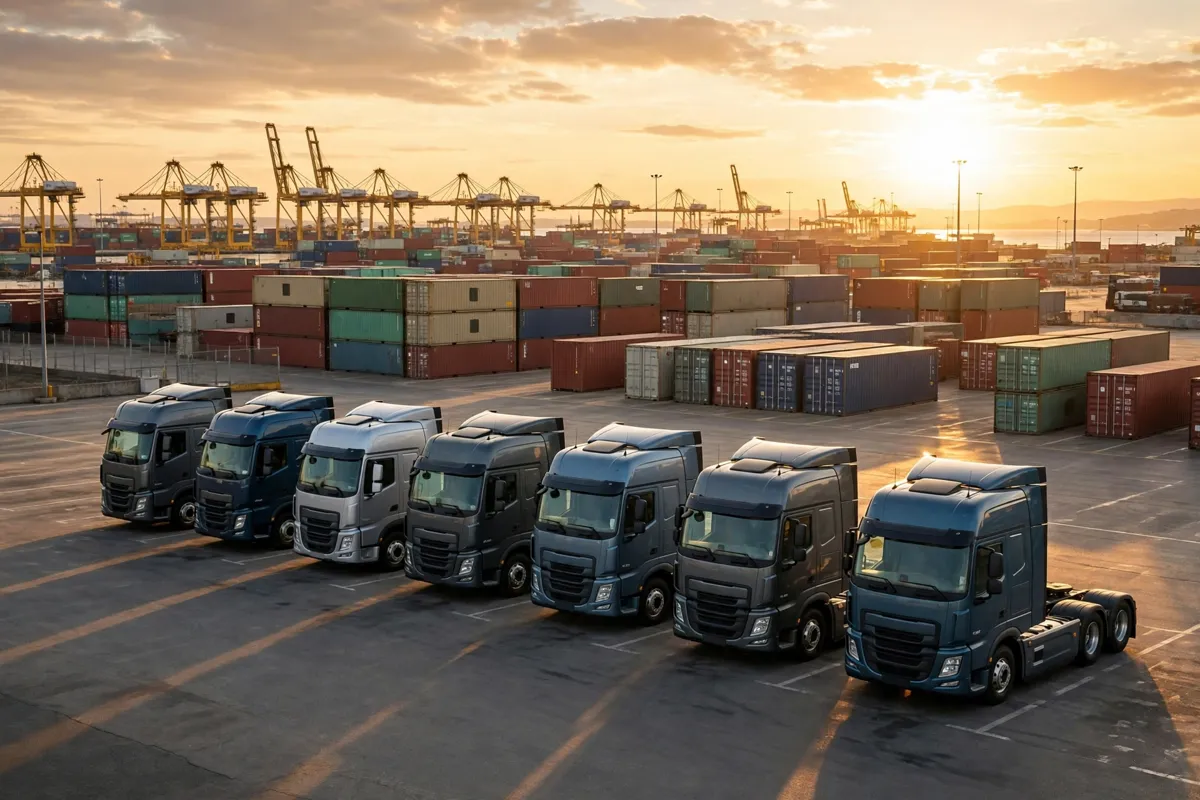
No, your trucking company cannot apply for EPA DERA money directly. The Diesel Emissions Reduction Act program (the source of EPA DERA grants) is open to government agencies, port authorities and qualifying nonprofits — not to for-profit carriers or owner-operators — and any guide that tells you otherwise is wasting your time. But the money is real, and it does reach fleets: about $180 million is on the table in the current national round, with applications closing on Friday 22 January 2027, and the route in is through an eligible partner who applies on your behalf. This guide shows you that route, step by step, with the real figures and the real deadlines.
By the end of this page you will know exactly who can apply, how much EPA pays toward a replacement truck, what paperwork has to be in place before you start, and what a realistic project looks like in dollars — including the worked example below, built on EPA Region 5's published allocation of about $18.2 million.
Key Points
- The 2026 DERA National competition opened on Thursday 24 September 2026 and closes on Friday 22 January 2027 at 11:59 p.m. ET, through Grants.gov. EPA expects to award approximately $180 million, combining fiscal year 2024, 2025 and 2026 funds into one competition (EPA, DERA National Grants page, September 2026).
- For-profit carriers and owner-operators cannot apply directly. Eligible applicants are regional, state, local and tribal agencies, port authorities, and qualifying nonprofit organisations. A fleet gets DERA money by partnering with one of them, or through a DERA State Program grant in its own state.
- EPA pays 25%, 35% or 45% of the cost of a replacement highway vehicle, depending on the certified nitrogen oxide (NOx) emissions of the new engine — the cleaner the engine, the bigger the share. Verified exhaust retrofits and engine upgrades can be funded at 100% (EPA DERA FAQ, EPA 420-F-26-018, September 2026).
- EPA anticipates 4 to 12 awards per EPA Region, with a maximum of $12 million per application in Region 9. EPA Region 5's allocation is about $18.2 million — so a typical regional award runs into the low millions, not tens of thousands.
- Every applicant needs an active SAM.gov registration, a Unique Entity Identifier (UEI) and an active Grants.gov account before applying. SAM.gov registration takes weeks, so it is the first thing to start, not the last.
What DERA Is — and What the 2027 Round Actually Offers
DERA — the Diesel Emissions Reduction Act — was created under the Energy Policy Act of 2005. It is a federal grant program run by the U.S. Environmental Protection Agency that pays part of the cost of replacing or retrofitting old diesel engines, vehicles and equipment with cleaner ones. The idea is simple: the oldest diesel trucks and equipment pollute the most, and their owners often cannot afford to replace them on their own, so the federal government shares the cost of the upgrade.
The current round is the big one. The 2026 DERA National Notice of Funding Opportunity, listed on Grants.gov as EPA-OAR-OTAQ-26-01 under Assistance Listing 66.039, opened on 24 September 2026. EPA expects to award approximately $180 million under it — money drawn from three fiscal years combined into a single competition: about $65 million from fiscal 2024, about $62 million from fiscal 2025 and about $53 million from fiscal 2026, according to EPA's announcement as reported by School Transportation News on 1 October 2026. That three-year pooling is why this round is larger than a normal single-year DERA competition, and it is also why the deadline matters: the next round of this size is not guaranteed.
Here is the part most guides get wrong. This is not one national pool of $180 million that every applicant in the country competes for. EPA runs ten parallel regional competitions — one per EPA Region — and anticipates 4 to 12 awards in each region. Your application competes against other projects in your region, not against the whole country. That changes the strategy: a strong project in a region with fewer applicants has a real chance, and the regional allocation tells you roughly how much money is on the table where you are. EPA Region 5, which covers Illinois, Indiana, Michigan, Minnesota, Ohio and Wisconsin, has an allocation of about $18.2 million, and Region 9 caps any single application at $12 million. EPA expects to award around 120 entities in total across the ten regions, with the maximum award set at $12 million.
Who Can Apply — and Who Cannot
| Applicant type | Can apply directly? | What that means in practice |
|---|---|---|
| Regional, state, local and tribal agencies | Yes | A state environmental agency, a city, a county, a tribal government or a regional air-quality agency can be the applicant. |
| Port authorities | Yes | The most natural applicant for drayage and port trucking projects — the port applies, the trucks serving the port get replaced. |
| Qualifying nonprofit organisations | Yes | Nonprofits working on air quality, clean transportation or community health can apply and partner with fleets. |
| Public school districts that own or operate diesel fleets | Yes | School bus replacement is a major DERA use, and districts apply in their own right. |
| For-profit carriers and owner-operators | No | A private trucking company cannot submit an application. The route in is partnership — see the next sections. |
| Private individuals | No | An individual driver cannot apply for DERA money for his own truck. |
If you run a for-profit fleet, that table is not the end of the story — it is the start of the real one. EPA's own guidance recognises that the trucks belong to private fleets, and the program is designed so that an eligible applicant can pass the benefit through to those fleets. In plain terms: the port authority or the nonprofit wins the grant, and your trucks are the ones that get replaced or retrofitted under it — provided you are part of the project from the start, with your trucks, your routes and your emissions numbers in the application.
How Much EPA Pays: The Cost-Share Tiers
DERA never pays for the whole truck. It pays a share, and you — or rather, the applicant and its fleet partners — pay the rest. The share depends on what you are buying and, for vehicle replacements, on how clean the new engine is. The figures below are maximums from the 2026 DERA National Program guide (EPA-420-B-26-034, September 2026) and EPA's published FAQ (EPA 420-F-26-018, September 2026) — not promises.
| Project type | Maximum EPA share | Your share |
|---|---|---|
| Highway vehicle replacement — new engine certified at 0.11–0.20 g NOx per brake-horsepower-hour | 25% | 75% |
| Highway vehicle replacement — new engine certified at 0.036–0.10 g NOx per brake-horsepower-hour | 35% | 65% |
| Highway vehicle replacement — new engine certified at 0.035 g NOx per brake-horsepower-hour or lower, or fully electric | 45% | 55% |
| Highway engine replacement only | 40–60% | 40–60% |
| Nonroad, locomotive or marine vessel replacement | 25% | 75% |
| Nonroad engine replacement | 35% | 65% |
| Nonroad Tier 1 or unregulated engine replaced with Tier 4 or zero-emission | 40% | 60% |
| Verified exhaust retrofits and engine upgrades | 100% | 0% |
| Idle-reduction technology | 25–100%, depending on type | 0–75% |
| Shore power | 25% | 75% |
| Electrified parking spaces | 30% | 70% |
| Hybrid retrofits | 60% | 40% |
| Alternative-fuel conversions | 40% | 60% |
Two details in that table decide real money. First, the NOx tier is set by the replacement engine's certified emissions limit, and the applicant must identify a suitable replacement engine family in the application — if that information is missing, an internal-combustion vehicle project generally falls to the 25% tier, according to EPA's guidance as summarised in industry coverage of the 2026 NOFO. Picking the engine is not a detail to leave for later; it is worth 10 or 20 percentage points of the grant. Second, the 45% top tier is available for fully electric replacements, but charging equipment is not eligible — EPA will fund 45% of the electric truck and none of the charger, so the fleet has to price the charging separately. Fuel-cell replacements are limited to transit buses, shuttle buses, drayage trucks, terminal tractors, stationary generators and forklifts.
The mandatory cost share must be real money or services directly tied to the project, reasonably valued and documented. Volkswagen settlement funds cannot be used as the match. Voluntary cost share — putting in more than the minimum — is allowed, and it can strengthen an application, but it is still your money, so weigh it against the return.
The Partner Route: How a For-Profit Fleet Actually Gets DERA Money
Here is the route, in the order it actually happens. If you run a small fleet or you are an owner-operator, this is the only path that works for the national program, and it starts months before the application deadline — which is why the 22 January 2027 close matters now, in November, and not in January.
- Find your eligible applicant. Look first at the port or intermodal rail yard your trucks already serve: its port authority is the most natural applicant, and it already has the relationship with EPA. Next, look at your state environmental agency or your city or county government. Then look for a nonprofit in your area that works on air quality or clean transportation. Approach them with a concrete offer — a list of your trucks, their model years, their annual miles and the routes they run — not with a vague request for help.
- Check whether your trucks qualify. The vehicles being replaced must be old enough and used enough to matter. For highway vehicles, the NOFO sets model-year and usage rules that vary by project type: engines from 2009 and earlier have the broadest replacement options, while for 2010 and newer engines the replacement pathway generally requires qualifying zero-emission technology or an engine certified at 0.10 grams of NOx per brake-horsepower-hour or lower, and replacement engines generally must be model year 2024 or newer. Drayage trucks have their own rules, including a 2019-or-newer model year for the replacement engine in some pathways. The applicant will confirm the exact eligibility of each truck against the NOFO's tables before the application is written — do not assume a truck qualifies until that check is done.
- Agree the deal in writing before the application goes in. Who buys the new truck, who owns it, who pays the cost share, how the grant money flows, and what happens if the award is smaller than requested. The most common structure is that the eligible applicant receives the grant and passes the benefit to the fleet as a rebate or subsidy toward the new equipment, with the fleet paying its share. Get the structure agreed while there is still time to walk away — not after the award is announced.
- Build the emissions case. DERA is an emissions program, and the application is scored on emissions reduced per dollar. The applicant needs your trucks' current emissions profile — engine model year, annual miles, fuel use, idle hours — and the profile of the replacement. The cleaner the replacement and the more miles the old truck runs, the stronger the case. A 2007 truck running 100,000 miles a year through a port beats a 2012 truck running 30,000 miles a year in a rural county, every time.
One more honest point: you can be part of more than one conversation, but you should only be in one application per project. Two applicants listing the same trucks in competing applications creates a mess EPA will notice, and it wastes everyone's time. Pick the strongest partner and commit to it.
Step by Step: From First Call to Submitted Application
- November 2026 — make the first call. Contact the port authority, state agency or nonprofit you have identified, with your truck list ready. At the same time, the applicant starts or confirms its SAM.gov registration and UEI — this is the step that takes the longest and cannot be rushed at the end.
- November to December 2026 — design the project. Which trucks get replaced, with what, at what cost, and what the emissions reduction looks like. Get written quotes for the replacement vehicles and identify the replacement engine families, because the NOx tier in the application depends on them. Questions to EPA are due by 24 November 2026 — if your project has a genuine ambiguity, this is the only window to ask.
- December 2026 — assemble the package. The application includes the project narrative, the emissions calculations, the budget with the cost-share split, the partnership documents, and the mandatory federal forms. EPA also publishes an optional cost-share calculator tool to help applicants get the numbers right — use it, because a wrong cost-share figure is an avoidable error.
- Friday 22 January 2027, 11:59 p.m. ET — the deadline. The complete application package must be received electronically through Grants.gov by this time. Late is late; EPA does not accept applications after the deadline.
- May 2027 — selections anticipated. EPA expects to announce which applicants are selected. Selection is not the award — it is the decision to award, subject to final checks.
- July 2027 — awards anticipated. Grants are awarded, and the two-to-four-year project period begins.
The Paperwork You Need Before You Start
Three registrations sit between any applicant and a DERA grant, and all three are free — which is also why no one should ever charge you to "set them up" for DERA. They take time, not money.
SAM.gov registration. The System for Award Management is the federal government's registry for anyone doing business with it, including grant recipients. The applicant must have an active SAM.gov registration, and new registrations can take several weeks — check it in November, not January.
Unique Entity Identifier (UEI). The UEI is the identifier issued through SAM.gov that replaces the old DUNS number. Every applicant needs one, and it must match the SAM.gov registration exactly.
Grants.gov account. Applications are submitted electronically through Grants.gov, and the applicant needs an active account with the right roles assigned. The account holder should log in and confirm access weeks before the deadline, not on the day of it.
Worked Example: A Port-Authority Project in EPA Region 5
Here is what a realistic DERA project looks like, built only on published figures — no invented grant amounts. Take a port authority in EPA Region 5, which covers Illinois, Indiana, Michigan, Minnesota, Ohio and Wisconsin, with a published regional allocation of about $18.2 million (EPA, 2026 DERA National Program materials).
Now suppose that port authority builds a project with a local drayage fleet to replace 20 older Class 8 trucks with new ones. To show the cost-share math, take an illustrative new-truck price of $200,000 — this is an example price for the arithmetic, not a DERA-published figure and not a promise of what a truck costs. The EPA share depends on the new engine's certified NOx level:
| New engine NOx tier | EPA share per truck | EPA share on 20 trucks | Fleet and partners pay |
|---|---|---|---|
| 0.11–0.20 g/bhp-hr (25%) | $50,000 | $1,000,000 | $3,000,000 |
| 0.036–0.10 g/bhp-hr (35%) | $70,000 | $1,400,000 | $2,600,000 |
| 0.035 g/bhp-hr or lower, or fully electric (45%) | $90,000 | $1,800,000 | $2,200,000 |
The math is the point. Moving from the 25% tier to the 45% tier is worth $40,000 per truck — $800,000 across 20 trucks — which is why the replacement engine family has to be identified in the application and why the cheapest new truck is not always the best DERA truck. At the 45% tier the whole 20-truck project costs $4 million in total, with $1.8 million from EPA and $2.2 million from the fleet and its partners — comfortably inside the $1.5 million to $4.6 million average-award range for the region, and well under the $12 million maximum award. At the 25% tier the same 20 trucks would need only $1 million from EPA, but the fleet would have to find $3 million of its own money — and the emissions reduction would be smaller, which is what EPA scores.
Two conditions attach to every replacement in that example. First, each truck being replaced must be scrapped or rendered permanently disabled within 90 days of the replacement becoming operational — scrappage is a statutory requirement, confirmed in EPA's DERA FAQ (EPA 420-F-26-018, September 2026). You cannot sell the old truck on and keep the grant. Second, the project has to be completed within the two-to-four-year project period, with the new trucks in service and the old ones gone.
DERA State Programs: The Second Door
If the national competition looks too big or too slow, there is a second door, and for many small fleets it is the better one. The DERA State Program gives money to state agencies, which then run their own solicitations for diesel-reduction projects in their state. EPA anticipates approximately $54 million for the combined fiscal year 2025 and 2026 state programs, subject to appropriations — a separate pot from the $180 million national competition.
State programs are smaller, closer and often simpler. Nevada's Clean Diesel program, for example, has run solicitations of about $1 million aimed at public fleets. Other states run theirs for school buses, transit, construction equipment or port trucks, and the rules — including who can apply and what the cost share is — are set by the state, following the DERA state program guide.
Check your own state environmental agency's DERA page now, while the national deadline is still two months away.
Timeline: The Dates That Decide Everything
| Date | What happens | Source |
|---|---|---|
| Thursday 24 September 2026 | 2026 DERA National NOFO opens; approximately $180 million expected | EPA, DERA National Grants page, September 2026 |
| Monday 24 November 2026 | Deadline for questions to EPA about the competition (11:59 p.m. ET) | EPA 2026 DERA NOFO; final FAQ update 8 January 2027 |
| Friday 22 January 2027 | Applications close — 11:59 p.m. ET, submitted through Grants.gov | EPA, DERA National Grants page, September 2026 |
| May 2027 | Selections anticipated | EPA 2026 DERA NOFO |
| July 2027 | Awards anticipated; two-to-four-year project periods begin | EPA 2026 DERA NOFO |
There is no second deadline, no extension window and no rolling intake — the questions deadline of 24 November 2026 is the last chance to get EPA's own answer on anything unclear, and EPA posts answers in its online FAQ, with the final update scheduled for 8 January 2027.
What DERA Will Not Pay For
Knowing what is excluded saves you from building a project around ineligible costs. Under the 2026 NOFO, DERA funds cannot be used for emission reductions that are already mandated by federal law — the program pays for early, voluntary reductions, not for compliance you were going to do anyway. Equipment for testing emissions is not eligible, and neither is fueling infrastructure: that includes the charging equipment for electric replacements, as noted above, and any fueling station build-out. The money goes to the vehicles, engines and equipment themselves, plus the verified technologies that cut their emissions.
What it can pay for is broad: buses, Class 5 to Class 8 heavy-duty highway vehicles, locomotives, marine engines, and eligible nonroad equipment, through replacements, verified retrofits and engine upgrades, idle-reduction systems, electrified parking spaces, shore power, hybrid retrofits, alternative-fuel conversions and aerodynamic upgrades. Replacement engines generally must be model year 2024 or newer, with the drayage exception noted earlier.
DERA and the Money That Ended: Do Not Confuse Them
Two other pieces of the 2027 funding picture get mixed up with DERA, and mixing them up costs people money. The first is the federal electric-vehicle tax credits under sections 45W and 30C of the tax code. Those credits were terminated for vehicles acquired after 30 September 2025. They are gone, and no 2027 DERA application can bring them back.
The second is the reauthorization question. DERA was created under the Energy Policy Act of 2005, and its authorization has to be renewed by Congress. H.R.2140, the Diesel Emissions Reduction Act of 2025, passed the House of Representatives on 15 September 2026 by a vote of 343 to 79, and it would extend the program's authorization through fiscal year 2029. As of this writing it awaits action in the Senate. Authorization is not appropriation: even if H.R.2140 becomes law, it adds no money to the $180 million already on the table, and the current round does not depend on it at all — it is funded from fiscal 2024, 2025 and 2026 appropriations already in place. The 22 January 2027 deadline is real whether or not the Senate acts, so do not wait for Congress before starting.
For the wider picture on what federal money is and is not available to a new or small carrier in 2027, including the loan programs that do accept for-profit applicants directly, see our guide to SBA loans for a trucking company — loans and grants answer different questions, and most fleets will need the loan answer as well as the grant answer.
Common Mistakes and Watch-Outs
Applying as a for-profit carrier. The most common DERA mistake is also the most basic: a private carrier submits an application to EPA and is rejected as ineligible. The NOFO is clear, and there is no exception. If you are for-profit, your application goes through an eligible partner or through your state program — never directly to EPA under the national competition.
Paying someone who promises a "guaranteed DERA grant" or sells a paid grant list. No one can guarantee a DERA award: EPA scores applications competitively, region by region, and no consultant controls the outcome. Anyone selling a guaranteed grant, a paid list of "secret" grants, or a service that charges you to register on SAM.gov or Grants.gov — both of which are free — is running a scam pattern. Legitimate help is a grant writer paid for their time, with no promise about the result, and even then the fee should be small next to the project.
Starting the SAM.gov registration in January. SAM.gov registration takes weeks, and an expired or inactive registration is one of the commonest reasons applications fail at submission. Check the applicant's SAM.gov status in November. If it is not active, that is the first job, before a single page of the narrative is written.
Leaving the engine family out of the application. As the cost-share table shows, the difference between the 25% tier and the 45% tier is 20 points of the project cost. Applicants who do not identify a suitable replacement engine family generally land at the 25% tier. Name the engine, with its certified NOx limit, in the application.
Forgetting the scrappage rule. The truck being replaced must be scrapped or permanently disabled within 90 days of the replacement becoming operational. Fleets that planned to sell the old truck, keep it as a spare, or move it to another terminal have had awards complicated or lost. Budget the scrappage and document it.
Waiting until January to find a partner. A port authority or a nonprofit needs weeks to design a project, get quotes, agree the partnership and write the application. A fleet that starts looking for a partner in January will find the good applicants already committed. November is the time to make the call.
FAQ
Can a trucking company apply for a DERA grant directly?
No. Under the 2026 DERA National NOFO, for-profit carriers and owner-operators are not eligible applicants. The eligible applicants are regional, state, local and tribal agencies, port authorities, and qualifying nonprofit organisations. A for-profit fleet gets DERA money by partnering with one of those applicants — typically a port authority or a state agency — which applies for the grant and passes the benefit to the fleet through rebates or subsidies toward eligible equipment.
What is the deadline for DERA grants in 2027?
Applications for the current national competition close on Friday 22 January 2027 at 11:59 p.m. ET, submitted electronically through Grants.gov. Questions to EPA were due by 24 November 2026. EPA anticipates announcing selections in May 2027 and making awards in July 2027.
How much of a new truck will DERA pay for?
For a highway vehicle replacement, EPA pays up to 25%, 35% or 45% of the eligible vehicle cost, depending on the certified NOx emissions of the new engine — 25% for engines certified at 0.11 to 0.20 grams of NOx per brake-horsepower-hour, 35% for 0.036 to 0.10, and 45% for 0.035 or lower, or for a fully electric replacement. Those are maximums from the 2026 DERA National Program guide (EPA-420-B-26-034, September 2026), and the fleet pays the rest. Verified exhaust retrofits and engine upgrades can be funded at 100%.
Do I have to scrap my old truck?
Yes. Scrappage is a statutory requirement: the vehicle being replaced must be scrapped or rendered permanently disabled within 90 days of the replacement becoming operational, according to EPA's DERA FAQ (EPA 420-F-26-018, September 2026). You cannot sell the old truck on, keep it as a spare, or move it to another terminal and keep the grant.
Can DERA pay for an electric truck and its charger?
DERA can pay up to 45% of the cost of a fully electric replacement vehicle, but charging equipment is not eligible — EPA funds none of the charger, its installation or the electrical work. Fueling infrastructure generally is excluded from the program. Price the charging separately and make sure the fleet can cover it before choosing the electric option.
What should a small fleet do first?
Make the partner call now, in November, while the good applicants are still choosing their projects — start with the port authority or state agency your trucks already work with, and bring a list of your trucks with model years and annual miles. At the same time, check your state's DERA program, which may have its own solicitation with simpler rules. And if your fleet is new and still building its finances, read our guide to how to start a trucking company and the free CDL training money in 2027 guide, which covers the workforce funding that does accept individual drivers directly.
The Bottom Line
EPA DERA grants in 2027 are real money — about $180 million, closing 22 January 2027 — but it is not money a for-profit carrier can apply for on its own. Find your eligible partner now, in November: a port authority, a state agency or a nonprofit that needs your trucks to make its application strong. Get the SAM.gov and UEI paperwork confirmed, name the replacement engine family so you land in the 35% or 45% tier instead of 25%, and remember the old trucks get scrapped within 90 days. Start this week — the fleets that get DERA money are the ones whose partners filed in January, not the ones who started looking in January.