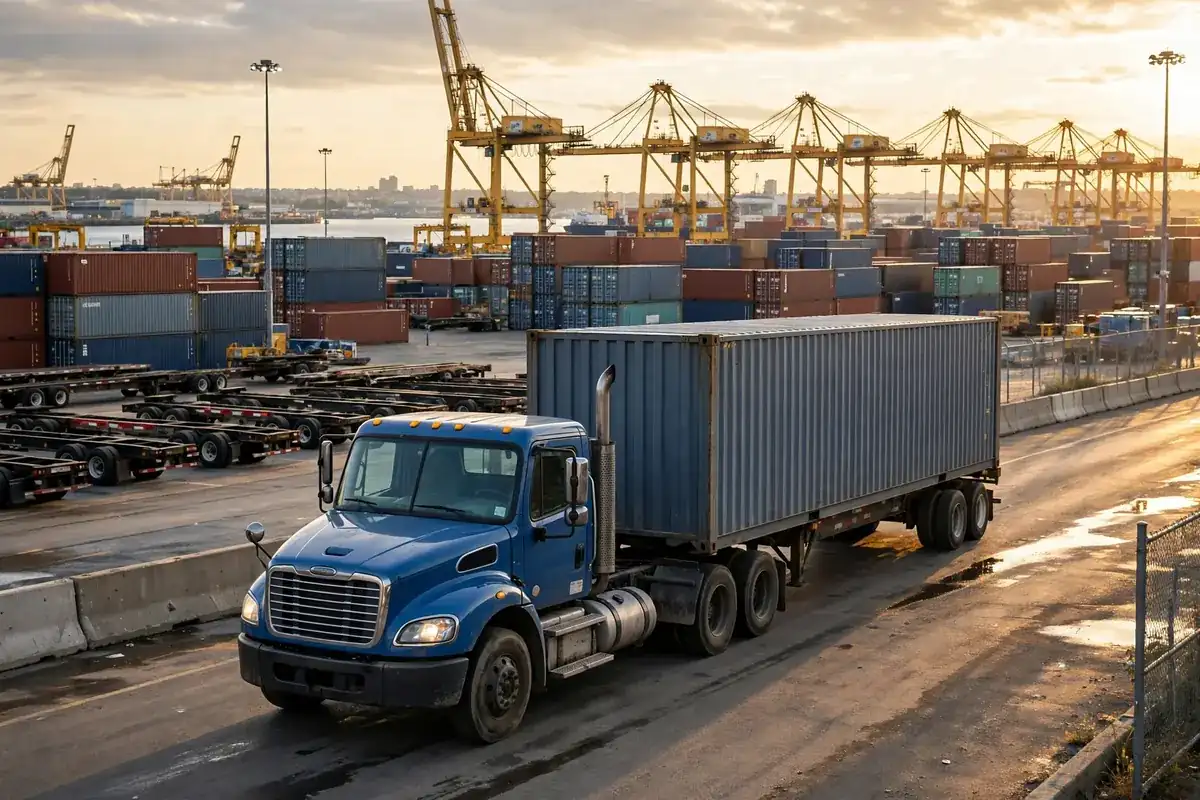
If you haul containers in and out of the Port of New York and New Jersey in a truck with an engine model year from 1999 to 2009, the Port Authority will pay up to half the price of a newer truck — capped at $25,000 — to get your old truck off the road and scrapped. That is real money, not a loan and the program is open and accepting applications right now. The catch is the commitment that comes with it: five years of regular port work, at least 150 trips a year to the marine terminals and the old truck destroyed, not sold on.
This guide covers the program as it stands in 2027: exactly who qualifies, how much money you actually get at different truck prices, the step-by-step application, the five-year rule and what it costs you and the brand-new zero-emission voucher program that launched in fall 2026 alongside it — worth up to $230,000 per truck and a different deal entirely. If you run drayage at the Port of New York and New Jersey, this is the page that tells you whether the money is yours to claim.
Key Points
- The Port Authority Truck Replacement Program (TRP) pays up to 50 percent of the replacement truck’s purchase price, capped at $25,000 per truck, for a maximum of two trucks per applicant, according to the Port Authority’s 2026 grant application (panynj.gov).
- Your old truck must be a Class 8 drayage truck with an engine model year of 1999 through 2009 and you must have owned and operated it for the 24 months before replacement. The replacement truck must have an engine model year of 2017 or newer and meet EPA emission standards.
- Approved participants make a five-year commitment: the replacement truck must make at least 150 trips per year to Port Authority marine terminals.
- Funding is limited and applications are handled first come, first served. Submitting an application does not guarantee funding, according to the Port Authority.
- Since the program launched in 2009 it has replaced 1,000 trucks and distributed $22.4 million in incentives, according to the Port Authority (April 2026). The 1,000th replacement took place on 11 March 2026.
- A separate zero-emission program launched in fall 2026: the Port Authority and CALSTART’s Clean Truck Incentive offers point-of-sale vouchers of up to $230,000 for a zero-emission Class 8 drayage truck, funded by a $451 million EPA Clean Ports grant, according to CALSTART (3 September 2026).
What the Program Actually Pays
The grant is simple in structure and easy to get wrong in the maths, so here it is plainly. The Port Authority pays the smaller of two numbers: 50 percent of the replacement truck’s purchase price, or $25,000.
That cap is what matters, because it bites early. On a $40,000 used truck, 50 percent is $20,000, so the grant is $20,000 and you pay the other $20,000.
On a $50,000 truck, 50 percent is exactly $25,000, so the grant is $25,000 and you pay $25,000. On a $60,000 truck, 50 percent would be $30,000, but the cap holds it at $25,000, so you pay $35,000.
On a $90,000 truck, the grant is still $25,000 and you pay $65,000. The grant covers at most half the truck and once the truck costs more than $50,000, the extra dollars are all yours.
Two trucks is the maximum per applicant, so the most one owner-operator can receive is $50,000 across two replacements — and only if both trucks cost $50,000 or more. The grant cannot be combined with any other government financial contribution toward the same purchase, according to the Port Authority’s application terms, so you cannot stack it with another voucher or grant on the same truck. It is a grant, not a loan: there is nothing to repay, provided you keep the five-year commitment that comes with it.
| Replacement truck price | 50% of price | Grant you receive | You pay |
|---|---|---|---|
| $30,000 | $15,000 | $15,000 | $15,000 |
| $40,000 | $20,000 | $20,000 | $20,000 |
| $50,000 | $25,000 | $25,000 | $25,000 |
| $60,000 | $30,000 | $25,000 (capped) | $35,000 |
| $80,000 | $40,000 | $25,000 (capped) | $55,000 |
| $100,000 | $50,000 | $25,000 (capped) | $75,000 |
The sweet spot is a replacement truck in the $45,000 to $55,000 range: a 2018 or 2019 tractor with 400,000 to 500,000 miles, where the grant covers close to half the price. Above $60,000, the grant is a fixed $25,000 discount and the percentage falls fast.
That does not make a more expensive truck a bad buy — a newer truck with lower miles costs less to run — but the grant should not be the reason you buy a $90,000 truck when a $50,000 truck does the same port work. Run the numbers on the truck, then add the grant, not the other way round.
Who Qualifies: The Checklist
Eligibility is narrow and it is checked before any money moves. The program is for drayage at the Port of New York and New Jersey specifically — not for general over-the-road work and not for other ports.
You apply as either an Independent Owner Operator (IOO) — a self-employed driver who owns and operates his own drayage truck — or a Licensed Motor Carrier (LMC). Both are eligible and the rules below apply to both.
The old truck must be a Class 8 diesel drayage truck with an engine model year of 1999 through 2009. Note that the test is the engine model year, not the truck model year: a 2010 truck with a 2009 engine qualifies and a 2009 truck with a 2010 engine does not. You must currently own and operate the truck and you must have owned and operated it during the 24 months before replacement — a truck bought last month to flip into the program does not count.
The old truck must be scrapped as part of the deal. It is not traded in, not sold on, not parked in the yard: the program exists to take old engines off the road and scrappage is the proof.
The replacement truck must be a Class 8 truck with an engine model year of 2017 or newer that meets EPA emission standards. In practice that means a 2018 or newer model year truck. It must be a drayage truck that will work the Port Authority marine terminals — this is not a grant for a long-haul tractor that never sees the port.
| Requirement | The rule | Source |
|---|---|---|
| Old truck | Class 8 drayage, engine model year 1999–2009 | Port Authority 2026 application |
| Ownership of old truck | Owned and operated by you for the 24 months before replacement | Port Authority 2026 application |
| Old truck fate | Scrapped, not sold or traded on | Port Authority 2026 application |
| Replacement truck | Class 8, engine model year 2017 or newer, EPA-compliant | Port Authority 2026 application |
| Maximum grant | 50% of price or $25,000, whichever is less, per truck | Port Authority 2026 application |
| Trucks per applicant | Maximum 2 | Port Authority 2026 application |
| Port commitment | 5 years; at least 150 trips per year to marine terminals | Port Authority 2026 application |
| Other government money | Cannot be combined on the same purchase | Port Authority 2026 application |
Two common disqualifiers are worth naming plainly. First, the 24-month ownership rule: if you bought the old truck recently, or you lease it, or it sits in someone else’s name, you do not qualify yet. Second, the trip commitment: if your work is mostly long-haul and you only touch the port a few times a month, 150 trips a year — roughly three a week, every week — is a real obligation and signing up for it without the freight to support it is how a grant turns into a problem.
The Five-Year Commitment: What It Really Costs
The grant is free money with a string attached and the string is five years long. For the duration of the commitment, the replacement truck must perform regular operations at Port Authority marine terminals, making at least 150 trips per year. That is the program’s core bargain: the Port Authority pays to clean up the air around its terminals and in return your truck works those terminals for five years.
Do the maths on your own operation before you apply. 150 trips a year is about 13 trips a month, or 3 trips a week.
A drayage driver working the port daily will clear that without thinking about it. A driver who runs the port twice a week and spends the rest of the week on regional work will fall short — and falling short puts the grant at risk, because the commitment is a condition of the funding.
Keep records of every terminal trip from day one: gate receipts, dispatch records and the terminal’s own entry logs. If the program administrator ever asks you to prove the trips, a folder of records is the difference between a quick answer and a fight.
The five-year clock also shapes the truck you buy. A 2018 truck bought in 2027 will be 14 years old when the commitment ends in 2032.
That is fine for port work — drayage trucks live long lives — but it means you should buy a truck with the miles and the maintenance history to survive five years of daily port cycles, not the cheapest 2017 engine you can find. A pre-purchase inspection is not optional here: $300 to $500 spent before you buy is cheap insurance against a truck that cannot finish the commitment it was bought for.
How to Apply, Step by Step
Applications go through the Port Authority’s grant administrator, Tetra Tech, Inc. The application form is published on the Port Authority’s website as the Truck Replacement Program grant application and the administrator can be reached at panynj@tetratech.com or 866-515-1716.
There is no application fee. The steps below follow the application’s own terms.
- Confirm your old truck qualifies. Check the engine model year — not the truck model year — against the 1999–2009 window and confirm you have owned and operated it for 24 months. Gather the title, registration and proof of ownership covering that period.
- Find the replacement truck. It must have an engine model year of 2017 or newer and meet EPA standards. Get the price in writing from the seller, because the grant is calculated on the purchase price. Do not buy it yet.
- Complete the application. Fill in the grant application with your details as an Independent Owner Operator or Licensed Motor Carrier, the old truck’s details and the replacement truck’s details and attach the supporting documentation the form asks for.
- Submit and wait for approval. Applications are considered first come, first served and funding is limited. Approval is not guaranteed by applying and the application says so plainly. Do not scrap the old truck or sign the purchase until you have the approval in hand.
- Buy the replacement and scrap the old truck. Once approved, complete the purchase and the scrappage through the program’s process, keeping every receipt, title transfer and scrappage certificate.
- Start the five-year clock. Run the port trips — at least 150 a year — and keep the records. The commitment starts when the replacement truck goes into service at the terminals.
One timing warning: because funding is limited and first come, first served, a slow application is a failed application. If your old truck qualifies and you have the replacement truck identified, apply now rather than after the next rate cut or the next quarter. The program has run since 2009 and has funding today, but no round is guaranteed to stay open and the application itself warns that completion and submission of the paperwork does not guarantee funding.
Worked Example: A 2008 Truck Becomes a 2019 Truck
Take a real case. An independent owner-operator in Newark, New Jersey, runs a 2008 Class 8 drayage truck he has owned since 2023 — more than 24 months — hauling containers out of Port Newark five days a week.
The truck is tired, the repairs are mounting and the engine is a 2008 model year, squarely inside the 1999–2009 window. He finds a 2019 tractor with a 2018 engine, 430,000 miles, listed at $52,000.
Step one, the grant: 50 percent of $52,000 is $26,000, so the $25,000 cap applies. The grant is $25,000 and he pays $27,000.
Step two, the rest of the cash: he needs the $27,000 balance, plus sales tax and registration on the purchase, plus insurance, plus a maintenance reserve — the down payment is not the whole cost and the same rule applies here as with any truck purchase. Our guide to how much down payment you need for a semi truck works through the full cash picture.
Step three, the commitment: at five days a week at the port he makes roughly 250 terminal trips a year, comfortably above the 150 minimum, so the five-year rule costs him nothing he was not already doing. Step four, the old truck: it is scrapped, which is also the end of its repair bills.
Now the same numbers on a cheaper truck. If he buys a 2018 tractor for $38,000 instead, 50 percent is $19,000, so the grant is $19,000 and he pays $19,000. The cheaper truck saves him $8,000 out of pocket versus the $52,000 truck — but it also leaves $6,000 of grant money unclaimed, because the grant only pays half the price.
The lesson is not to buy the more expensive truck to chase the grant; it is that the grant rewards trucks up to $50,000 and stops rewarding above that. Buy the truck that will survive five years of port work at the lowest total cost and let the grant fall where it falls.
And the case where it does not work: a driver who bought his 2007 truck fourteen months ago, or who runs the port once a week and spends the rest of the week on regional dry van, should not apply. The first fails the 24-month ownership rule outright. The second can pass the application and then fail the 150-trip commitment — which is the worse outcome, because the grant is already spent and the truck is already bought.
The New Zero-Emission Vouchers: Up to $230,000, a Different Deal
Running alongside the $25,000 diesel replacement program is a much bigger, much newer pot of money — and confusing the two is the easiest mistake a port driver can make in 2027. On 3 September 2026, the Port Authority and CALSTART, a clean-transportation nonprofit, announced a pair of incentive programs worth $45 million to put zero-emission drayage trucks and terminal tractors into service at the Port of New York and New Jersey, with the programs starting in fall 2026. The money comes from a $451 million grant the Port Authority received through the U.S. Environmental Protection Agency’s Clean Ports Program — the largest sustainability grant in Port Authority history, according to CALSTART.
The headline number is the Clean Truck Incentive: up to $39 million in point-of-sale vouchers for zero-emission drayage trucks, with a Class 8 drayage truck eligible for a voucher worth $230,000 and an off-road terminal truck eligible for a $150,000 discount. A separate $5 million Green Drayage Accelerator will fund up to five electric truck charging hubs within 10 miles of the port’s marine terminal facilities. CALSTART designs and administers both programs and will build dashboards to track the incentives, vehicle performance and charger use before handing the programs over to the Port Authority in 2028.
The zero-emission vouchers are not the same program as the $25,000 Truck Replacement Program and they do not stack with it on the same truck. The TRP replaces an old diesel with a newer diesel (2017 engine or newer) and pays up to $25,000. The Clean Truck Incentive buys a zero-emission truck — battery-electric — and pays up to $230,000 at the point of sale.
The right choice depends on your operation: a $230,000 voucher on a truck that costs $350,000 to $450,000 still leaves a six-figure balance and needs charging you can actually reach, while a $25,000 grant on a $50,000 diesel is a deal a one-truck owner-operator can close this month. If you run the port every day and can charge near the terminals, the zero-emission voucher deserves a hard look.
If you need a truck now, on a working budget, the TRP is the one that fits. Check the Port Authority’s Truck Information pages and CALSTART’s program pages for the current voucher status before you plan around either number, because the zero-emission program was still rolling out as 2026 ended.
Other Ports Have Their Own Money
The Port of New York and New Jersey is not the only port paying to retire old trucks and a driver who works more than one port should know the map. The Port of Baltimore runs a drayage truck replacement program of its own: up to $35,000 toward a newer truck, for trucks with an engine model year of 2009 or older replaced by a truck with a 2017 or newer engine, with the truck owned by the applicant for at least two years and used to move cargo to and from Baltimore’s port facilities, according to the program’s published FAQ. Other ports run their own versions under different names and different rules, often funded through the same EPA Diesel Emission Reduction Act money that backs the Port Authority program — our guide to EPA DERA grants explains how that funding reaches ports and fleets.
The point is not to chase every program at once. It is that port replacement money is local: each port sets its own amounts, its own engine-year windows and its own trip commitments. If you work two ports, check both programs before you buy, because a truck that qualifies at one may not qualify at the other and the grants cannot be combined on the same purchase.
Common Mistakes and Watch-Outs
Buying the replacement before approval. The application is explicit: applying does not guarantee funding and funding is limited and first come, first served.
A driver who buys the new truck and scraps the old one before the approval arrives has spent the money and destroyed the qualifying asset and may find the fund empty. Wait for the approval letter.
Confusing truck year with engine year. Eligibility is set by the engine model year on both sides of the deal — 1999–2009 for the old truck, 2017 or newer for the replacement.
A truck’s model year and its engine’s model year are usually the same, but not always and the engine year is the one the program checks. Verify it on the engine plate before you apply, not after.
Failing the 24-month ownership rule. The old truck must have been owned and operated by you for the 24 months before replacement.
A truck bought six months ago, a truck in a partner’s name, or a leased truck does not qualify. If you are close to the 24-month mark, wait — the program has run since 2009 and the truck is not going anywhere.
Signing up for trips you do not run. 150 terminal trips a year is a real number.
If your freight does not take you to the marine terminals three times a week, do not sign a five-year commitment that assumes it will. The commitment is a condition of the grant and a grant that turns into a dispute is worse than no grant at all.
Paying someone to “get you the grant.” There is no paid grant list or guaranteed-approval service for this program.
The application is free, the administrator is named on the Port Authority’s own pages and anyone charging you to access it is selling you something that costs nothing. The same warning applies across the whole grants world — our grants for trucking companies guide names the scam patterns to watch for.
Forgetting the money is taxable-adjacent. A grant that pays for half your truck changes the truck’s cost basis for tax purposes. Talk to your accountant before you file the return for the year you receive it — the same way you would for any SBA loan or equipment purchase — so the grant does not surprise you in April.
Frequently Asked Questions
How much does the Port Authority Truck Replacement Program pay?
Up to 50 percent of the replacement truck’s purchase price, capped at $25,000 per truck, for a maximum of two trucks per applicant. On a $50,000 truck the grant is $25,000; on a $40,000 truck it is $20,000; on a $60,000 truck it is still $25,000 because of the cap. The figures come from the Port Authority’s 2026 grant application.
Does my old truck have to be scrapped?
Yes. The program replaces and scraps old Class 8 drayage trucks — the old truck is destroyed, not sold on or traded in. Scrappage is part of the deal and you will need the scrappage documentation for the program file.
Can I apply if I only haul to the port part-time?
You can apply, but think hard about the five-year commitment first. Approved participants must run the replacement truck to the marine terminals at least 150 times per year. If your regular freight does not take you to the port three times a week, the commitment is a risk, not a formality.
Is the $230,000 zero-emission voucher part of the same program?
No. The $230,000 voucher is the Clean Truck Incentive, a separate zero-emission program launched by the Port Authority and CALSTART in fall 2026 for battery-electric drayage trucks. The $25,000 Truck Replacement Program is for newer diesel trucks. They are different programs, with different rules and they do not stack on the same truck.
How long does the application take and is funding guaranteed?
There is no published processing time and funding is explicitly not guaranteed. Applications are considered first come, first served from a limited fund, so apply as soon as your old truck qualifies and you have a replacement identified. Do not buy or scrap anything until you hold the approval.
Do I need a TWIC card to work the port?
Port access generally requires a Transportation Worker Identification Card (TWIC) for unescorted access to secure port areas. If you do not already hold one, factor the application time and the $127 fee into your plan — the fee rose on 1 October 2026.
Bottom Line
The Port Authority Truck Replacement Program is one of the few grants in trucking that pays a one-truck owner-operator directly: up to $25,000 toward a newer drayage truck, for an old 1999–2009 engine you scrap, with five years of port work — at least 150 trips a year — as the price. If you already run the Port of New York and New Jersey daily, own your old truck for more than two years and can buy a 2017-or-newer replacement in the $45,000 to $55,000 range, the grant covers close to half the truck and the commitment costs you nothing extra.
Apply through the Port Authority’s grant administrator, Tetra Tech, at panynj@tetratech.com or 866-515-1716 — and wait for the approval before you buy or scrap anything. If you run the port every day and can charge near the terminals, look at the new $230,000 zero-emission voucher too, but judge it on the truck’s full price and the charging, not on the voucher alone.
Related Guides
- EPA DERA Grants in 2027: How Fleets Actually Get Diesel Replacement Money
- Grants for Trucking Companies: What Actually Exists
- SBA Loans for a Trucking Company: 7(a), 504 and Microloans Explained for Carriers
- How Much Down Payment Do You Need for a Semi Truck in 2027?
- California HVIP for Small Fleets in 2027