
This screener is a screening tool, not a diagnosis. A high score does not mean you have sleep apnea.
Only a sleep study ordered by your doctor can diagnose sleep apnea. Talk to your doctor about any score that worries you.
Answer the 4 STOP questions, add your measurements and press Check my score. Nothing you type is saved anywhere.
The 4 STOP questions
S. Do you snore so loudly that someone can hear you through a closed door?
T. Are you often tired or sleepy during the day?
O. Has anyone seen you stop breathing, choke or gasp while you sleep?
P. Do you have high blood pressure, or are you being treated for it?
Your measurements
G. What is your sex?
The STOP-BANG questionnaire was validated with male and female as the two options for this item.
Disclaimer: This tool is provided for general information only. It is not professional advice — verify figures from official sources before acting on them. Rates change often, so confirm the current rate with the official source before you rely on a figure.
Quick answer
This sleep apnea risk screener runs the 8-question STOP-BANG questionnaire doctors use to spot possible obstructive sleep apnea. Answer 4 questions about snoring, tiredness, observed breathing pauses and blood pressure, then add your height, weight, age, neck size and sex. Your score from 0 to 8 gives a low, intermediate or high risk band and your next step.
Worked examples
Example 1: low risk, score 0
A 38 year old woman driver, 5 feet 6 inches tall and 150 pounds, with a 14 inch neck, answers No to all 4 STOP questions. Her BMI is 24.2 in the healthy range and her neck measures 35.6 cm. She scores 0 out of 8, in the low risk band.
Example 2: upgraded to high risk, score 3
A 45 year old man, 5 feet 10 inches and 210 pounds, with a 15 inch neck, snores loudly and feels tired during the day. His BMI is 30.1 in obesity class 1 and his neck measures 38.1 cm. He scores 3 out of 8, with 2 STOP answers plus male sex, so the rule upgrades him to high risk.
Example 3: high risk, score 8
A 58 year old man, 6 feet tall and 300 pounds, with an 18 inch neck, answers Yes to all 4 STOP questions. His BMI is 40.7 in obesity class 3 and his neck measures 45.7 cm. He scores 8 out of 8, the highest possible score, in the high risk band.
How the score works
Each Yes answer scores 1 point, for a total from 0 to 8. Scores 0 to 2 fall in the low risk band, 3 to 4 in the intermediate band and 5 to 8 in the high band. The bands come from the validation studies behind the questionnaire.
A score of 3 or 4 can also count as high risk. When 2 or more of the 4 STOP answers are Yes and any one of male sex, BMI over 35 or neck over 40 cm also applies, the result is high risk. Age over 50 does not trigger this rule.
| Score | Risk band | What it means |
|---|---|---|
| 0 to 2 | Low | Low chance of moderate to severe sleep apnea. Check again if symptoms change. |
| 3 to 4 | Intermediate | Some risk. Mention the score to your doctor. |
| 5 to 8 | High | High chance of moderate to severe sleep apnea. Talk to your doctor about a sleep study. |
The tool rounds your BMI to 1 decimal before the over 35 check, so a BMI of exactly 35.0 does not score the B item. It rounds your neck to 1 decimal cm before the over 40 check, so a neck of exactly 40.0 cm does not score the N item. What you see is exactly what scores.
How accurate is STOP-BANG?
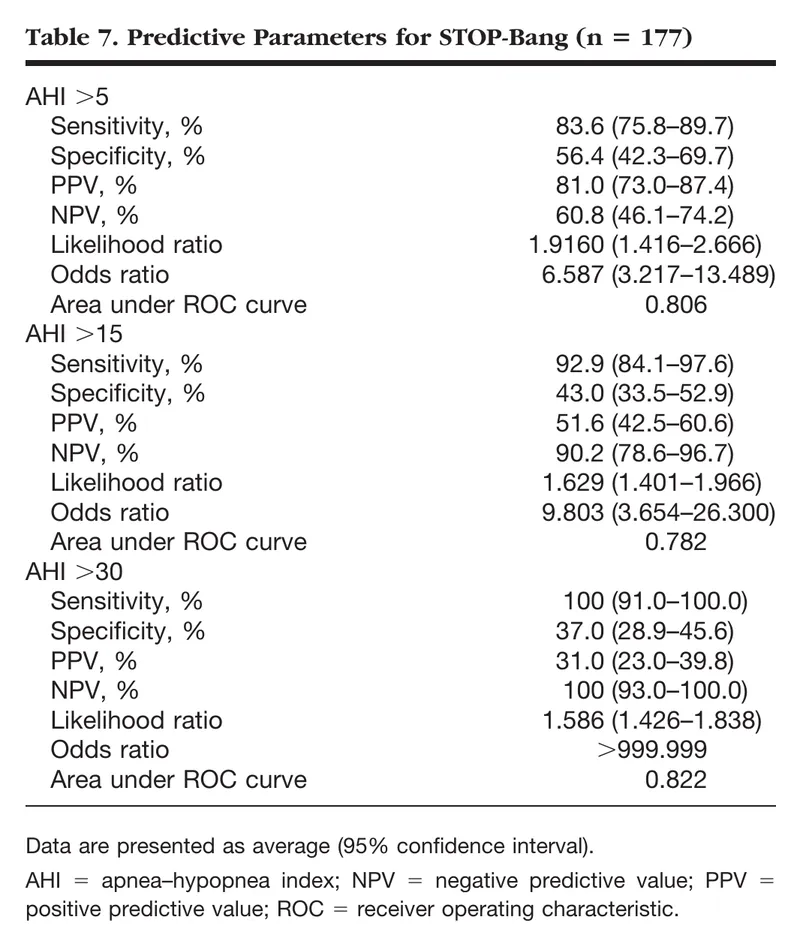
Chung 2008 tested the questionnaire against sleep studies in 177 surgical patients. At a cutoff of 3 or more, it caught 83.6 percent of patients with an apnea hypopnea index over 5, 92.9 percent over 15 and 100 percent over 30. High sensitivity means few cases are missed, while lower specificity means some high scores are not sleep apnea.
| Apnea hypopnea index | Sensitivity | Specificity |
|---|---|---|
| Over 5 | 83.6% | 56.4% |
| Over 15 | 92.9% | 43.0% |
| Over 30 | 100% | 37.0% |
The table shows the STOP-Bang figures from Table 7 of Chung 2008, at a cutoff of 3 or more. Sensitivity rises with severity, so the questionnaire is best at catching severe cases.
Chung 2012 followed 746 surgical patients and reported the chance of moderate to severe sleep apnea for each score. The chance was 18 percent for scores 0 to 2, 36 percent for a score of 3 and 60 percent for scores 7 to 8. The tool shows your figure from this study next to your score.
| Score | Chance of moderate to severe sleep apnea |
|---|---|
| 0 to 2 | 18% |
| 3 | 36% |
| 4 | 42% |
| 5 | 50% |
| 6 | 57% |
| 7 to 8 | 60% |
Both studies ran in surgical patients at hospital clinics, not in truck drivers. The figures still guide the risk bands, but your own chance may differ. Only a sleep study gives a personal answer.
Sleep apnea and truck drivers
FMCSA reports that almost one third of commercial truck drivers, 28 percent, have mild to severe sleep apnea. The figure comes from a University of Pennsylvania study of commercial drivers sponsored by FMCSA. Long hours sitting, irregular sleep and extra weight all raise the risk.
Sleep apnea interrupts breathing during sleep and breaks up rest, so the driver wakes unrefreshed. Daytime sleepiness behind the wheel raises crash risk, which is why the DOT medical exam asks about sleep. A driver who snores loudly or nods off during the day should talk to a doctor.
Sleep apnea and the DOT medical exam
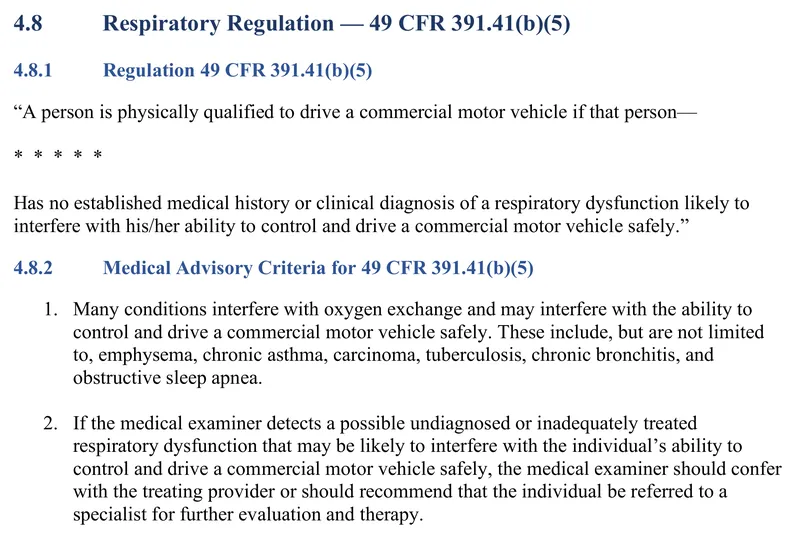
No FMCSA regulation names sleep apnea as a disqualifying condition. The rule at 49 CFR 391.41(b)(5) says a driver must have no established medical history or clinical diagnosis of a respiratory dysfunction likely to interfere with safe driving. Sleep apnea falls under that general standard, not under a rule of its own.
The regulation reads: “Has no established medical history or clinical diagnosis of a respiratory dysfunction likely to interfere with his/her ability to control and drive a commercial motor vehicle safely.”
The Medical Advisory Criteria for the same rule name obstructive sleep apnea among conditions that interfere with oxygen exchange. If an examiner detects an undiagnosed or inadequately treated respiratory dysfunction, the examiner should confer with the treating provider or recommend a referral to a specialist. The criteria guide the examiner and set no pass or fail line for sleep apnea.
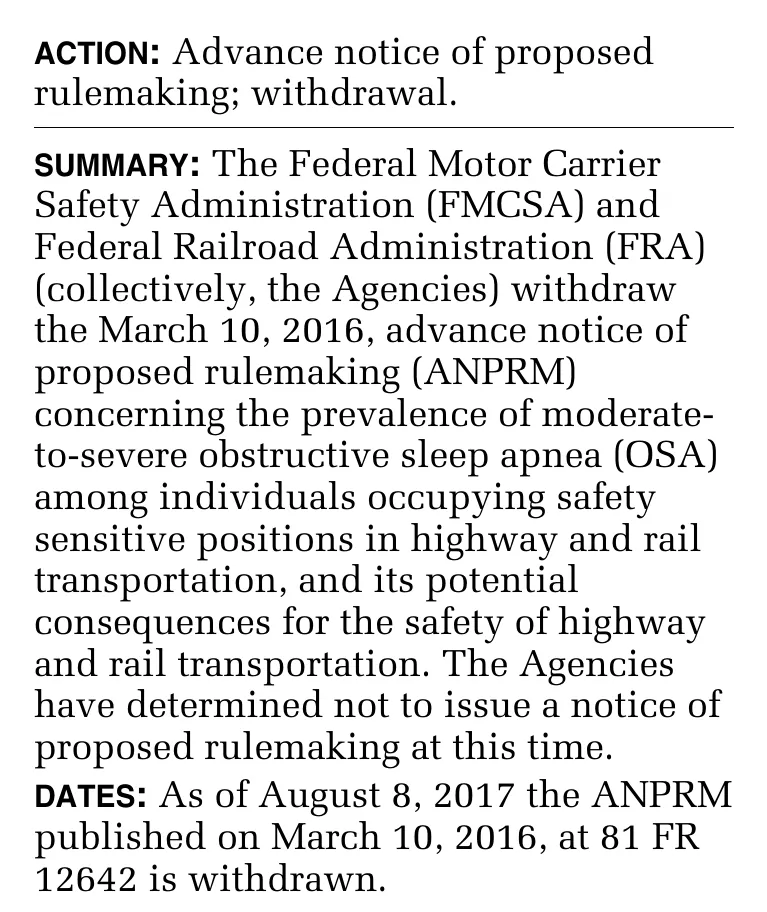
FMCSA and the Federal Railroad Administration opened a sleep apnea rulemaking in March 2016, then withdrew the notice on August 8 2017. The agencies said they had decided not to issue a notice of proposed rulemaking at that time. No sleep apnea rule followed, so no federal screening threshold or disqualification standard exists.
Congress added a guardrail in 2013. Public Law 113-45 says the Secretary may set a screening, testing or treatment requirement for sleep disorders only if the requirement is adopted pursuant to a rulemaking proceeding. A new sleep apnea rule would have to go through full rulemaking first.
The current guidance sits in the Medical Examiner Handbook, January 2024 edition, section 4.8.3.6. It states that the FMCSRs do not include requirements for medical examiners to screen drivers for sleep apnea or to refer drivers for sleep apnea testing. It also states that treated moderate to severe sleep apnea does not preclude certification.
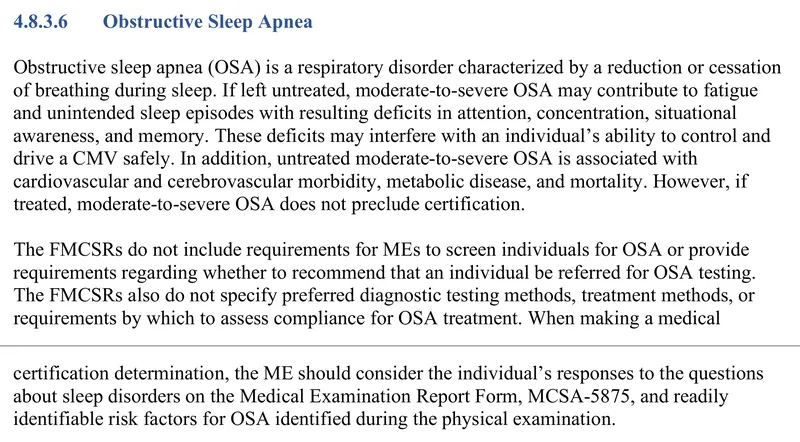
The examiner considers the sleep disorder answers on the Medical Examination Report Form, MCSA-5875, plus risk factors found in the exam. The handbook lists loud snoring, witnessed apneas, daytime sleepiness, obesity, a large neck, high blood pressure and heart disease. With several factors present, the examiner should consider recommending a sleep study when the driver has not had one.
If the examiner suspects sleep apnea, the examiner may ask for a sleep study or refer the driver to a specialist. A driver with treated sleep apnea can hold a medical card because the handbook says treatment does not preclude certification. The examiner decides on medical judgment, not on a fixed federal rule.
How to measure your neck
Stand in front of a mirror with a soft tape measure. Wrap the tape around your neck at the level of the lump at the front of the throat, keeping it level and snug without pulling tight. Read the number in inches or cm and enter it in the tool.
Measure in the morning before eating, with the tape flat against the skin and your head level. Take the reading twice and use the larger number if the two readings differ. If the tape reads between marks, round to the nearest tenth of an inch or the nearest centimetre.
What this screener does not do
This screener does not diagnose sleep apnea or grade severity. A low score does not rule out sleep apnea. A high score does not confirm it.
Only a sleep study ordered by a doctor can diagnose sleep apnea. The screener also gives no treatment advice and names no device or brand. Bring your score to your doctor and let the doctor decide the next step.
How to use this screener
Answer the questions in order and press Check my score. The tool works out your BMI from your height and weight and scores all 8 items at once. Nothing you type is saved anywhere.
- Answer the 4 STOP questions about snoring, tiredness, observed breathing pauses and blood pressure.
- Pick imperial or metric units, then enter your height and weight.
- Enter your age in years.
- Measure your neck and enter the number in inches or cm.
- Pick male or female.
- Press Check my score and read your score, risk band and next step.
Frequently asked questions
What is a good STOP-BANG score?
A score of 0 to 2 sits in the low risk band, the best result from this screener. Scores of 3 or 4 sit in the intermediate band and scores of 5 to 8 sit in the high band. Any score is a risk band, not a diagnosis, so talk to your doctor about a score that worries you.
Does a high score mean I have sleep apnea?
No. A high score means a higher chance of sleep apnea, not a diagnosis. Only a sleep study ordered by a doctor can diagnose sleep apnea, so bring a high score to your doctor.
What should I do with a score of 3 or 4?
A score of 3 or 4 sits in the intermediate band unless the alternative rule upgrades it. The rule upgrades scores of 3 or 4 when 2 or more STOP answers are Yes plus male sex, BMI over 35 or neck over 40 cm. Mention the score to your doctor and ask whether a sleep study makes sense for you.
Can sleep apnea cost me my CDL?
Sleep apnea itself is not a named disqualifier in the FMCSA rules. A medical examiner can hold or limit certification when untreated sleep apnea is likely to interfere with safe driving. Treated sleep apnea does not preclude certification, so a driver who follows treatment can keep a medical card.
Should I get a sleep study before my DOT physical?
A sleep study before the physical can speed the exam when the examiner asks about sleep. The examiner may still order a fresh study or refer you to a specialist. Talk to your doctor first: the doctor can say whether a study makes sense for you.
How do I measure my neck for this screener?
Wrap a soft tape measure around your neck at the level of the lump at the front of the throat. Keep the tape level and snug without pulling tight, with your head level. Enter the number in inches or cm: the tool converts inches to cm before it scores the neck item.
Related tools
- DOT Blood Pressure Tracker: High blood pressure is the P item in STOP-BANG, so track your readings here.
- HOS Calculator: Daytime sleepiness and short rest both feed fatigue. Plan legal rest with the hours of service calculator.
- Truck Stop Meal Builder: Extra weight raises sleep apnea risk. Build lighter meals at truck stops.
- Daily Cab Workout Generator: Movement helps weight and sleep. Get a workout that fits in the cab.
- All tools: Browse every free Trucking Mind tool.
Sources
- STOP-BANG official screening page: The 8 items, the score bands and the alternative high risk rule.
- Chung 2008, Anesthesiology: STOP-Bang validation: sensitivity and specificity at a cutoff of 3 or more.
- Chung 2012, British Journal of Anaesthesia: Predicted chance of moderate to severe sleep apnea by score.
- FMCSA, Driving When You Have Sleep Apnea: 28 percent of commercial truck drivers have mild to severe sleep apnea.
- Federal Register 82 FR 37038: Withdrawal of the 2016 sleep apnea advance notice, August 8 2017.
- Public Law 113-45: Sleep disorder rules only by rulemaking.
- FMCSA Medical Examiner Handbook guidance, 88 FR 3892: January 2024 handbook, section 4.8.3.6 on sleep apnea.
- 49 CFR 391.41, Cornell Law: The respiratory dysfunction standard at (b)(5).
- CDC adult BMI categories: BMI formula and categories.