
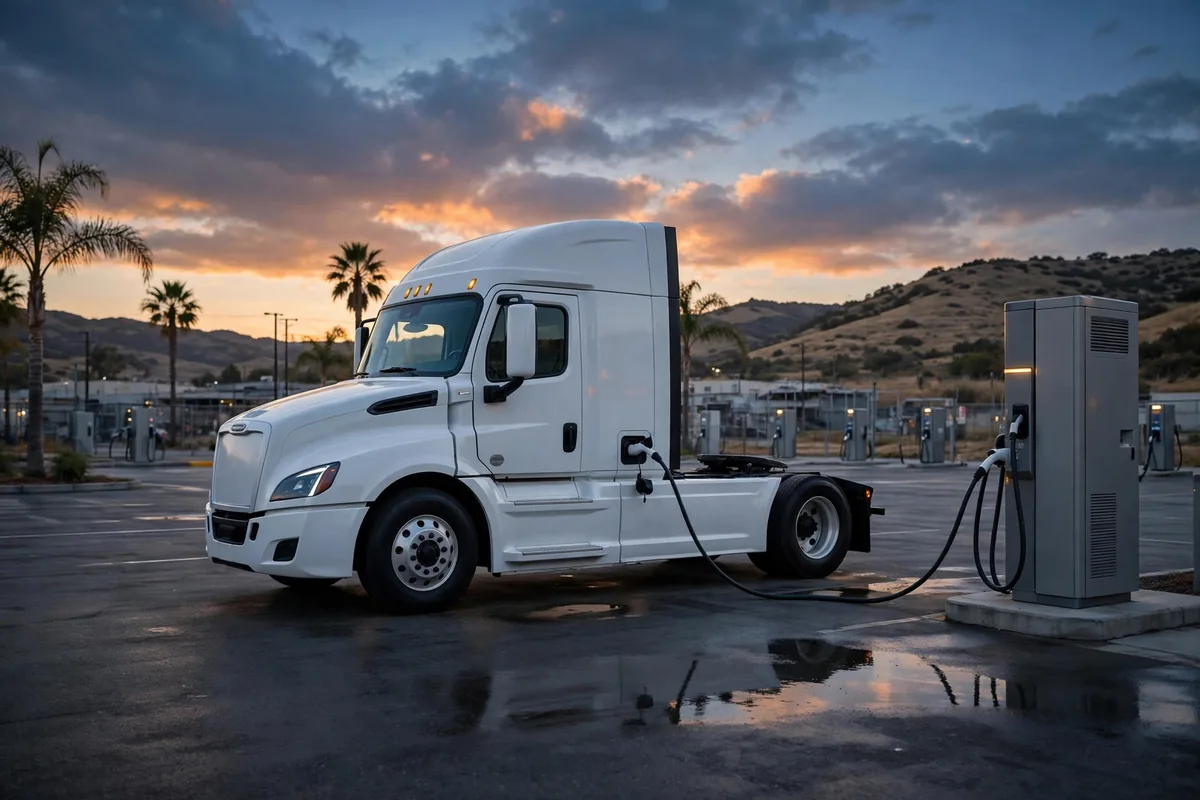
California's Standard HVIP funding is closed to new applications right now — it filled up in early September 2026 — and the program administrator aims to reopen it by the end of 2026, likely in November (not confirmed as of 12 November 2026). When it reopens, a small fleet can get up to $330,000 toward a single Class 8 electric truck. That is the honest answer up front: this is real, claimable state money, it works on a first-come, first-served basis, and the amount depends on your fleet size and the truck you buy. The federal EV tax credits are gone, but HVIP is California state money and is not affected by that change. Check californiahvip.org/funding before you plan a purchase around a date.
This guide gives you the current voucher amounts by vehicle class, the exact definition of a small fleet, and the application steps in order. Every dollar figure below was checked against the California Air Resources Board (CARB) or californiahvip.org on 7 November 2026.
Key Points
- Standard HVIP closed to new applications in early September 2026 after its funds were fully committed; the administrator aims to reopen by the end of 2026, likely in November (not confirmed as of 12 November 2026). The Drayage Truck Set-Aside was still accepting applications on 30 October 2026. When Standard funding is open, vouchers are first-come, first-served, subject to funding availability — check californiahvip.org/funding before you plan around it.
- A Class 8 battery-electric truck carries a $120,000 base voucher, a $150,000 drayage voucher, and a $330,000 small business voucher for qualifying small fleets (CARB, current HVIP and ISEF pages).
- A small fleet is 20 or fewer vehicles over 8,500 lbs GVWR plus $15 million or less in annual revenue for private fleets; nonprofits and public fleets are exempt from the revenue cap (californiahvip.org Funding page).
- The small business voucher is limited to five vouchers per fleet, all-time, not per year. Standard HVIP vouchers must be redeemed within 18 months of the request (HVIP Implementation Manual).
- The federal 45W commercial clean vehicle credit ended for vehicles acquired after 30 September 2025. HVIP is separate California state money, unaffected by the federal change (IRS guidance under Public Law 119-21) — but Standard HVIP funding itself is closed right now, as above.
What HVIP Is, and What It Pays For
HVIP stands for the Hybrid and Zero-Emission Truck and Bus Voucher Incentive Project. It is run by the California Air Resources Board (CARB) and administered by the nonprofit CALSTART. The program gives point-of-sale vouchers that cut the purchase price of a zero-emission truck or bus at the dealership. The dealer applies the voucher to the purchase price when you buy.
The program covers Class 2b through Class 8 zero-emission trucks and buses. Both battery-electric and hydrogen fuel cell vehicles qualify, and funding is also available for eligible electric power take-off systems. Hybrids and natural gas vehicles no longer qualify. If a truck burns fuel, HVIP does not pay for it.
Since the program launched in 2009, CARB has provided nearly $1 billion through HVIP vouchers, funding more than 16,000 zero-emission vehicles across more than 2,500 fleets, according to californiahvip.org.
Understand that HVIP is a voucher, not a grant application. There is no essay, no competitive scoring, and no waiting months for a decision letter. If funding is available, your vehicle is eligible, and your dealer submits a complete request, the voucher is reserved. HVIP is one part of a bigger set of government money for trucking, and our guide to grants for trucking companies explains the full picture, including why no federal grant buys a truck.
Voucher Amounts by Vehicle Class
The voucher amount depends on three things: the weight class of the truck, whether you qualify as a small business, and whether the truck will run drayage at a port or railyard. The base column applies to any fleet; the small business column is the enhanced amount for qualifying small fleets.
| Vehicle class | Base voucher (any fleet) | Small business voucher | Drayage voucher |
|---|---|---|---|
| Class 2b | $7,500 | $9,000 | Not available |
| Class 3 | $15,000 | $40,000 | Not available |
| Class 4-5 | $60,000 | $130,000 | $75,000 |
| Class 6-7 | $85,000 | $160,000 | $106,250 |
| Class 8 battery-electric | $120,000 | $330,000 | $150,000 |
| Class 8 fuel cell | $240,000 | $420,000 | $420,000 |
Sources: base and drayage amounts from CARB's Clean Truck and Bus Vouchers (HVIP) page; small business amounts from CARB's Innovative Small E-Fleet (ISEF) page, which states the small business amounts align with the new Standard HVIP amounts, effective 22 September 2025. The Class 8 fuel cell base figure comes from Commercial Carrier Journal's September 2026 review of HVIP amounts. All figures checked 7 November 2026.
The small business column is where the real money is. A Class 8 battery-electric truck pays $120,000 to a large fleet and $330,000 to a qualifying small fleet. If you run a small fleet, never accept the base amount without checking your small business eligibility first. Drayage pays more: a Class 8 truck working the ports gets $150,000 at the base level, and small fleets in drayage or refuse work get $330,000 for battery-electric or $420,000 for fuel cell (CARB ISEF drayage/refuse table). Vouchers run from $7,500 to $420,000 depending on vehicle type, size, and fleet characteristics, according to the HVIP FAQs. But fuel cell trucks cost more than battery-electric trucks, so the bigger voucher does not automatically mean the better deal. For private fleets, HVIP can cover up to 90 percent of the cost of each vehicle, excluding taxes and fees.
The Small-Fleet Rules: Who Counts as a Small Fleet
HVIP's small business definition is specific, and it decides whether you get $120,000 or $330,000 on a Class 8 truck. A private fleet qualifies as a small business when it meets both of these tests at once: twenty or fewer vehicles over 8,500 lbs GVWR, and $15 million or less in annual revenue. Public fleets and nonprofits with twenty or fewer vehicles qualify without the revenue test.
Fleet size counts more vehicles than most owners expect. For Standard HVIP, it includes every vehicle over 8,500 lbs GVWR domiciled anywhere in the world, including vehicles under common ownership or control and non-operational vehicles. It also includes your existing unredeemed HVIP vouchers, and it counts the voucher you are requesting now. Off-road vehicles and dismantled vehicles do not count.
That counting rule creates a trap. Suppose your fleet has 17 trucks and you request five vouchers. You are eligible for three small business vouchers, because 17 plus 3 reaches the 20-vehicle line, and the remaining two would be base vouchers. That is HVIP's own example, published on its Funding page.
Revenue is verified from your tax filings. Private fleets identify the total revenue, receipts, and sales reported to the IRS in the purchasing entity's most recent filing, which appears in Box 1c of IRS Form 1120, Box 1c of Form 1065, or Box 3 of Schedule C on Form 1040, according to the HVIP FAQs. Nonprofits submit Form 990 instead.
Two other rules catch people out. First, a private business must have been operating in California for at least one year before submitting a voucher request, A brand-new authority does not qualify on day one. If you are still setting up, our guide to starting a trucking company walks through the setup sequence. Second, you must operate the vehicle in California for at least three years after the voucher is redeemed. The small business voucher is limited to five vouchers per fleet, all-time, not five per year, so use them on the trucks where the voucher changes the decision.
How to Apply, Step by Step
You do not apply to HVIP directly. Your dealer does it for you. Only purchases made through HVIP-approved dealers qualify.
- Check the Funding page first. Go to californiahvip.org/funding and confirm funding is available for the vehicle class you want. HVIP is first-come, first-served, and availability changes as funds are reserved.
- Confirm your small fleet status. Count every vehicle over 8,500 lbs GVWR under your ownership or control, including non-operational trucks, and check your most recent tax return for the revenue figure.
- Pick an eligible vehicle from the HVIP catalog. Only vehicles in the HVIP Vehicle Catalog qualify, and only in the model years listed. Confirm the exact make, model, and model year with the dealer.
- Find an HVIP-approved dealer. Use the approved dealer catalog on californiahvip.org and contact dealers directly to confirm current inventory and voucher availability. Ask how many HVIP vouchers they have processed.
- Get a purchase order and a negotiated price. Negotiate the truck price first, then subtract the voucher. The catalog shows only the base incentive amounts, not vehicle prices, so the dealer quote is where the real price appears.
- The dealer submits the voucher request. The dealer submits the request through HVIP's Voucher Processing Center, with your documentation attached. You provide the paperwork; the dealer handles the submission.
- Complete the labor law attestation. Under California Assembly Bill 794, any voucher request for a tractor, panel-step van, straight truck, refuse truck, or Class 2b vehicle requires a mandatory attestation that you comply with labor laws. Submit it through the state's compliance site, and renew it annually until three years after voucher redemption.
- Wait for the funding email. Both you and the dealer receive an email update when funding is secured.
- Take delivery, register, and redeem. Once the truck is delivered and registered with the California DMV, the dealer submits the redemption paperwork with the signed final invoice, the DMV registration, the delivery bill of lading, and the vehicle inspection.
If you would rather lease than buy, or you want a truck-as-a-service arrangement where charging and maintenance are bundled, that is what the Innovative Small E-Fleet (ISEF) set-aside is for. ISEF supports the same small fleets through all-inclusive leases, rentals, truck sharing, and truck-as-a-service deals with approved providers. ISEF reopened on 21 October 2025 with $30.5 million in new incentives, so check the Funding page for current ISEF availability. Standard HVIP and ISEF cannot be stacked on the same truck under any circumstances.
Worked Example: One Class 8 Electric Truck for a Three-Truck Fleet
Take a real small fleet: three trucks, based in Fresno, running regional produce loads. The owner wants to replace one aging diesel tractor with a battery-electric Class 8 truck.
The truck costs $420,000. That is the Class 8 battery-electric purchase price used in the International Council on Clean Transportation's July 2026 baseline analysis of California truck incentives. A comparable new diesel Class 8 tractor costs about $185,000 in the same analysis.
The fleet qualifies as a small business. Its small business voucher for a Class 8 battery-electric truck is $330,000 (CARB, effective 22 September 2025). The subtraction is simple: $420,000 minus $330,000 leaves $90,000 to pay.
Check the cap: for a private fleet, combined public incentives cannot exceed 90 percent of the vehicle cost, excluding taxes and fees. Ninety percent of $420,000 is $378,000, and the $330,000 voucher is 78.6 percent of the price, so it sits under the cap. Against the $185,000 diesel with no voucher, the electric truck at $90,000 after the voucher is $95,000 less up front.
The electric truck still needs charging, which the voucher does not pay for, and taxes and fees sit outside the voucher as well, so budget for a depot charger and for the tax bill on the full price. For context, the same fleet running the truck in drayage at the ports would get the same $330,000 as a small fleet, while a large fleet doing the same drayage work would get $150,000.
One caution: the $420,000 price is an industry baseline assumption, not a dealer quote. Your dealer's price will differ by make, model, battery size, and options. Before you commit, get the real quote, subtract the real voucher, and run your own cost per mile on the result. Our guide to calculating cost per mile shows the method, and the break-even rate per mile guide shows the rate you must average to cover the truck.
What Happens After Approval
Approval is the middle of the process, not the end of it. Once your voucher is reserved, three clocks start running.
First, the redemption clock. All vouchers except transit vouchers must be redeemed within 18 months of the date the voucher request was submitted; transit vouchers get 36 months. If your truck is not delivered, registered, and redeemed inside that window, the voucher expires. Extensions can be requested, but they are granted at CARB's discretion, not as a right.
Second, the delivery date review. At least once every 90 days from the date the voucher is requested, the anticipated delivery date must be reviewed and updated. If the delivery date slips and nobody updates it, the voucher can run into trouble.
Third, the three-year operation rule. You must operate the vehicle in California for at least three years after voucher redemption, and you must answer the program's annual surveys during that period. Selling the truck early or moving it out of state can trigger a demand to return the money.
After redemption, the dealer gets paid, not you. The voucher is a point-of-sale discount, so the money never passes through your bank account. The new truck also changes your insurance picture: an electric Class 8 tractor costs more to replace than the diesel it replaced. See our guide to new authority trucking insurance costs.
Stacking HVIP With Other Money
HVIP can be combined with other eligible public incentives, but there are rules, and breaking them can cancel the voucher and force you to return the money. The headline rule is the cap: for private fleets, combined public incentives cannot exceed 90 percent of the vehicle cost, excluding taxes and fees. For public fleets, the limit is 100 percent. HVIP always pays last: other incentives apply first, and HVIP covers the remaining cost up to its maximum voucher amount.
The federal money that used to stack with HVIP is gone. The commercial clean vehicle credit under Section 45W, worth up to $40,000 for a heavy truck, is not available for vehicles acquired after 30 September 2025. The One, Big, Beautiful Bill Act, signed 4 July 2025, ended the 45W, 30D, and 25E clean vehicle credits for vehicles acquired after that date, according to IRS guidance. The charger credit under Section 30C, which covered charging equipment placed in service through 30 June 2026, has also now expired. HVIP is state money and is unaffected, which is exactly why it matters more now than it did a year ago.
California money that can stack with HVIP includes port funding for drayage trucks. The Ports of Los Angeles and Long Beach made $60 million available for zero-emission Class 8 drayage tractors, with a $100,000 enhancement per truck for fleets of 20 or fewer, on top of the $150,000 HVIP drayage voucher, according to the November 2023 announcement, updated March 2024. That was a limited allocation, so confirm it is still open before you count on it. California is also building a new Clean Fuel Reward program funded by Low Carbon Fuel Standard credits, which CARB projected would deliver $250 million in 2026 and $1 billion through 2030, according to the International Council on Clean Transportation's July 2026 analysis. Treat it as money to watch in 2027, not money to count on today.
If the truck purchase still needs financing after the voucher, a loan is a separate decision with its own costs. Our guide to SBA loans for trucking companies covers the real terms. Use the free Cal Fleet Advisor service or the Funding Finder Tool on the HVIP Funding page to check your stacking plan before you sign anything.
Common Mistakes and Watch-Outs
Ordering the truck before the voucher is approved. HVIP does not provide funding for vehicles delivered or paid for ahead of a voucher request. If you sign, pay, and take delivery first, then ask for the voucher, the answer is no.
Paying someone to "guarantee" your voucher. Nobody can guarantee an HVIP voucher. Anyone selling a guaranteed voucher or a paid application service is selling you something HVIP gives away for free.
Using a dealer who is not HVIP-approved. Only purchases through HVIP-approved dealers qualify. A good price from a dealer outside the program is worth nothing under HVIP.
Counting the wrong fleet size. The 20-vehicle test counts trucks under common ownership or control, non-operational trucks, and your unredeemed vouchers, including the one you are requesting.
Forgetting the three-year rule. The truck must operate in California for three years after redemption. A fleet that plans to move operations out of state or sell the truck early should not take the voucher.
Missing the 18-month redemption window. Electric truck delivery times slip. If your delivery date moves past 18 months from the voucher request and nobody asks for an extension or updates the delivery date every 90 days, the voucher can expire while the truck is still being built.
Budgeting the voucher against taxes and fees. HVIP does not cover taxes, fees, or other non-vehicle costs, and the 90 percent cap is calculated excluding them. Budget for it separately.
Believing a stale guide. HVIP amounts changed on 22 September 2025, when the small business amounts were aligned with the new Standard HVIP amounts. Any guide, video, or dealer quote from before that date shows old numbers. Check the current Funding page before you trust a number.
FAQ
Is HVIP open right now?
No — not Standard HVIP. Standard funding closed to new applications in early September 2026 after the funds were fully committed, and the administrator aims to reopen by the end of 2026, likely in November (not confirmed as of 12 November 2026). The Drayage Truck Set-Aside was still accepting applications on 30 October 2026. Check californiahvip.org/funding for the live status before you plan a purchase — when Standard funding is open, vouchers are first-come, first-served, subject to funding availability.
How much can a small fleet get for a Class 8 electric truck?
A qualifying small fleet can get a $330,000 voucher for a Class 8 battery-electric truck, or $420,000 for a Class 8 fuel cell truck, according to CARB's current voucher tables. A fleet that does not meet the small business definition gets the $120,000 base voucher for battery-electric or $240,000 for fuel cell.
Do I apply to HVIP myself?
No. Your HVIP-approved dealer submits the voucher request through the Voucher Processing Center on your behalf.
Can I use HVIP if my business is less than a year old?
Not yet. A private business must have been operating in California for at least one year before submitting a voucher request, with proof such as a Secretary of State registration or a municipal business license. The ISEF set-aside can grant exceptions on a case-by-case basis, but Standard HVIP does not.
How long do I have to use the voucher after it is approved?
Non-transit vouchers must be redeemed within 18 months of the date the voucher request was submitted. The anticipated delivery date must be reviewed and updated at least once every 90 days while you wait. If delivery slips past 18 months, an extension can be requested at CARB's discretion.
Does the federal EV tax credit still apply to my truck?
No, not for a truck acquired now. The federal commercial clean vehicle credit under Section 45W ended for vehicles acquired after 30 September 2025, under the One, Big, Beautiful Bill Act. HVIP is California state money and is not affected by the federal change.
The Bottom Line
Standard HVIP is closed right now, with reopening aimed by the end of 2026 — but when it is open, it is the biggest single discount available on an electric truck for a California small fleet: up to $330,000 on a Class 8 battery-electric truck, or $420,000 on a fuel cell truck. Check your fleet size and revenue against the small business definition, confirm funding on the Funding page, and let an HVIP-approved dealer submit the request before you pay for anything. Do not order the truck before the voucher is reserved. Get the voucher first, then buy the truck.
