Key Points:
- Decide your operation type before you file anything: for-hire or private, intrastate or interstate and what you will haul — household goods, oversize loads and port containers each add their own credential layer.
- Build the federal foundation first: a USDOT number, MC operating authority for for-hire interstate work, at least $750,000 in public liability coverage for general freight, a BOC-3 process agent filing and clean safety files for the 18-month New Entrant monitoring period.
- Register in New Jersey through MVC Motor Carrier Services: Code 11 commercial registration, lettering at least three inches high and IRP and IFTA accounts if you run interstate in a qualifying vehicle; entering without credentials takes a $25 trip permit bought before travel.
- Anything over New Jersey’s legal limits — 8 feet 6 inches wide, 13 feet 6 inches high, 80,000 pounds gross — needs an NJDOT SUPERLOAD permit before it moves; permits are route-specific and load-specific, with fees and escort rules set by load dimensions.
- Port drayage is a separate system on top of everything else: a TWIC for the driver ($127.00 for a new applicant), Drayage Truck Registry registration through PortTruckPass with a valid RFID tag, a SeaLink credential ($30 for a new card) and a truck that meets the port’s model year 2014 engine standard.
- Work the step-by-step checklist in order and calendar every renewal — IRP, IFTA, the biennial USDOT update, insurance filings and port credentials — and keep every credential in the cab.
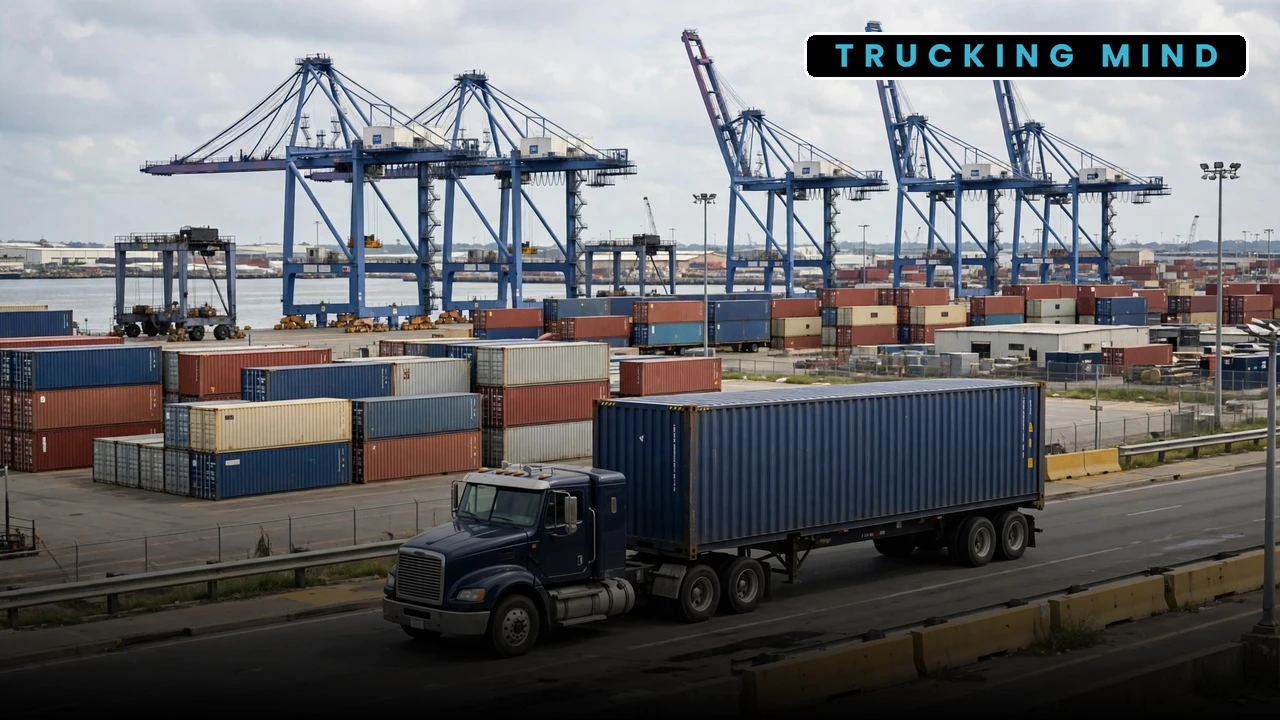
If you are starting a trucking company in New Jersey, you are stepping into one of the most freight-dense states in the country. Warehouses line the New Jersey Turnpike, the ports at Newark and Elizabeth move an enormous volume of containers and freight flows constantly between New York City, Philadelphia and the rest of the Northeast.
That opportunity comes with a layered permit system. Federal registration, New Jersey Motor Vehicle Commission (MVC) credentials, New Jersey Department of Transportation (NJDOT) oversize permits and Port Authority of New York and New Jersey port rules all apply to different parts of the job and confusing one for another is the most common mistake new carriers make.
For the full state-by-state picture, see our trucking permits by state hub.
This guide walks through the whole picture in the order a new owner-operator should tackle it: first, what kind of operation you are; second, the federal foundation; third, the New Jersey state credentials; fourth, oversize and overweight permits; and finally, the separate world of port drayage. Read it as a checklist, not as background reading. Every section ends with the practical action to take before you book your first load.
What Kind of Carrier Are You in New Jersey?
Before you apply for anything, answer three questions, because they decide which permits you need.
First, will you haul for hire, or will you haul only your own company’s goods? A for-hire carrier transports other people’s freight for payment and needs operating authority.
A private carrier hauls its own goods and generally does not need federal operating authority, although it still needs a USDOT number, vehicle registration and safety compliance. The distinction matters in New Jersey just as it does everywhere else and if you are unsure, start from the assumption that hauling a broker’s load for payment makes you a for-hire carrier.
Second, will you stay inside New Jersey, or will you cross state lines? A carrier that never leaves New Jersey is intrastate. A carrier that crosses into New York, Pennsylvania, Delaware, or anywhere else is interstate, even if most of its miles are in New Jersey.
Interstate carriers need apportioned registration and fuel tax credentials. Intrastate-only carriers register differently and do not need those interstate credentials, but they still need New Jersey registration, insurance and a USDOT number where the vehicle and operation meet the thresholds.
Third, what will you haul and with what equipment? General dry freight in a standard tractor-trailer is the simplest case. Household goods, passengers, hazardous materials, oversize loads and port containers each add their own layer.
Household goods movers in particular face additional state licensing in New Jersey and port container work adds the entire drayage credential system described later in this guide. If any of those apply to you, do not skip ahead — read the section that covers your niche before you spend money on equipment.
Write down your answers before you file anything. Changing your operation type after registration is possible, but it costs time and time is exactly what a new carrier cannot afford to waste.
The Federal Foundation: USDOT Number, MC Authority and Insurance
Every new carrier starts at the federal level with the Federal Motor Carrier Safety Administration (FMCSA). You need a USDOT number if you operate a commercial motor vehicle in interstate commerce and New Jersey, like most states, also expects intrastate carriers meeting the weight and operation thresholds to have one. A commercial motor vehicle, for this purpose, generally means a vehicle with a gross vehicle weight rating or gross combination weight rating of 10,001 pounds or more, a vehicle designed to transport 16 or more passengers including the driver, or a vehicle transporting hazardous materials in a quantity that requires placarding.
The USDOT number itself is a safety identifier. It is not permission to haul freight for hire. That permission is operating authority, represented by an MC number and it applies to for-hire carriers in interstate commerce.
For a clear explanation of how the two numbers differ and which one you need, read MC Number vs DOT Number. The distinction is worth understanding before you pay any filing fee, because carriers regularly confuse the free USDOT registration with the paid authority application.
Insurance comes next and it is not optional or cosmetic. For-hire general freight carriers in interstate commerce must maintain public liability coverage, commonly at a minimum of $750,000 for general freight, with higher limits for hazardous materials and certain other cargoes. Your insurer files proof of that coverage with FMCSA and your authority does not become active until the filing is in place.
You also need a process agent filing, known as a BOC-3, designating agents in every state where you operate. Many new carriers use a blanket process agent service for this, which is a routine and legitimate way to satisfy the requirement in one filing.
Finally, new interstate carriers enter FMCSA’s New Entrant Safety Assurance Program and are monitored for their first 18 months, with a safety audit scheduled during that period. Build your safety files from day one: driver qualification files, drug and alcohol testing enrollment, hours-of-service records, vehicle inspection and maintenance records and an accident register. The audit is not a surprise inspection of a mature company; it is a check that a new company set up basic safety management controls.
Carriers that keep clean files from the first load pass it without drama. Carriers that plan to “organize later” struggle.
New Jersey Registration: The MVC and Motor Carrier Services
Once the federal foundation is in place, turn to the New Jersey Motor Vehicle Commission, specifically its Motor Carrier Services unit. This is the office that handles the International Registration Plan (IRP) and the International Fuel Tax Agreement (IFTA) for New Jersey-based registrants.
Its mailing address for IRP matters is the New Jersey Motor Vehicle Commission, Motor Carrier Services, IRP Section, 225 East State Street, P.O. Box 133, Trenton, NJ 08666-0133 and its customer service email is mcscustomerservice@mvc.nj.gov. Apportioned registrations themselves are handled through Motor Carrier Services in Trenton, not at a local motor vehicle agency, although many transactions can be completed through the MVC’s online Motor Carrier Services portal, known as mCarrier.
New Jersey commercial trucks and tractors are registered under Code 11, the commercial truck and tractor classification. Plates display the word “commercial,” and the vehicle must carry lettering showing the name of the owner, lessee, or lessor, the municipality of the principal place of business and, for vehicles of 26,001 pounds or more registered or principally garaged in New Jersey, the gross vehicle weight rating or combined gross vehicle weight rating.
That lettering must be at least three inches high and clearly visible. This is a roadside check item, not a formality: enforcement officers look for it and missing or undersized lettering is an easy citation to avoid.
If your truck is registered at 55,000 pounds or more, you also owe the federal Heavy Vehicle Use Tax, reported on IRS Form 2290 and you will need the stamped Schedule 1 as proof of payment when you register. Treat the 2290 as a gating item in your startup sequence, not an afterthought. File it before you apply for plates so you are not sent back for a missing document.
IRP: Apportioned Plates for Interstate Carriers
The International Registration Plan is the agreement that lets an interstate carrier register once, in its base jurisdiction and operate in every member jurisdiction where it pays fees based on the miles it runs there. For a New Jersey-based interstate carrier, New Jersey is the base jurisdiction and the MVC issues one apportioned plate and one cab card per vehicle.
You need IRP registration if your power unit has two axles and a registered or gross vehicle weight over 26,000 pounds, has three or more axles regardless of weight, or is part of a combination whose gross weight exceeds 26,000 pounds and the vehicle is used or intended for use in two or more member jurisdictions. Recreational vehicles, vehicles displaying restricted plates and government-owned vehicles are exceptions. That definition covers essentially every standard over-the-road tractor-trailer, so if you plan to run interstate, budget for IRP from the start.
The application requires the completed IRP application form and supporting documents, submitted by mail, by email, or through the online portal where applicable. The MVC notes that approval of a new account is done manually, so submit your request once and do not submit duplicates. Keep an Individual Vehicle Mileage Record for each vehicle in the fleet, including owner-operated and leased vehicles.
Driver trip sheets and driver logs are the most common forms of this record. Mileage records are the basis for your apportioned fees and the first thing an auditor asks for, so set up a simple, consistent system before your first interstate trip: every trip, every jurisdiction, every mile, recorded the same way.
Understand what IRP does not do, because new carriers overestimate it. IRP does not grant operating authority in any state, does not replace IFTA, does not waive other taxes such as income tax or the Heavy Vehicle Use Tax, does not allow you to exceed length, width, height, or axle limits and does not exempt you from filing proof of liability coverage where a state requires it.
Think of IRP as registration only. Authority, fuel tax, permits and insurance are separate filings.
IFTA: Fuel Tax for Interstate Carriers
The International Fuel Tax Agreement works on the same one-filing principle, but for fuel tax. Instead of filing a fuel tax return in every state you drive through, you hold one IFTA license from your base jurisdiction, display IFTA decals on your vehicles and file one quarterly return reporting miles and fuel purchases by jurisdiction. The base jurisdiction then distributes the tax to the other jurisdictions.
You need an IFTA license if you operate in New Jersey and at least one other IFTA jurisdiction with a vehicle that has two axles and a gross or registered weight over 26,000 pounds, has three or more axles regardless of weight, or is used in combination with a combined weight over 26,000 pounds. If you operate only within New Jersey, IFTA does not apply.
The moment you cross a state line in a qualifying vehicle, it does. All license holders must file quarterly returns, even for quarters with no miles traveled and licenses remain active until officially closed — so if you stop operating interstate, close the account properly rather than simply ignoring it.
New Jersey trip permits exist for carriers that enter the state without IRP or IFTA credentials. In place of IRP credentials, MVC Motor Carrier Services or one of its properly designated providers can issue a temporary authorization for a $25 fee, valid for 72 hours from the time of issue.
In place of an IFTA license, a single-trip permit costs $25 and covers 96 hours. Both must be obtained before travel and carried in the cab.
Do not enter New Jersey in a qualifying vehicle hoping to sort out credentials at the scale house. Buy the trip permit before you cross the border, carry it in the cab and keep it with the trip paperwork.
Oversize and Overweight: NJDOT SUPERLOAD Permits
Standard legal dimensions in New Jersey are 8 feet 6 inches wide, 13 feet 6 inches high and 80,000 pounds gross, with standard axle limits. Anything beyond those limits needs a permit before it moves and in New Jersey that permit comes from NJDOT through its SUPERLOAD online permitting system. SUPERLOAD also handles annual ocean-borne container permits for the movement of containers statewide.
The permit system is route-specific and load-specific for single trips. Your application will be reviewed against the route, the vehicle’s load and its axle configuration and applications can be rejected where the load would overstress structures on the proposed route. If that happens, you either modify the load or axle spacing or choose an alternative route; NJDOT’s Bureau of Structural Engineering can assist with acceptable alternative routes.
Once a single-trip permit is issued, some details such as the applicant’s name or vehicle information can be revised before travel, but changing the load dimensions, axle configuration, gross weight, travel dates, or route requires a new permit application and its associated fees. Read the permit before you move and do not assume a revision covers a changed load.
Fees for oversize and overweight permits are structured as a base fee plus excess dimension or excess weight fees, plus transaction and service charges. Under N.J.A.C. 13:18-1.6, the base fee is $10 for a single-trip permit that is either oversize or overweight, $20 for a permit that is both and $100 for an annual ocean-borne containerized cargo multiple-trip permit. Before you book the load, price the New Jersey oversize permit so the base fee, excess charges and escort costs are in your quote.
The excess-dimension fee is $1 for each foot or part of a foot by which the width exceeds 14 feet or the length exceeds 63 feet (70 feet for a house-type trailer and its towing vehicle) and the excess-weight fee is $5 for each 2,000 pounds or part of 2,000 pounds over the applicable axle or gross weight limit. Each permit transaction also carries a $12 transaction fee plus a 5 percent service charge.
Escort requirements are set by N.J.A.C. 13:18-1.12: one escort vehicle is required when the width, including load, exceeds 14 feet or the length exceeds 100 feet and two escort vehicles are required when the width exceeds 16 feet or the length exceeds 120 feet.
A carrier that guesses at escort rules risks both a citation and a load that cannot legally proceed. Check the escort requirement for your exact dimensions in the current NJDOT guidance before dispatching a pilot car, or before deciding you do not need one.
A related New Jersey credential is the Code 23 overdimensional and overweight trailer registration and permit system for certain trailers used to move heavy machinery and equipment. The route permits in this system are for non-divisible loads only, are route-specific and are valid for one-way trips, with a validity period of 30 days.
If you haul heavy equipment on a Code 23 trailer, confirm whether your trailer’s registration already covers the move or whether a separate route permit is required for that trip. The distinction is easy to miss and expensive to get wrong at roadside.
Port Drayage: A Separate Credential System
Port drayage is the work of moving containers between the marine terminals of the Port of New York and New Jersey and nearby warehouses, rail yards and distribution centers. It is some of the most consistent freight available to a New Jersey owner-operator and it has its own access system that sits on top of everything described above.
Federal authority, IRP and IFTA do not get your truck through a terminal gate. Port credentials do.
The Port Authority of New York and New Jersey operates the port complex, which includes terminals at Port Newark, Elizabeth and Bayonne, among others. The major container terminals a new drayage carrier will encounter include Port Newark Container Terminal, APM Terminals Elizabeth, Maher Terminals and Port Liberty Bayonne.
Each terminal runs its own appointment and container-availability system, so the first operational habit to build is checking the specific terminal’s system for your container before you drive to the gate. APM Terminals Elizabeth, for example, runs a truck appointment system through TERMPoint and Port Liberty Bayonne takes appointments only during its morning gate hours, while other terminals handle arrivals differently.
Four credentials form the core of port access. First, the driver needs a valid Transportation Worker Identification Credential, known as a TWIC, issued by the Transportation Security Administration. You must present the original TWIC for inspection when requesting unescorted access to a secure or restricted area; a photocopy is not a substitute and can lead to serious consequences.
Apply early, because TWIC enrollment involves an application, identity verification and a waiting period measured in weeks, not days. TSA lists the new-applicant fee at $127.00 for a credential valid for five years (online renewal is $119.00) and TSA recommends enrolling at least 60 days before you need the card, because processing times for some applicants may exceed 45 days.
Second, the truck must be registered in the Port Authority’s Drayage Truck Registry and carry a valid RFID tag properly mounted on the vehicle. Registration is handled electronically through the PortTruckPass system.
No truck that cannot be verified as compliant through the registry is permitted access to a Port Authority terminal. Third, the driver or carrier needs the Port Authority’s SeaLink credential, which is the port access card system used at the terminals.
SeaLink sign-up is handled at the Port Authority’s Truck Service Center in Elizabeth and the Port Authority lists a $30 fee for a new SeaLink card and a $30 fee for renewal of an expired card. Fourth, the driver needs a valid Class A commercial driver’s license and the carrier needs active operating authority and insurance, just as for any for-hire work.
On top of access credentials, the port enforces a clean-truck standard. Drayage trucks must meet or exceed model year 2014 engine federal emissions standards to access Port Authority marine terminals, with exemptions for trucks operating on liquefied or compressed natural gas, electricity, or hybrid electric technology.
For this rule, a drayage truck is defined as an on-road vehicle with a gross vehicle weight rating of 33,001 pounds or greater intended to load, unload, or transport cargo from Port Authority terminals. Older trucks are progressively phased out, and a truck that does not meet the standard will be turned away at the gate regardless of how good its paperwork is.
If you are buying a truck specifically for port work, verify its engine model year against the current Port Authority clean-truck rule before you sign anything. This single check saves more new drayage carriers from an unusable purchase than any other.
Violations of drayage requirements can lead to suspension of access privileges. Treat port compliance as a business asset: a suspension does not just cost a day’s revenue, it costs the relationships with the brokers and shippers who depend on you pulling their containers on schedule.

Step-by-Step Checklist for a New New Jersey Carrier
Work through this list in order and do not book a load until every item that applies to your operation is complete.
- Decide your operation type: for-hire or private, intrastate or interstate and the cargo and equipment you will run.
- Register with FMCSA for a USDOT number and, if you are a for-hire interstate carrier, apply for MC operating authority, file insurance proof and file your BOC-3 process agent designation.
- Enroll in a drug and alcohol testing program and set up driver qualification, hours-of-service, inspection, maintenance and accident-register files.
- File IRS Form 2290 and keep the stamped Schedule 1 if your truck is 55,000 pounds or more.
- Register your truck with the New Jersey MVC under Code 11, with lettering at least three inches high showing your business name, municipality and weight rating where required.
- If you run interstate in a qualifying vehicle, open IRP and IFTA accounts through MVC Motor Carrier Services, display your apportioned plate and IFTA decals and set up mileage and fuel recordkeeping.
- If you will haul oversize or overweight loads, set up NJDOT SUPERLOAD access and confirm permit, fee and escort requirements for your dimensions before you accept such a load.
- If you will run port drayage, apply for TWIC credentials for every driver, register each truck in the Drayage Truck Registry through PortTruckPass, obtain SeaLink credentials, confirm your truck meets the port clean-truck standard and learn each terminal’s appointment system.
- Set calendar reminders for every renewal: IRP and IFTA renewals, the biennial USDOT update, insurance filings and any port credential renewals.
- Keep every credential, permit and card in the truck, in the cab, where the driver can produce it at a gate or a scale house without digging through a glove box full of old paperwork.
Frequently Asked Questions
Do I need a separate New Jersey intrastate authority to haul freight only inside New Jersey?
New Jersey does not operate a general intrastate operating authority system for property carriers comparable to some other states’ intrastate authority programs. What you do need for intrastate work is New Jersey vehicle registration, a USDOT number where your vehicle and operation meet the thresholds, insurance and compliance with state safety rules. Household goods movers are an exception: all public movers and warehousemen operating intrastate in New Jersey must be licensed by the New Jersey Division of Consumer Affairs — a PM license to move only, a PW license for warehousing only, or a PC license for both — so if you haul household goods, get that license before you operate.
What is the difference between IRP and IFTA?
IRP is vehicle registration. It gives you one apportioned plate and cab card that cover every member jurisdiction where you pay fees based on miles run. IFTA is fuel tax.
It gives you one license and decals and lets you file one quarterly fuel tax return instead of a return in every state. An interstate carrier in a qualifying vehicle generally needs both and neither replaces the other or replaces operating authority.
Can I run port drayage with a regular tractor-trailer and a TWIC?
Only if the rest of the port system is also in place. You need the truck registered in the Drayage Truck Registry with a valid RFID tag, SeaLink credentials, a truck that meets the port clean-truck standard, active authority and insurance and compliance with the specific terminal’s appointment and container-availability system. The TWIC identifies the driver for secure-area access; it does not register the truck or book the container.
How long does it take to get a TWIC?
TWIC enrollment involves an application and identity verification and the wait is measured in weeks rather than days. TSA recommends enrolling at least 60 days before you need the card and says processing times for some applicants may exceed 45 days. Apply well before you plan your first terminal pull and do not promise a shipper a port start date until the credential is in hand.
Do I need NJDOT SUPERLOAD permits for every oversize load?
Yes, if the load exceeds New Jersey’s legal dimensions or weight limits, you need a permit before it moves and the permit is route-specific and load-specific for single trips. Standard loads within legal limits do not need a SUPERLOAD permit. When in doubt, measure the load and check it against the legal envelope before you dispatch.
What happens if I enter New Jersey without IRP or IFTA credentials?
You need a trip permit obtained before travel through an authorized channel and it must be carried in the cab. Entering without credentials and without a trip permit exposes you to citations, delays and possible out-of-service action. Buy the permit before you cross the border.
Where do I start if I want to start a trucking company in New Jersey?
Start with the federal foundation and the business setup covered in How to Start a Trucking Company, then work through the New Jersey steps in this guide in order: MVC registration and lettering, IRP and IFTA if you run interstate, SUPERLOAD if you haul oversize loads and the port credential system if you run drayage. Doing the steps in order avoids the most common startup delays.
This guide was prepared in good faith from official sources, including FMCSA and state agency publications and was checked at the time of writing. Fees, rules and procedures change and errors and omissions are excepted.
Please confirm current requirements with the relevant agency before filing or travelling. If you spot anything that needs correcting, email us at contact@truckingmind.com — we will verify it and update this page.