

By Saleem Mubarak
For a decade, Paul Tarus beat his body down doing backbreaking manual labor under the relentless Florida sun.
He reached a point where he simply needed a break—something that would let him sit down, but without trapping him behind a sterile computer screen.
Having held a Commercial Driver’s License (CDL), Paul looked at the open highway and saw a doorway to a completely different life.
This time, however, he vowed he would never work for someone else again.
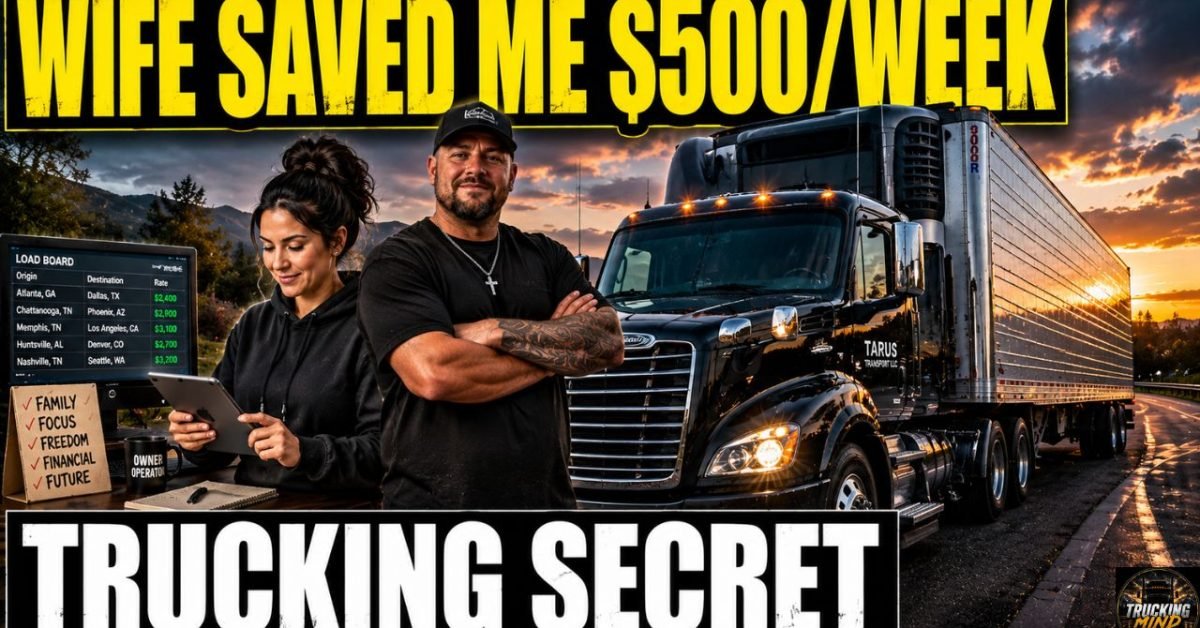
Today, Paul operates under his own authority as an independent owner-operator. But unlike the countless truckers who face the crushing isolation of the highway alone, Paul turned his cab into a family business.
"Me and my wife decided we could do it together," Paul says, a distinct note of pride in his voice. "I drive, and she dispatches. She also helps me load and unload the truck."
The Ultimate Co-Pilot
The long-haul trucking lifestyle is notorious for fracturing relationships and keeping parents away from their families. But Paul completely bypassed that heartbreak. When he looks to his right, his wife is sitting right there in the passenger seat. When he looks behind him, his dog is curled up comfortably in the back.
"I just talk to them when I need to," Paul smiles cleanly. "And our kids, we talk to them daily over the phone."
Having his wife step into the role of a professional dispatcher didn't just protect their marriage from the strain of long distance—it completely transformed their business.
In a volatile freight market where third-party dispatchers charge high percentages regardless of how much a driver actually profits, keeping the business in the family has been a financial game-changer.
"Having my wife dispatch for me saves me about $500 a week in dispatcher fees," Paul explains. "And it makes it so I don’t have to hunt for loads at night when I'm completely done driving. I’ve honestly made more money with her dispatching for me than I ever did with an actual dispatch company."
The Reality of the "Google Map" Myth
Despite the freedom of picking his own hours and choosing exactly which days he wants to work, Paul is intensely realistic about the physical toll of the road.
"If you're an active person, it can definitely slow you down," he admits. "It can make you gain weight and force you to eat crappy food. Your sleep schedule gets completely messed up when you have to run night shifts."
When he finally parks the truck and steps out of the cab, Paul aggressively fights the sedentary trucking lifestyle by throwing himself into the outdoors. He is an incredibly active person who loves paddleboarding, swimming, carpentry work and building things from scratch.
That active spirit is exactly why he loves the travel aspect of the job, citing the scenic stretches of Alabama and the Carolinas as his favorite places to roll through. But the road has a habit of keeping a driver humble. When asked if he has any cool or funny stories from his journeys, Paul laughs dryly.
"I don’t really have any cool or funny stories. Most of them just aggravate me. During my very first week on the road as an owner-operator, I got three flat tires. I guess some people might find that funny, but I didn't."
The flat tires highlight a deeper frustration Paul harbors: the general public’s complete lack of understanding regarding what it actually takes to move freight across the country.
"People just don't understand how long it takes to drive long distances," Paul says flatly. "They look at Google Maps and it says it takes eight hours to get somewhere. But they don't factor in the reality. It actually takes nine and a half hours. You have to stop and get fuel. You have to stop and eat. There are a lot of real-world variables, and God forbid you get a flat tire."
Learning Before You Leap
With his family by his side and a steady stream of revenue flowing directly back into his household, Paul’s ultimate, long-term dream is to take his rig all the way north to Alaska. Though he knows that specific trip won't happen anytime soon, the mere opportunity to see the continent keeps his wheels turning every morning.
For the wave of new drivers looking to buy a truck and claim their own piece of independence on the highway, Paul offers a vital, unvarnished piece of advice rooted in regulatory survival:
"Learn all the rules of the road first," Paul warns seriously. "You need to deeply understand how many hours you are legally allowed to drive and what specific days you can operate. There is a mountain of compliance and fine print you absolutely have to read into before you just jump inside a truck and take off."