
Key Points:
- California follows the federal CDL sequence — medical certificate, knowledge tests, CLP, ELDT, skills test — plus two California extras: at least 15 hours of behind-the-wheel training (10 of them on public roads) certified on form DL 1236, and a 12-month application window that a CLP renewal does not extend.
- DMV fees are the small part: $100 for an original Class A or B application, $59 for Class C, and $46 if you retake the skills test. Training is the real cost, commonly $3,000 to $8,000.
- Hold your CLP for at least 14 days before the skills test; the CLP is valid for 180 days and can be renewed for one additional 180 days, never beyond one year from your original application.
- You get three attempts at each knowledge test and three attempts at the skills test in total; a third failure ends the application, and you reapply and pay again.
- Once you pass, the DMV issues an interim CDL valid for 60 days while the permanent card is mailed; if the card has not arrived after 45 days, contact the DMV.
California issues commercial driver's licenses under the same federal framework as every other state, and then adds its own layer on top: a California-specific behind-the-wheel training requirement, a DMV testing system with its own appointment realities, and a 12-month application clock that other states do not impose in the same way. A driver who follows a generic national guide to a California CDL will miss at least one of those California pieces — and will discover it at the DMV counter, after paying for training.
This guide walks through how to get a CDL in California from zero: eligibility, classes and endorsements, the medical certificate, the Commercial Learner's Permit (CLP), federal Entry-Level Driver Training (ELDT) plus California's additional behind-the-wheel hours, the three-part skills test, fees, and a realistic timeline. It is written for a brand-new driver seeking a Class A license for tractor-trailer work, with notes for Class B and Class C where they differ.
Fees and rules in this guide were checked against current official sources at the time of writing. California DMV fees and procedures change, so confirm current figures with the DMV before you budget or book a test.
Which CDL Class Do You Need
California uses the federal CDL classes, and the class follows the vehicle:
Class A covers a combination of vehicles with a gross combination weight rating of 26,001 pounds or more, where the towed vehicle weighs more than 10,000 pounds. This is the tractor-trailer license, and it is the license most readers need. A Class A holder can generally operate Class B and Class C vehicles as well, subject to endorsements and restrictions.
Class B covers a single vehicle with a gross vehicle weight rating of 26,001 pounds or more, or such a vehicle towing a vehicle not exceeding 10,000 pounds, plus applicable passenger vehicles. Think straight trucks, dump trucks, large box trucks, and buses.
Class C covers vehicles that are not Class A or Class B but are designed to transport 16 or more passengers including the driver, or are used to transport hazardous materials requiring placarding, under California's descriptions. Class C carries no federal ELDT requirement for the base license itself, though first-time passenger, school bus, or hazmat endorsement applicants need endorsement ELDT.
Choose for the vehicle you will actually drive first. If tractor-trailer freight is your goal, get Class A even if a Class B program looks quicker. Upgrading later means a second round of training and testing, and a second set of fees. If you are certain you will only drive a straight truck, Class B is the honest choice — but be certain, because Class A work commonly pays more and offers more lanes, and certainty has a way of changing after the first paycheck.
Eligibility: Age, License, Residency, and Record
To get a California CDL, you must:
- Be at least 18 years old to drive commercially within California, and 21 years old to drive across state lines or transport hazardous materials. An 18-year-old Californian can hold a CDL for intrastate work but cannot legally drive interstate or haul hazmat until 21. For most freight careers, the practical entry age is 21.
- Hold a valid California driver's license, and provide proof of identity, Social Security number, and California residency as the DMV requires. California's REAL ID and residency documentation rules are strict — bring the documents the DMV lists for a commercial application, not a general license renewal, and check the list before you go.
- Hold a valid Medical Examiner's Certificate appropriate to your self-certification category, from a National Registry medical examiner.
- Pass the knowledge tests, complete ELDT and California's behind-the-wheel requirement where applicable, hold a CLP for at least 14 days, and pass the skills test, all within the DMV's 12-month application period (see below).
Your driving record matters before you spend money on training. Serious violations, suspensions, and certain convictions can disqualify you or delay eligibility, and impaired-driving history carries severe CDL consequences. Check whether any item on your record affects CDL eligibility, and for how long, with the California DMV before you enroll in training. A disqualification discovered after a training program is paid for is a costly lesson.
Step 1: Get Your DOT Medical Certificate
Visit a medical examiner listed on FMCSA's National Registry of Certified Medical Examiners for a DOT physical. The examiner checks vision, hearing, blood pressure, cardiovascular health, diabetes management, sleep apnea risk factors, medications, and other conditions affecting safe commercial driving. Bring your medication list, glasses or contacts, and documentation for any managed condition.
You submit a Medical Examination Report and Medical Examiner's Certificate as part of the California application process, and you declare a self-certification category describing the type of commercial driving you will do. Non-excepted interstate and non-excepted intrastate drivers need a medical certificate on file. Certificates are commonly valid for up to two years, with shorter periods where a condition needs monitoring, so check the validity period and any monitoring condition on your own certificate. Keep it current: an expired medical certificate can downgrade or invalidate your CDL privileges even if the license card itself has not expired.
Budget for the exam separately. Published estimates commonly put a DOT physical around $90 to $140, varying by clinic, so check the price at the clinic you choose. Some training programs and employers include or reimburse the exam — ask before you pay twice.
Step 2: Study the California Commercial Driver Handbook
The California DMV publishes a Commercial Driver Handbook, and the knowledge tests are drawn from it. Study the handbook first; use third-party practice tests only as a supplement. Practice questions from other states or outdated editions will teach you wrong answers with confidence.
For Class A, you take the general knowledge test, plus air brakes and combination vehicles tests. Endorsement tests are added for each endorsement sought. You must pass each knowledge test, and you are allowed three attempts to pass on a single application — if you exhaust all three, you must reapply and pay again. That rule alone justifies serious study before your first attempt: a failed test is not just a bad day, it burns one of your three attempts, and a third failure ends the application and the fee with it.
The general knowledge test covers vehicle control, driving safety, cargo, hours of service, inspections, and related topics. Read the handbook cover to cover, note the numbers — stopping distances, weight limits, inspection items — and test yourself from the handbook before booking a DMV appointment. Drivers who fail most often fail because they studied practice questions instead of the source.
Step 3: Apply for Your Commercial Learner's Permit at the DMV
Visit a California DMV office to apply. You will complete the Commercial Driver License Application (form DL 44C), provide proof of identity, Social Security number, and California residency, submit your medical documentation, have your thumbprint scanned and photo taken, pass a vision screening, pay the application fee, and take the knowledge tests.
The application fee is $100 for an original commercial Class A or Class B application, and $59 for an original commercial Class C application, according to the California DMV licensing fees list. The fee is non-refundable, which is another reason to study before you apply rather than treating the first attempt as a practice run.
Pass the knowledge tests, and the DMV issues your CLP. Federal rules require you to hold the permit for at least 14 days before you can take the skills test. The CLP itself is valid for 180 days, and it can be renewed for an additional 180 days so long as the expiry date is not more than one year from the initial date of application. That one-year limit is the California application clock: you must complete the process within 12 months of your original application. A CLP renewal does not extend the original application beyond that one-year limit. Plan backward from that deadline — if training, testing, and any retest will take months, start early in the application period, not at its end.
On a CLP, you may drive a commercial vehicle only with a licensed CDL holder in the appropriate class riding along. You cannot drive solo, take a paying load, or work as a CDL driver on a CLP. Treat the CLP period as supervised training time, not as a provisional license to earn.
Step 4: Complete ELDT — Plus California's Behind-the-Wheel Requirement
Federal ELDT applies to first-time Class A and Class B applicants and first-time hazmat, passenger, and school bus endorsement applicants. Training must come from a provider listed on FMCSA's Training Provider Registry. The provider certifies your completion electronically, and the DMV checks that record before issuing your permit or license as applicable. If the registry does not show completion, the DMV will not proceed, however well you drive.
ELDT has theory and behind-the-wheel components. Theory may be delivered online through a registered provider. Behind-the-wheel training is in person, on a range or a public road. The federal rule sets a curriculum and proficiency standard rather than a fixed hour count — but California adds its own requirement on top of the federal rule, and this is the piece national guides miss.
California requires a minimum of 15 hours of behind-the-wheel training, with at least 10 of those hours on a public road. Your training provider must complete a California Commercial Driver Behind The Wheel Training Certification (form DL 1236), which you submit to the DMV before receiving your CDL. This requirement catches applicants off guard, especially those who completed training out of state: federal ELDT completion alone, without the California behind-the-wheel certification, does not satisfy California. If you train out of state and plan to license in California, confirm before you enroll that the provider will complete form DL 1236 and document the California hours. If you train in California, confirm the same thing in writing — do not assume every provider's standard program automatically includes the California certification paperwork.
Choosing a provider is your largest financial decision in this process. Verify TPR registration on the registry itself. Compare the vehicle you will train and test in, the behind-the-wheel hours and road time included, whether the program covers the DL 1236 certification, the skills test arrangement (DMV Commercial Drive Test Centers versus a third-party site, and who provides the test vehicle), the total price including retests, and the placement record if any. Get it all in writing before you enroll.
Training cost is the dominant expense. Full CDL training programs commonly cost between $3,000 and $8,000, depending on the school and program length, with California programs commonly reported in the $4,000 to $7,000 range for private schools. Get the current total price, including retest and test-vehicle fees, from each provider you consider, in writing. Some employers sponsor training for a driving commitment afterward, and California workforce programs — including CalJOBS-linked assistance in some cases — may help eligible applicants with training costs. Ask specifically about fee coverage and about any commitment or repayment obligation before you sign. A sponsored program that pays for training is valuable; a sponsored program that binds you to a carrier for a year with a repayment clause is a contract, and should be read as one.
Step 5: Practice, Then Pass the Three-Part Skills Test
Once you have held your CLP for at least 14 days, completed ELDT, and satisfied California's behind-the-wheel requirement, you can take the CDL skills test at a DMV Commercial Drive Test Center or an approved test site. Schedule as soon as you are eligible and ready — California DMV commercial test appointments can involve waits, and published guidance commonly describes the full California CDL process taking 6 to 12 weeks, with DMV appointment availability a major variable. Do not let a nearly expired CLP or a nearly expired 12-month application window force a rushed test.
The test has three parts, and you must pass all three:
1. Vehicle inspection test. You inspect the vehicle, identify components, and explain defects that would take it out of service — brakes, steering, suspension, tires, lights, coupling devices, leaks, and more. Practice the inspection as a fixed routine in the same order every time. Nerves cause skips, and skips cause failures.
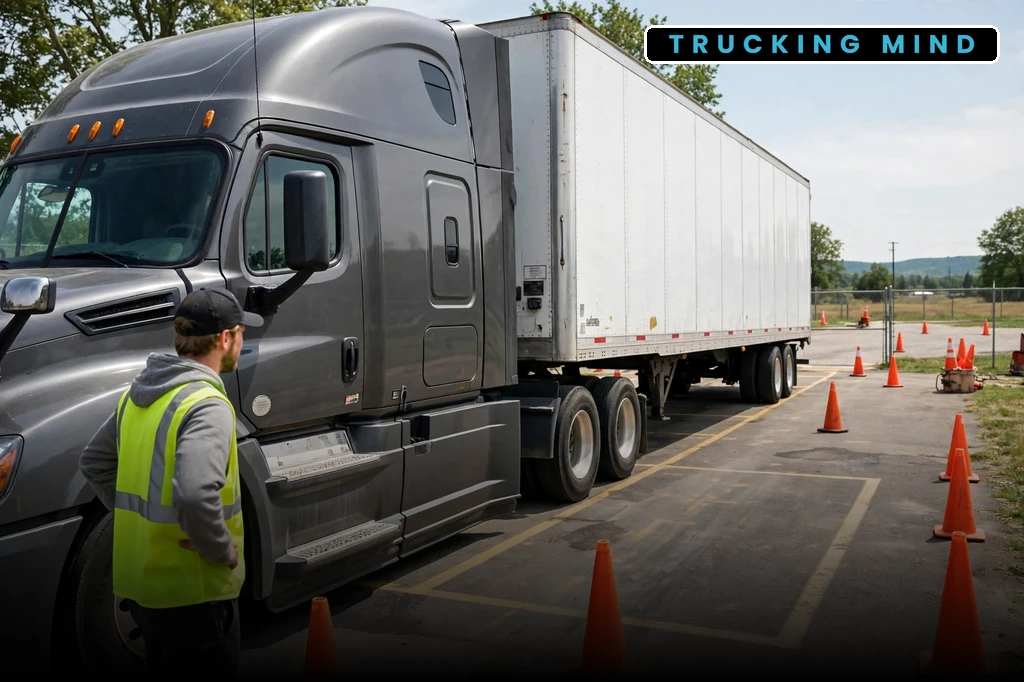
2. Basic control skills test. On a range, you demonstrate backing and parking maneuvers — straight-line backing, offset backing, alley dock or parallel parking as the site specifies — plus turning control. Practice until the maneuvers are routine. Routine passes; improvisation does not.
3. Road test. On public roads in traffic, you demonstrate safe driving judgment: lane discipline, turns, intersections, merging, speed management, and communication with other road users. Drive professionally. The examiner is grading judgment, not flair.
If you fail any section, the remaining testing is postponed, and the failure counts as one attempt. You are allowed a total of three attempts to pass the entire skills test (all three parts combined), and you pay a retest fee each time you retake it. The commercial driving or skills retest fee is $46, according to the DMV licensing fees list, so confirm the current retest fee and your test site's scheduling policy before your first attempt. Three attempts sounds generous until you have used two; treat every attempt as if it were the last, because the third failure ends the application and requires reapplying and paying again.
Test in a vehicle that matches the class you seek, with the transmission and braking system you want licensed for. The test vehicle must pass a pre-inspection by the DMV before the test begins — a vehicle with a defect does not test, however good the driver. If you use a provider's vehicle, confirm who is responsible for its inspection readiness on test day.
Step 6: Receive Your Interim CDL and Wait for the Card
After passing all three parts of the skills test, you complete the license issuance process with the DMV. No separate issuance fee applies on top of the application fee you already paid: the DMV licensing fees list shows the $100 original application fee for Class A or B (and $59 for Class C) and no additional issuance charge. The DMV issues an interim CDL, valid for 60 days or until the permanent CDL arrives in the mail, whichever comes first. If the permanent CDL has not arrived after 45 days, contact the DMV to check its status.
You are licensed to drive commercially within your class, endorsements, and restrictions once the interim is issued, subject to your medical certificate remaining current and, for interstate work, being age 21. Keep the interim, your medical certificate, and your training certifications together until the permanent card arrives, and then keep the card and a current medical certificate together for the life of your driving career.
If you plan to operate as an owner-operator rather than as a company driver, the CDL is only the first credential. Carrier registration, authority, insurance, and California permits come next — see How to Start a Trucking Company — and the carrier numbers are explained in MC Number vs DOT Number. California's CA number and Motor Carrier Permit system is a separate stack from the CDL itself, and a licensed driver without carrier permits cannot legally haul for hire as an owner-operator in California.
What It Costs: A Realistic Budget
| Item | Typical cost |
|---|---|
| DOT medical exam | Around $90 to $140 |
| DMV application fee, Class A or B | $100 |
| DMV application fee, Class C | $59 |
| Skills retest fee, if needed | $46 |
| ELDT training program | Commonly $3,000 to $8,000; California private programs commonly $4,000 to $7,000 |
| Hazmat TSA assessment, if sought | $85.25 federal fee |
The DMV fees — $100 for Class A/B, plus a possible $46 retest — are the smallest part of the budget. Training dominates, and the California behind-the-wheel requirement means a program that looks cheap because it skimps on road hours may leave you without the DL 1236 certification you need. Compare programs on total cost including the California certification, retests, and test-vehicle use, not on the headline tuition alone.
Add living costs during training. Full-time programs run several weeks without earnings. If you leave a job to train, you need a bridge to your first driving paycheck. Employer-sponsored training can solve that, at the price of a commitment afterward. Read that commitment before you sign it, including what happens if you leave early.
Frequently Asked Questions
How old do I need to be to get a CDL in California?
18 for intrastate driving within California, 21 for interstate driving or hazardous materials.
How much does it cost to get a CDL in California?
DMV fees are $100 for Class A or B and $59 for Class C, plus a possible $46 retest fee. Training is the major cost, commonly $3,000 to $8,000, plus a medical exam around $90 to $140. Budget the whole package.
How long does it take to get a CDL in California?
Commonly 6 to 8 weeks in a straightforward case, and 8 to 12 weeks where DMV test-center waits apply. The fixed minimum is 14 days on the CLP; the outer limit is the 12-month application period.
What is California's extra behind-the-wheel requirement?
Beyond federal ELDT, California requires at least 15 hours of behind-the-wheel training, with at least 10 hours on a public road, documented on form DL 1236 and submitted to the DMV before you receive your CDL.
Do I need a medical certificate before applying?
Yes, for non-excepted operations. You submit a Medical Examination Report and Medical Examiner's Certificate as part of the California application, with a self-certification of your driving category.
The Bottom Line
Getting a CDL in California follows the national sequence — medical, study, CLP, ELDT, 14-day hold, three-part skills test — plus two California pieces that national guides miss: 15 hours of behind-the-wheel training with 10 on public roads, documented on form DL 1236, and a 12-month application clock that a CLP renewal does not extend. DMV fees are $100 for Class A or B; training is the real cost, and the provider you choose determines whether that cost buys a first-time pass or a cycle of retests.
Do it in order, confirm the California certification in writing before you enroll, protect your record and medical certificate, and the license at the end opens every freight lane in the largest trucking market in the country.
This guide was prepared in good faith from official sources, including FMCSA and state agency publications, and was checked at the time of writing. Fees, rules and procedures change, and errors and omissions are excepted. Please confirm current requirements with the relevant agency before filing or travelling. If you spot anything that needs correcting, email us at contact@truckingmind.com — we will verify it and update this page.