By Ahsan Ali
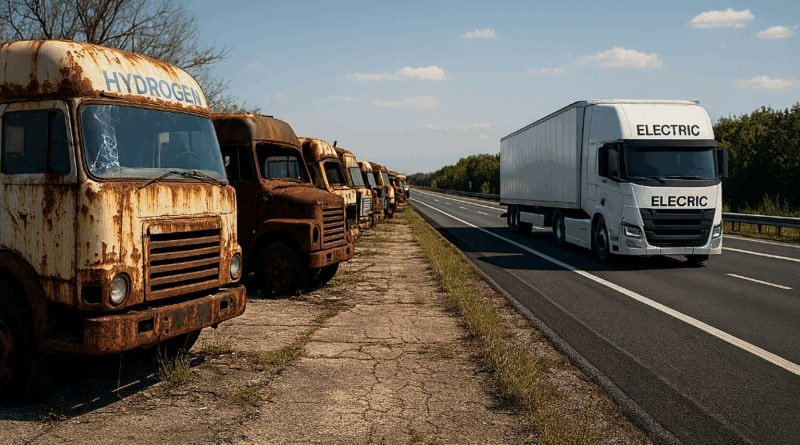
The race between hydrogen and electric batteries in the trucking world is no longer a close call. New data shows that battery power has taken a clear and unstoppable lead.
BloombergNEF’s 2025 Factbook on zero-emission trucks, published on September 18, paints a decisive picture: the global freight industry is going electric, while hydrogen’s role is rapidly shrinking.
In the first half of 2025 alone, almost 90,000 zero-emission trucks were sold worldwide — more than during the entire previous year. Around 97% of them ran on batteries. Hydrogen trucks barely registered, with just about 1,000 sold — half as many as in 2024.
Those numbers make one thing clear: hydrogen is losing the trucking race.
China’s Electric Boom
China is driving the biggest shift.
During the first six months of 2025, the country sold nearly 80,000 electric trucks — more than double its 2023 total.
This explosive growth is fueled by an efficient battery supply chain, government programs encouraging older vehicle trade-ins, and a steady push to cut costs.
Hydrogen trucks, however, are going the opposite way. Even with state incentives and toll breaks, they can’t match battery models on cost or performance.
If China, known for its powerful industrial policies, can’t keep hydrogen trucks afloat, it’s a clear sign of where the market is headed.
Europe Bets on Batteries
Across Europe, the same story is playing out.
Sales of electric trucks jumped over 50% in the first half of 2025 compared to last year. Countries like the Netherlands, the UK, and the Nordic nations are seeing rapid adoption, boosted by major charging infrastructure projects and new low-emission zones in cities.
Hydrogen programs, meanwhile, are fading. Daimler has delayed its hydrogen truck launch from 2027 to sometime in the 2030s, slashing production targets in the process.
Volvo and DAF continue small-scale hydrogen experiments, but nothing close to market-ready.
Meanwhile, the EU is investing billions into powerful charging networks and binding infrastructure goals, locking in a future dominated by electric freight.
America’s Slow Lane
The United States is falling behind the rest of the world.
In the first half of 2025, only about 200 electric trucks were sold — a staggering 80% drop compared to last year. Policy changes, cancelled zero-emission mandates, and regulatory gridlock have frozen progress.
Hydrogen isn’t picking up the slack either. After the collapse of companies like Nikola and Hyzon, most American hydrogen projects have been reduced to small trials.
While Europe and China move forward with battery trucks, the U.S. trucking market is standing still.
Costs Tell the Story
Battery economics have become impossible to ignore.
In China, the average cost of truck battery packs dropped to just $90 per kilowatt-hour in 2024 — a result of cheaper lithium iron phosphate chemistry and a glut of manufacturing capacity.
Outside China, prices remain around $190 per kilowatt-hour but are falling fast. Analysts expect prices to reach $80 per kilowatt-hour by 2030, making electric trucks as cheap to operate as diesel.
Hydrogen fuel, however, still costs far more. It must be produced, liquefied, transported, and then converted back into electricity — a wasteful and expensive chain that keeps operating costs high.
Long-Haul Electric Trucks Arrive?
Electric trucks are no longer limited to short distances.
Models like the Tesla Semi, Volvo FH Aero Electric, MAN eTGX, and Mercedes eActros 600 already cover 480 to 600 kilometers per charge while hauling up to 48 tons. They can recharge during mandated rest breaks using new megawatt charging systems.
These trucks are two to three times more energy-efficient than diesel engines. Hydrogen once claimed an edge in long-haul routes, but that gap has closed completely.
Why Batteries Win in the Long Run?
There’s also the issue of value after use.
When truck batteries wear down, they can be reused for stationary energy storage or recycled into new battery cells. That gives them a second life and adds financial value for operators.
Hydrogen trucks have no such option. Once their fuel cells and tanks degrade, they become worthless.
Researchers Saw This Coming
Years ago, researchers predicted this exact outcome.
A European freight study led by Sweden’s RISE Institute projected that battery-electric trucks would dominate nearly every transport segment — from city delivery to long-haul routes.
The findings were based on simple economics: batteries are more efficient, cheaper to operate, and easier to scale using existing power grids. Hydrogen, by contrast, required a costly new fueling system and suffered major energy losses.
Now, the real-world data matches the forecast.
Hydrogen’s Industry Meltdown?
Early in 2025, analysts began tracking what they called the “hydrogen transportation death watch” — a running record of failed projects and bankrupt startups.
Since then, that list has only grown. BloombergNEF’s report shows global hydrogen truck sales falling by half, even in China where government support remains strong.
Four major hydrogen truck makers have already gone bankrupt. Three others have walked away from hydrogen entirely. Among smaller manufacturers, most are now considered high risk or near collapse.
The situation in light commercial vehicles is even worse — multiple companies have failed, and only one remains stable. For many firms, hydrogen isn’t just an underperforming technology — it’s a financial threat.
The Market Has Spoken
When you put together the data, policies, and technology trends, the conclusion is clear.
Hydrogen is losing the freight battle. Batteries are advancing because they’re simpler, cheaper, and backed by solid industrial growth.
The global trucking market has made its decision — and that decision is electric.
Author Profile
Latest Entries
 Business4 months agoImmigrant Truck Drivers CDL Rule Could Cost Thousands Jobs
 Business4 months agoTruck Driver English Language Law Sparks Debate
 Logistics5 months agoTruck Driver English Language Violations Linked to Safety
 Logistics5 months agoCourt Reversal Opens Door to Truckers Demurrage Charges