By Ahsan Ali
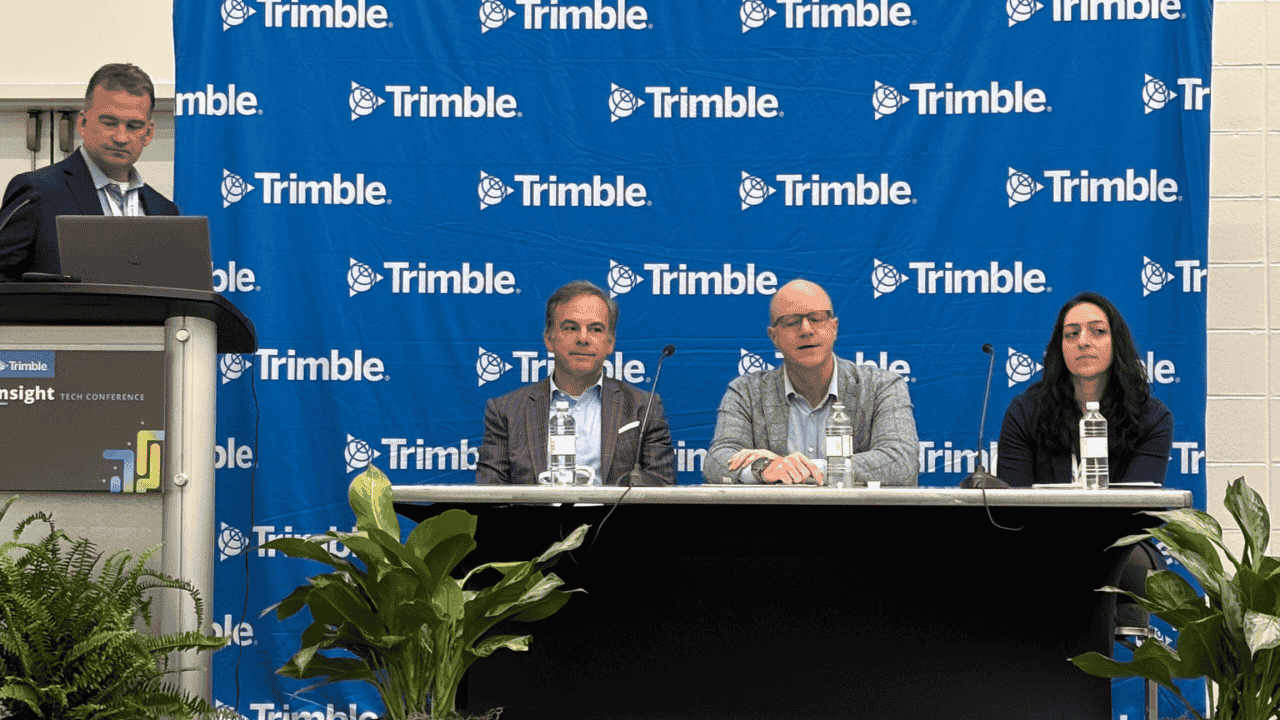
NEW ORLEANS — At Trimble’s Insight conference, industry experts gathered to break down the ongoing freight slump and guess when things might finally improve. The discussion felt similar to FreightWaves/SONAR’s monthly State of Freight webinar, as panelists tried to untangle what’s keeping the freight recession going.
The session, called “Transportation 2025-2026: A look back, a look ahead,” featured FreightWaves and SONAR CEO Craig Fuller, who is also a regular voice on State of Freight webinars. He was joined by Lee Klaskow of Bloomberg Intelligence and Angela Acocella from MIT’s Center for Transportation & Logistics. Together, they explored a market outlook that left them unsure whether things should be seen as “glass half full” or “glass half empty.”
Here are five major takeaways from the Trimble (NASDAQ: TRMB) panel.
Markets reeling from unpredictable tariff moves
Klaskow said the best word to describe the year so far is “chaos.” At the start of the year, he explained, many businesses expected the new administration to lower taxes and cut regulations. “Business behind it was going to be great,” he said.
The industry assumed tariffs would mainly target China. Instead, tariffs began popping up on a wide range of countries, creating widespread uncertainty across supply chains. “Chaos is the one thing I wasn’t expecting,” Klaskow said.
Acocella added that every tariff-related announcement sparked confusion. People didn’t know whether a tariff would actually go into effect or be reversed. That led many companies to place unusually large orders to stay ahead of potential costs — only to cut back later when they found themselves stuck with too much inventory and not enough demand.
The real problem: demand has collapsed
While many conversations focus on driver capacity and new regulations, the panelists said the deeper issue is disappearing freight volume.
Fuller, who previously predicted the freight recession would end last year, admitted the call didn’t pan out because demand dropped sharply. Enough trucking capacity had been removed from the market that recovery had seemed likely — but only if freight volumes stayed steady. They didn’t.
According to SONAR’s Outbound Tender Volume Index (OTVI), which tracks national freight volumes, the industry has seen its steepest decline since at least 2016. Fuller said other measures, such as the Cass Index, show the same trend.
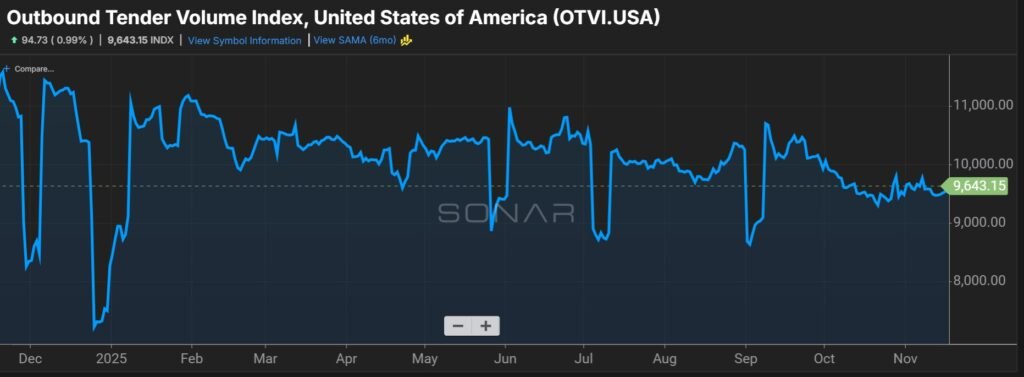
The main cause, he said, is a “pretty significant industrial recession.” The big unknown now is how long this weak, non-capacity-driven freight market will last.
Acocella pointed out that past freight recoveries were sparked by major events — like the 2017 ELD mandate or the surge in demand during the pandemic. “We haven’t seen something big enough to really rock the entire market,” she said.
Immigration battles spill into trucking
The panel also highlighted how trucking has become a major front in the nation’s immigration debate. Fuller said the administration views trucking as a “safe place” to push concerns about immigrants because the focus can shift to safety and licensing.
He explained that people tend to respond emotionally to stories about immigrant families being detained. But when the narrative changes to immigrant drivers operating 18-wheelers under questionable licensing or regulatory oversight, the public conversation shifts dramatically.
Fuller said the administration tends to highlight accidents involving immigrant drivers. Statistically, about 10 such accidents occur each week, he said.
The number of drivers may drop sharply
A major part of the conversation centered on the crackdown on foreign-born drivers, including enforcing English-language rules and pressuring states to end non-domiciled commercial driver’s licenses, which mostly go to non–U.S.-born drivers.
Fuller cited findings from a report by well-known freight economist Noel Perry, commissioned by J.B. Hunt (NASDAQ: JBHT). Perry estimated that immigrants make up about 25% of trucking workers, similar to what’s seen in construction and agriculture. Of those workers, about 8% may be undocumented.
If the administration succeeds in removing undocumented drivers from the industry, Perry wrote, the driver pool could shrink by nearly 16%, or 614,000 drivers.
The main threats to the workforce, Perry said, include:
- Losing a CDL due to a lack of English proficiency
- Removal for lacking legal immigration status
- Ending non-domiciled CDLs
Fuller also noted that cutting driver numbers dramatically could ease one long-standing issue: truck parking. With drastically fewer drivers on the road, he said, “How much of the truck parking problem goes away? It will be interesting to see.”
Will shrinking capacity finally boost the market?
Klaskow admitted he was “as pessimistic as I ever was” this summer. But he’s started to feel “incrementally more positive,” largely because the expected drop in driver numbers could tighten capacity and help push the market toward recovery.
Still, he said his outlook on the broader economy is gloomy. Many retailers have been absorbing part of the tariff costs to avoid raising prices, but he expects that to end soon. When it does, he warned, consumers could face more inflation and rising prices. “It will be very interesting to see how consumers react to that,” he said.
Despite his concerns, Klaskow believes the market may begin to improve next year. “I think the second half next year won’t be as bad,” he predicted.
Author Profile

-
Ahsan Ali is a technology and business journalist who covers the latest developments in autonomous vehicles and innovative startups.
With a sharp eye for industry trends, he breaks down complex tech stories into clear, engaging insights for general readers.
Latest Entries
 Business4 months agoTrucking Safety Reforms: New Plan Targets Industry Risks
 Business4 months agoOctober 2025 Trucking Slowdown Hits Freight and Capacity
 Business4 months agoAI Electric Trucking Startup NexDash Raises €5M
 Business4 months agoTrucking Industry Crisis: New Rules Threaten U.S. Supply Chain