By Ahsan Ali
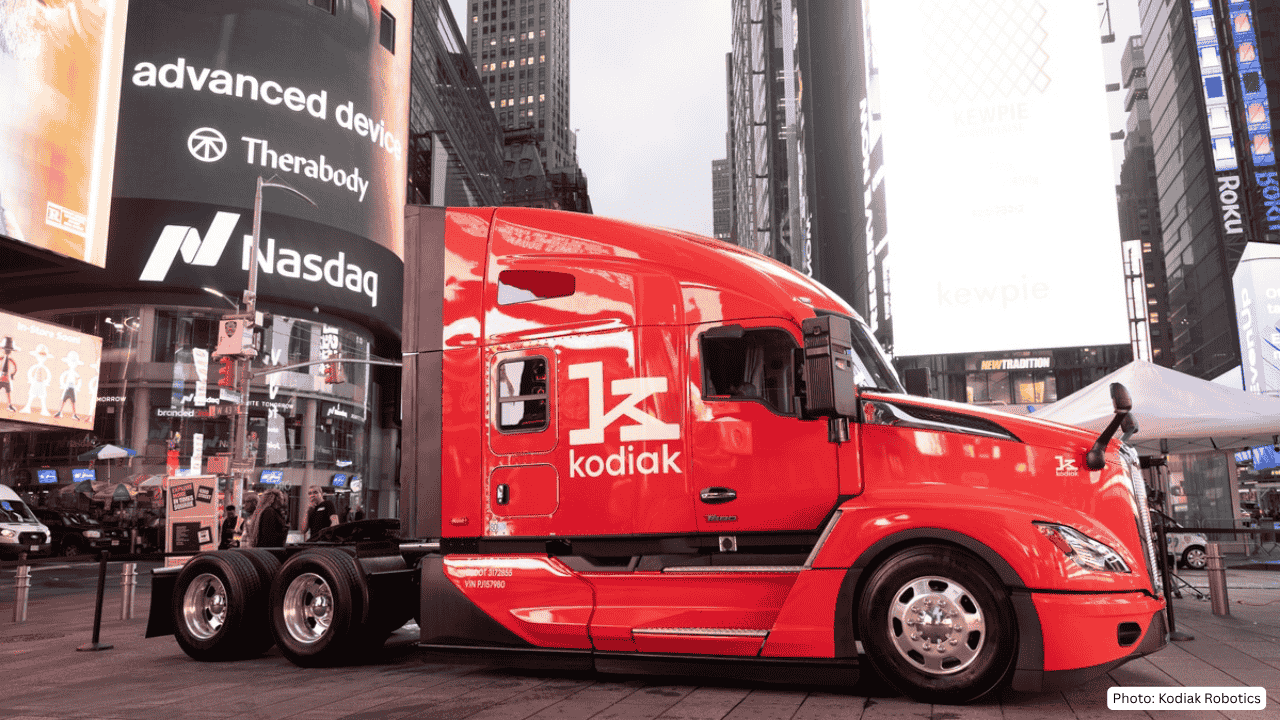
Autonomous truck company Kodiak Robotics has officially gone public on the Nasdaq Stock Market after merging with Ares Acquisition Corporation II.
As part of the deal, Kodiak raised more than $275 million, including $145 million from private investors and about $62.9 million in trust cash from Ares before expenses.
The company is now called Kodiak AI Inc., and it is valued at roughly $2.5 billion, making it one of the largest de-SPAC transactions in 2025.
“The event was super exciting — being at Nasdaq, doing live TV interviews, ringing the bell, and having the whole team there,” said Don Burnette, Kodiak’s founder and CEO, in an interview with FreightWaves.
“For most people, it’s a once-in-a-lifetime experience.”
For Burnette, who has been working on self-driving technology for more than 16 years, becoming a public company is both “the close of one chapter” and “the beginning of a new one” for his seven-and-a-half-year-old company.
The funding provides Kodiak with more capital to ramp up production and scale its driverless truck operations.
From Promises to Real-World Use
The self-driving industry has faced years of high expectations followed by delays. Burnette acknowledges the long “coming soon” narrative. But 2025 marks what he calls “an inflection point,” when the technology is finally ready for commercial use.
“We’ve been around for seven and a half years. I’ve personally been working on self-driving technology for over 16 years,” Burnette said.
“We’ve seen many trends come and go. A lot of it was hype. For years, we’ve been told self-driving is the future, and it almost felt like it would never happen.”
“Where I think 2025 is really an inflection point — not just for Kodiak as we go public, but for the entire self-driving industry — is that it’s finally here. It’s being deployed. It’s being used,” he added.
Technology Comes Together
Moving from lab testing to real-world deployment required several technological breakthroughs.
“We’re seeing the industry grow up, thanks to advances in AI research, more reliable hardware, and smarter algorithms,” Burnette said.
“It was really all of the above — everything coming together. There’s nothing magical about 2025, except that this is when the ecosystem finally reached maturity all at once.”
Kodiak currently operates eight fully driverless trucks in the Permian Basin, a 75,000-square-mile area where the trucks run day and night, delivering loads for Atlas. These vehicles have empty cabs — no drivers, no observers, no safety personnel.
Expanding Operations and Manufacturing
Next, Kodiak plans to scale up operations and manufacturing. The company has partnered with Roush to set up an assembly line for its technology.
The partnership focuses on flexibility and modularity, with Roush adding “redundancy, the AV kit, computers, and sensors” to base trucks from manufacturers.
“We built this partnership with Roush around flexibility and modularity, and we can support other makes and models of vehicles,” Burnette said.
“Roush takes a base truck from the OEM, adds the AV kit, computers, and sensors, and returns it ready for the customer.”
Expanding Highways and Industrial Markets
Kodiak is developing its long-haul highway operations, aiming for fully driverless highway runs by the second half of 2026.
The company also sees opportunities in other industries. In the past six months, it has added over 3,000 miles to its commercial highway network and hauls freight for companies like J.B. Hunt and Werner Enterprises.
“We see a huge opportunity in the oil and gas industry as we deploy more trucks,” Burnette said. “Other industries, such as mineral and metal mining, also represent global opportunities.”
These industrial sites are often remote, with high driver turnover, steep labor costs, and tough working conditions — exactly the challenges autonomous trucks can solve. Burnette also mentioned forestry and timber operations as potential markets.
Balancing Growth and Responsibility
Now that Kodiak is public, it must balance ambitious growth with financial responsibility.
“We want to be very careful and conservative with our decisions,” Burnette said. “We have to watch our earnings, manage our spending, and pay attention to the markets.”
Even with these challenges, driverless technology is advancing quickly, pushing the industry further into the age of autonomy.
“This technology is only accelerating,” Burnette said, emphasizing that building a sustainable business is essential.
“That’s something you haven’t seen from other self-driving companies — reaching a point where a company can become profitable and control its own destiny.”
Author Profile

-
Ahsan Ali is a technology and business journalist who covers the latest developments in autonomous vehicles and innovative startups.
With a sharp eye for industry trends, he breaks down complex tech stories into clear, engaging insights for general readers.
Latest Entries
 Business4 months agoTrucking Safety Reforms: New Plan Targets Industry Risks
 Business4 months agoOctober 2025 Trucking Slowdown Hits Freight and Capacity
 Business4 months agoAI Electric Trucking Startup NexDash Raises €5M
 Business4 months agoTrucking Industry Crisis: New Rules Threaten U.S. Supply Chain